Hyelim
Park
a,
Keonwoo
Ko
a,
Yunjin
Kim
a,
Sourabh S.
Chougule
a,
Abhishek A.
Chavan
a,
Jaemin
Kim
a,
Yeongeun
Im
a,
Hun
Kim
a,
Wonhong
Choi
a,
Kwang Bok
Yi
*ab and
Namgee
Jung
*a
aGraduate School of Energy Science and Technology (GEST), Chungnam National University, 99 Daehak-ro, Yuseong-gu, Daejeon 34134, Republic of Korea. E-mail: cosy32@cnu.ac.kr; njung@cnu.ac.kr
bDepartment of Chemical Engineering Education, Chungnam National University, 99 Daehak-ro, Yuseong-gu, Daejeon, 34134, Republic of Korea
First published on 26th January 2026
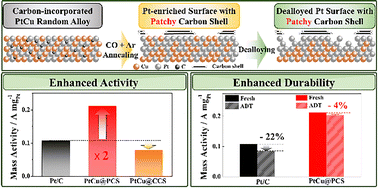
Low-temperature CO treatment induces Pt surface segregation in carbon-incorporated PtCu nanoparticles, creating Pt-rich surface domains that localize carbon growth. Subsequent high-temperature Ar treatment forms a patchy carbon shell, enabling selective near-surface Cu dealloying, boosting oxygen reduction reaction (ORR) activity while suppressing particle degradation and markedly improving durability.
To date, Pt-based catalysts have been most widely used for ORR, however, because Pt is expensive and its reserves are limited, catalyst design strategies that can achieve both reduced Pt usage and improved performance are required for commercialization.10–13 Although various Pt-alloy catalysts have been developed to reduce Pt usage and enhance activity, a persistent issue remains that performance degradation occurs under long-term operating conditions due to dissolution of less noble alloying elements, surface and lattice reconstruction, and particle growth and agglomeration.14,15
In this study, to simultaneously achieve improved performance and durability, we propose a PtCu alloy catalyst in which the surface composition of alloy nanoparticles is controlled by tuning the heat-treatment atmosphere, and the carbon shell structure is precisely regulated accordingly. By adjusting the heat-treatment conditions, carbon shell formation with appropriate defect sites is induced through modulation of the surface composition. Under acidic conditions, Cu in the near-surface region selectively dissolves through these defect sites, thereby increasing the electrochemically accessible Pt surface area. The increased Pt surface area, together with the alloy effect, improves ORR performance,16–18 while the protective and nano-confinement effects of the carbon shell enhance structural stability and thus improve catalyst durability.19–21
Fig. 1 schematically illustrates how the heat-treatment gas atmosphere alters the surface composition of PtCu alloy nanoparticles, the associated carbon shell formation behavior, and consequently the electrochemical dealloying behavior. First, when a solvothermal reaction is conducted at 300 °C using Pt and Cu precursors containing carbon sources (metal acetylacetonates, acac), carbon derived from the precursor ligands migrates into the metal particles, leading to the formation of PtCu alloy nanoparticles incorporating a carbon source.22–24 Subsequently, high temperature heat-treatment of these carbon-incorporated alloy nanoparticles induces diffusion and reorganization of the carbon within the particles toward the surface, thereby forming a carbon shell.22,24–26
![]() | ||
| Fig. 1 Schematic illustration of atmosphere-controlled surface segregation and carbon-shell formation in PtCu alloy nanoparticles, and the resulting electrochemical dealloying behavior. | ||
When heat-treatment is performed under an Ar atmosphere, Cu, which has a relatively larger surface segregation energy,27–29 tends to segregate more abundantly to the surface and to be distributed relatively uniformly. As a result, a thin and conformal carbon shell is formed on the catalyst surface, yielding a Cu-enriched surface with a conformal carbon shell. In contrast, when a first-step heat treatment is conducted under a CO atmosphere at 200 °C for 1 h, Pt, which has a stronger binding energy with CO,30–32 preferentially segregates to the surface. When a subsequent second-step heat-treatment is continuously carried out under an Ar atmosphere at 800 °C for 1 h. As a result, the surface Pt fraction increases compared with the sample heat treated only under Ar, and a Pt-enriched surface with a high carbon solubility, patchy carbon shell growth is favored in regions where Pt is present,33 whereas shell continuity decreases and defect sites are predominantly formed in regions where Cu is relatively exposed. According to these heat-treatment conditions, the sample heat treated only under Ar was denoted as PtCu@CCS (conformal carbon shell, CCS), while the sample subjected to a first step CO heat-treatment followed by a second step Ar heat-treatment was denoted as PtCu@PCS (patchy carbon shell, PCS).
Upon applying electrochemical dealloying, PtCu@CCS exhibits only relatively limited Cu dissolution because Cu is effectively shielded by the uniform carbon shell, thereby resulting in a low Pt surface area. In contrast, for PtCu@PCS, the carbon shell is selectively present in regions where Pt is distributed, while defect sites are formed in Cu-exposed regions, enabling more extensive dissolution of near-surface Cu during the dealloying process. Consequently, the electrochemically accessible Pt surface area increases substantially, leading to an increased number of Pt active sites participating in the reaction. Therefore, the carbon shell formation behavior regulated by the gas atmosphere determines not only the extent of Cu dissolution during dealloying but also the spatial distribution of Pt active sites that can contribute to the catalytic reaction. Furthermore, in PtCu@PCS, the Pt skin formed during the dealloying process acts as a buffer layer at the surface to suppress additional Cu dissolution, and the subsequent carbon shell encapsulates the structure from the outside, effectively blocking overall metal dissolution. That is, the combined dual-protection effect chemical stabilization by the Pt skin and physical shielding by the carbon shell can simultaneously enhance the structural stability and electrochemical durability of the catalyst.
Transmission electron microscopy (TEM) observations (Fig. S1) confirmed that the as-prepared PtCu_ASP was relatively uniformly dispersed on the support without particle agglomeration, compared with commercial Pt/C. In addition, for the PtCu@CCS and PtCu@PCS samples subjected to high-temperature heat-treatment, a carbon shell structure surrounding the catalyst particles was clearly observed (Fig. 2a and b), indicating that excessive particle growth was effectively suppressed despite the high-temperature treatment due to carbon-shell formation. Furthermore, X-ray diffraction (XRD) analysis (Fig. S2) showed that the Pt (111) peak in the diffraction patterns of PtCu@CCS and PtCu@PCS shifted to higher angles relative to commercial Pt/C, clearly confirming the formation of a Pt–Cu alloy phase in both samples. In addition, X-ray photoelectron spectroscopy (XPS) survey spectra and near-surface atomic composition (Fig. S3) show that PtCu@PCS exhibits a higher surface Pt fraction than PtCu@CCS. To directly verify the distinct carbon shell structures formed on these surfaces, we further performed scanning transmission electron microscopy (STEM) and energy dispersive X-ray spectroscopy (EDS) mapping analysis (Fig. S4). The PtCu@PCS sample shows a non-uniform carbon distribution on the particle surface, indicating a patchy carbon shell. In contrast, PtCu@CCS exhibits a relatively uniform carbon distribution following the particle contour, consistent with a conformal carbon shell.
With these surface composition and carbon shell structure differences established, we compared how they influence Cu dissolution behavior and the resulting changes in the effective surface area during electrochemical dealloying. Cyclic voltammetry (CV) cycling accompanied by electrochemical dealloying was performed in an acidic electrolyte, and the electrochemical responses of the first cycle and the final (10th) cycle were compared. As shown in Fig. 2c, for PtCu@PCS, the hydrogen underpotential deposition (Hupd) peak near 0.2 V was not clearly observed in the first cycle, whereas it increased significantly in the final cycle after cycling. Simultaneously, the Cu oxidation peak located near 0.7 V disappeared in the final cycle compared with the first cycle. In contrast, for PtCu@CCS (Fig. 2d), changes in the Hupd and Cu-related peaks were also observed, but the magnitude of these changes was relatively limited due to the presence of a conformal carbon shell, compared with PtCu@PCS.
To further verify that the observed peak changes originate from Cu dissolution, CVs measured in a KOH electrolyte, where Cu dissolution is suppressed, were compared with CVs measured in the same KOH electrolyte after dealloying was conducted in an acidic electrolyte. As a result, consistent with the trend observed in the acidic electrolyte, both samples exhibited an increase in the intensity of Pt-related peaks and a decrease in Cu-related peaks after dealloying (Fig. 2e and f). However, even in this case, the peak changes for PtCu@CCS were relatively smaller than those for PtCu@PCS. This observation can be attributed to the following differences between the two samples. In PtCu@PCS, a defect rich carbon shell is formed in surface regions where Cu is present due to the non-uniform surface composition, which facilitates more active Cu dissolution. In contrast, in PtCu@CCS, Cu is more effectively protected by a relatively uniform Cu-enriched surface and a continuous carbon shell. Consequently, these results suggest that PtCu@PCS induces greater Cu dissolution from the surface and a correspondingly larger increase in the effective Pt surface area than PtCu@CCS.
To quantitatively compare Cu dissolution and the resulting increase in effective Pt surface area, we monitored cycle-by-cycle Cu dissolution during CV cycling in an acidic electrolyte and compared electrochemical surface area (ECSA) values in a KOH electrolyte before and after dealloying (Fig. 2g). Cu dissolution occurred predominantly during the early cycles and then tended to level off with continued cycling. Notably, PtCu@PCS exhibited a more pronounced dissolution behavior than PtCu@CCS. This difference can be ascribed to their distinct surface compositions and carbon shell structures. PtCu@CCS is more effectively shielded by a continuous and uniform carbon shell, whereas the defect containing shell of PtCu@PCS allows greater electrolyte access and thus more active near-surface Cu dissolution. As a result, PtCu@PCS induces greater cumulative Cu removal during dealloying, leading to a larger increase in accessible Pt sites, which is reflected in a higher ECSA. Consistently, ECSA increased after dealloying for both samples, but PtCu@PCS exhibited higher ECSA both before and after dealloying. This trend is further supported by CO stripping in acidic electrolyte (Fig. S5), where PtCu@PCS shows a larger CO oxidation peak than PtCu@CCS.
Based on the aforementioned structural differences and dealloying behavior, PtCu@PCS exhibited higher ORR performance than PtCu@CCS (Fig. 2h), which is interpreted as a result of the concurrent contributions from the carbon shell derived structural advantages and the Pt–Cu alloy effect. In particular, PtCu@PCS showed superior ORR activity even compared with commercial Pt/C, because the increased electrochemically accessible Pt active sites after dealloying and the electronic structure modulation induced by alloying acted synergistically. To quantitatively evaluate this performance difference, mass activity was calculated, and the mass activity of PtCu@PCS was approximately two times higher than that of commercial Pt/C, demonstrating that the surface and carbon shell control strategy proposed in this study enables both reduced Pt usage and the achievement of high activity simultaneously.
To confirm the structural stability and performance retention under long-term operating conditions, the stability of PtCu@PCS was evaluated through a durability test. Owing to the protective effect of the carbon shell surrounding the surface, PtCu@PCS effectively suppressed particle agglomeration and metal dissolution during the durability evaluation, and consequently exhibited superior durability compared with commercial Pt/C (Fig. 3a). For a quantitative comparison, changes in mass activity before and after the durability test were analyzed (Fig. 3b). As a result, the performance of Pt/C decreased by 22% relative to the initial value after the test, whereas PtCu@PCS showed only a 4% decrease, confirming that performance degradation was markedly mitigated. This trend was also consistent with the CO stripping results (Fig. S6), where the CO oxidation peak of Pt/C decreased after ADT, while that of PtCu@PCS remained nearly unchanged, showing a tendency similar to the performance retention.
To more directly verify the protective effect of the carbon shell, the elemental composition before and after the durability test was examined by EDS spectra (Fig. 3c and Fig. S7a, b), together with TEM analysis after durability test. After the durability test, the Pt:Cu ratio changed to approximately 60
:
40, indicating a reduced Cu fraction compared to the initial state. This change is mainly attributed to selective removal of near-surface Cu during electrochemical dealloying, and it implies that additional metal dissolution during the subsequent durability test was limited. Consistent with this interpretation, PtCu@PCS retained its particle level morphology with the carbon shell even after the test (Fig. 3c and Fig. S7c, d), whereas Pt/C showed pronounced particle agglomeration and growth after the durability test (Fig. S8). Overall, the combined EDS and TEM results indicate that the carbon shell effectively mitigates both particle growth and metal loss under degradation conditions, contributing to the high performance retention and enhanced durability of PtCu@PCS.
In conclusion, we present a gas atmosphere-controlled strategy to tune the surface composition and carbon shell microstructure of carbon-encapsulated PtCu alloy catalysts, thereby regulating electrochemical dealloying and the accessibility of Pt active sites. The Ar-treated PtCu@CCS forms a conformal carbon shell that limits Cu dissolution, whereas PtCu@PCS obtained by sequential heat-treatment under CO and then Ar develops a patchy, defect-containing shell that promotes selective near-surface Cu dissolution and increases the electrochemically accessible Pt surface area. Consequently, PtCu@PCS exhibits higher ORR activity than PtCu@CCS and outperforms commercial Pt/C through the synergy between increased accessible Pt sites and the alloy effect. PtCu@PCS also shows improved durability, consistent with suppressed particle agglomeration and mitigated metal dissolution enabled by the carbon shell. This coupled control of surface composition and carbon shell architecture provides a practical design guideline for Pt-based alloy catalysts and can be extended to other Pt–M systems by selecting appropriate gas atmospheres and thermal protocols to tailor surface segregation and shell growth.
| This journal is © The Royal Society of Chemistry 2026 |