


 PLATFORM UPDATE:


Coupling single-atom sites and nanoclusters/nanoparticles: collective catalysis toward the oxygen reduction reaction
 *a
Mei
Xiang,
a
*a
Mei
Xiang,
a
Abstract
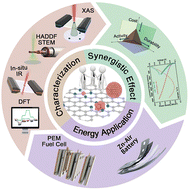
The oxygen reduction reaction (ORR) plays a crucial role in the field of energy such as in proton exchange membrane fuel cells (PEMFCs) and zinc–air batteries (ZABs), but the process is kinetically slow and requires efficient catalysts. The high cost and scarcity of Pt-based catalysts limit their practical applications despite their superior performance. Researchers are therefore committed to reducing the use of Pt or developing highly active alternative non-precious metal-based catalysts to reduce costs. Collective effect catalysts (CECs) combine the advantages of single atoms and atomic clusters/nanoparticles and can significantly improve the activity, selectivity and durability of the catalyst by precisely controlling their composition and geometric and electronic structure. The enhanced intrinsic activity of CECs contributes to the realization of efficient and low-cost electrocatalysis, which is receiving increasing attention. This article reviews the research progress of CECs for electrocatalytic ORR, including their structural features, identification methods, and synergistic effects, and summarizes their representative application research progress in ZABs and PEMFCs. Finally, the article looks forward to future developments to provide new insights for the design of advanced catalysts.
 Please wait while we load your content...


