Jackson
Geary†
,
Caith E.
McKeown†
,
Nickolas
Gantzler
,
N. Scott
Bobbitt
and
Dorina F.
Sava Gallis
*
Sandia National Laboratories, Albuquerque, NM 87185, USA. E-mail: dfsava@sandia.gov
First published on 16th December 2025
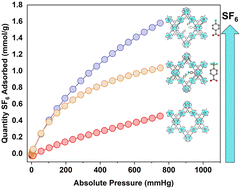
Herein, an investigation into the impact of subtle binding site changes on SF6 affinity is presented by systematically altering the pore environment of MOF-808 via post-synthetic modification with aryl and benzylic fluoride groups. All functionalized derivatives outperform the parent material, with aryl fluorides increasing SF6 uptake fourfold.
SF6 capture is typically performed using energy-intensive, low temperature liquefaction methods.6 An alternative is the use of heterogeneous physisorbent materials. Metal–organic frameworks (MOFs) porous, crystalline network solids assembled from organic linkers and metal nodes—have shown promise for the capture of SF6.7–15 However, most reported materials rely primarily on sieving effects, rather than chemical affinity, to capture SF6.16–20 Despite the unreactive nature of SF6, there is opportunity to enhance affinity with MOF pores by tailoring the chemical environment of the pores to increase MOF–SF6 interactions.
To address this opportunity, herein we present a systematic investigation into the effect of modifying MOF pore environments on SF6 capture capacity using a series of MOF-808 materials post-synthetically modified with different fluorinated benzoic acid derivatives, Fig. 1. The incorporation of fluorinated groups into MOF pores has been shown to alter the chemical environment, leading to enhanced interactions with adsorbate molecules.21 Fluorinated MOFs have shown promise in a variety of gas-capture applications,21,22 including the separation of non-polar hydrocarbons,23 trace CO2 capture,24,25 and removal of SO2 from flue gas.27 Further, fluorinated porous polymers have shown promise for SF6 capture.28 Thus, the fluorobenzoic acid groups are expected to interact favourably with SF6, which in turn will enhance adsorption.
![]() | ||
| Fig. 1 Overview of the post-synthetic exchange of capping formates in MOF-808 for functionalized groups (top),4,26 and the functional groups used in this work (bottom). | ||
To investigate the impact of the fluorines’ electronic environment in conjunction with the degree of fluorination, a set of fluorinated benzoic acids with aryl fluorides, 4-fluorobenzoic acid (F1) and 3,5-difluorobenzoic acid (F2) along with a set of fluorinated benzoic acids with benzylic fluorides, 4-(trifluoromethyl) benzoic acid (CF3) and 3,5-bis(trifluoromethyl)benzoic acid ((CF3)2) were selected as model fluorinated groups. Increasing the overall number of fluorines within the pore is expected to increase the number of dispersive interactions with SF6, leading to increased adsorption, so long as sufficient porosity is maintained; differences in electronic environment between aryl and benzylic fluorines should also alter their relative changes to the pore microenvironment, creating different adsorption sites and thus influence SF6 uptake.
First, MOF-808 was synthesized and post-synthetically functionalized with each of the fluorobenzoic acids. The resulting MOF-808 fluorinated derivatives were evaluated by powder X-ray diffraction (PXRD), gas sorption, and thermal gravimetric analysis (TGA). The successful incorporation of the fluorinated moieties was confirmed using a combination of digestion 1H nuclear magnetic resonance (NMR) and Fourier-transform infrared (FT-IR) spectroscopies. Scanning electron microscopy coupled with energy-dispersive X-ray spectroscopy (SEM-EDS) demonstrated the homogeneous distribution of fluorines within the bulk material.
Next, the materials were tested for SF6 capture. Importantly, uptake could be tuned based on the identity of the fluorinated group installed, with aryl fluorines exhibiting an outsized affinity for SF6 relative to their incorporation. MOF-808-F1 exhibited a fourfold increase in SF6 uptake versus the parent MOF-808, a demonstrable improvement stemming from our pore-engineering strategy.
To gain further insight into the adsorbent–adsorbate interactions at play, we turned to computational modelling. Models for each material, at different degrees of functionalization, were first optimized using density functional theory (DFT). Grand canonical Monte Carlo (GCMC) simulation was then performed to assess the SF6 uptake for each material. Gratifyingly, the experimental and simulated trends were found to be broadly in agreement. These computational results underscore the impact of functional group identity on the pore microenvironment. Overall, this work highlights the power of synthetically straightforward post-synthetic modification for tailoring the pore environment of MOFs for specific, challenging gas capture applications.
The parent MOF-808 material was synthesized following a modified literature procedure,29 then treated with the four different fluorine containing benzoic acids. The chosen fluorinated benzoic acids were selected due to their varying type and number of fluoride groups; it is expected that aryl fluorides may interact differently with SF6 than benzylic fluorides, while increasing the degree of fluorination should increase SF6 uptake. The fluorobenzoic acid derivatives were installed by heating pristine MOF-808 with a given reagent in DMF at 60 °C overnight (see SI for full synthetic details).
PXRD confirmed the desired bulk crystalline structure and phase purity of pristine MOF-808 and functionalized MOF-808 (Fig. 2a). By TGA, no significant decrease in thermal stability was observed upon addition of the fluorinated groups (Fig. S1). The materials exhibit permanent porosity, as evidenced by their N2 adsorption at 77 K (Fig. 2b). MOF-808 was found to have a Brauner–Emmett–Teller (BET) surface area of 1820 m2 g−1, while the functionalized MOFs possessed surface areas between 760–1680 m2 g−1. The functionalized MOF-808 materials have decreased surface area compared to the parent material, which is an expected consequence of the functional groups obstructing some of the pore volume. The materials exhibited comparable CO2 at 298 K adsorption isotherms, suggesting the fluorinated groups did not greatly impact the materials’ interactions with CO2. Additionally, none of the materials showed appreciable uptake for N2 at 298 K. The CO2 and N2 adsorption at 298 K are presented in Fig. S2.
Incorporation of the functional groups was quantified by digesting a portion of each material in a mixture of KOD in D2O, filtering the organics from the insoluble ZrO2, and analysing the filtrate by 1H NMR spectroscopy (Fig. S4–S6). The NMR results are summarized in Table 1, highlighting the stoichiometry of the fluorinated functional group derivatives per Zr6 cluster. All the groups incorporated well, between 2 to 5 groups per cluster. F2 incorporated the least, at approximately 2 groups per Zr6 cluster. Conversely, and somewhat surprisingly given its steric bulk, (CF3)2, incorporated the most, at approximately 5 groups per cluster. As a qualitative complement, SEM-EDS was also employed to assess the bulk distribution of fluorine and zirconium within each material (Fig. 2c and Fig. S7).
To confirm that the groups were incorporating at the Zr6 cluster, FT-IR was used (Fig. 2d). If incorporation occurs via exchange of the native capping formate groups, a shift to the carboxylate peak at 1663 cm−1 is expected. Indeed, for all materials, a new carboxylate peak at ∼1655 cm−1 is noticed, while the peak at 1663 cm−1 is no longer observed. The FT-IR data is consistent with incorporation of the fluorinated groups via post-synthetic formate exchange on the clusters, rather than simple impregnation of the pores. A schematic of the post-synthetic incorporation of fluorinated groups is outlined in Fig. 3a.
With the functionalized materials in hand, we next sought to validate their performance as SF6 adsorbents. Experimental SF6 adsorption isotherms collected at 298 K revealed substantial differences in capacity for the differently functionalized materials, Fig. 3b. MOF-808-F1 and MOF-808-F2 exhibited the highest SF6 uptakes at saturation, reaching a maximum uptake of 1.6 mmol g−1 and 1.3 mmol g−1, respectively. For MOF-808-F1, this is a fourfold increase compared to the parent MOF-808. MOF-808-CF3 and MOF-808-(CF3)2 exhibited lower uptakes, less than 1 mmol g−1, though MOF-808-CF3 had comparable uptake to that of MOF-808-F1 at low pressures. MOF-808-CF3 may have favorable adsorption sites at low pressures, yet the accessible pore volume impedes uptake at higher pressures.
Amongst the other four materials, the best performers, MOF-808-F1 and MOF-808-F2, are the least functionalized at 3.8 and 2.1 groups per cluster. While these materials are more porous than MOF-808-CF3 and MOF-808-(CF3)2, given that MOF-808 possesses higher surface area, porosity alone does not explain this trend. Rather, the type of fluorinated group plays an integral role in driving SF6 adsorption. Bound directly to the aromatic phenylene ring, the aryl fluorides in MOF-808-F1 and MOF-808-F2 are more engaged with the pi-system of the ring, changing the electronic structure.30 This, in turn, may increase the dispersive interactions with SF6 at adsorption sites on the ring, leading to enhanced adsorption.31–33 Similar dispersive SF6-MOF interactions have been implicated in other MOF systems.17,19,20,34,35 Conversely, the −CF3 groups of MOF-808-CF3 and MOF-808-(CF3)2, being less electronically connected to the ring, do not disrupt the pi-system to generate new adsorption sites. Rather, these groups may rely primarily on adsorption sites at the −CF3 groups. Overall, a combination of these interactions in conjunction with accessible pore space are the primary factors driving enhanced adsorption.
To further investigate the effects of the different fluorinated groups on SF6 uptake, atomistic simulations were used. First, DFT calculations were used to optimize the structure of each MOF-808 derivative at varying degrees of functionalization: 1 group per cluster, 2 groups per cluster, and 3 groups per cluster. Then, the optimized structures were used to simulate SF6 uptake at pressures between 0–760 mmHg (see SI for Computational methods). The simulated isotherms at different loadings for each material are shown in Fig. S8–S11.
Simulated results most closely matching the experimentally observed degree of functionalization for each material (3 groups per cluster for F1, CF3, and (CF3)2 and 2 groups per cluster for F2) are overlaid in Fig. 3c. The absolute uptake values for the simulated results generally overperform experiment, given the higher degrees of functionalization determined experimentally. This agrees with previous work comparing force field models for SF6, which showed that most models overpredict SF6 uptake at low pressure due to overestimating interaction strength.36,37 Notably, general trends are preserved, with MOF-808-F1, MOF-808-F2, and MOF-808-CF3 performing best in simulation. However, the ordering is switched at higher pressures. For MOF-808-CF3 and MOF-808-(CF3)2 the experimental loading was higher than the simulated loading of functional groups per nodes; therefore, the experiments reflected a greater reduction in pore volume. This highlights the complex trade-off between increased affinity and reduction in pore volume when adding functional groups. Clearly, myriad factors must be considered when designing functionalized physisorbents for SF6 capture, including the identity, type, and number of functional groups installed, as well as their impact on the pore structure. The interplay of these factors must be considered in concert to achieve the greatest enhancement in performance.
Herein, a series of fluorinated MOF-808 derivatives were investigated for their ability to adsorb SF6. All functionalized materials outperformed the parent MOF, and the best performing material, MOF-808-F1, exhibited a four-fold increase in SF6 uptake, highlighting the power of simple post-synthetic chemistry to enhance performance. The complex interplay between the identity and number of fluorinated groups critically influences the adsorption capacity, with aryl fluorides exhibiting superior performance compared to benzylic counterparts. While an increase in the number of fluorinated groups generally correlates with improved SF6 uptake, this relationship is nuanced by the impact of functionalization on the material's porosity. The findings underscore the importance of carefully selecting both the type and quantity of fluorinated groups to optimize the electrostatic environment within the MOF pores, ultimately enhancing gas capture efficiency. This work paves the way for future research aimed at developing tailored MOF materials for effective gas separation applications, contributing to advancements in sustainable practices within industries reliant on SF6.
This work was supported by the Laboratory Directed Research and Development program at Sandia National Laboratories. This article has been authored by an employee of National Technology & Engineering Solutions of Sandia, LLC under Contract No. DE-NA0003525 with the U.S. Department of Energy (DOE). The employee owns all right, title and interest in and to the article and is solely responsible for its contents. The United States Government retains and the publisher, by accepting the article for publication, acknowledges that the United States Government retains a non-exclusive, paid-up, irrevocable, world-wide license to publish or reproduce the published form of this article or allow others to do so, for United States Government purposes. The DOE will provide public access to these results of federally sponsored research in accordance with the DOE Public Access Plan https://www.energy.gov/downloads/doe-public-access-plan. This paper describes objective technical results and analysis. Any subjective views or opinions that might be expressed in the paper do not necessarily represent the views of the U.S. Department of Energy or the United States Government.
Footnote |
| † Co-first author. |
| This journal is © The Royal Society of Chemistry 2026 |