Peng-Fei
Wang
a,
Qiang-Qiang
Li
a,
Hao
Liu
a and
Pei-Jun
Yang
*ab
aAnhui Province Key Laboratory of Functional Coordinated Complexes for Materials Chemistry and Application, School of Chemical and Environmental Engineering, Anhui Polytechnic University, Middle Beijing Road, Wuhu, Anhui 241000, China. E-mail: yangpeijun@ahpu.edu.cn
bMOE Key Laboratory of Functional Molecular Solids, Anhui Laboratory of Molecule-Based Materials, Institute of Organic Chemistry, College of Chemistry and Materials Science, Anhui Normal University, 189 South Jiuhua Road, Wuhu, Anhui 241002, China
First published on 8th December 2025
Our investigations demonstrate that aryldiazonium salts effectively trigger the ring-opening of azetidines with excellent regiocontrol. This transformation exhibits remarkable versatility, accommodating different organic sulfur reagents under mild reaction conditions. The methodology combines several advantageous features: (a) scalability to gram quantities, (b) straightforward execution without metal catalysts, and (c) mild operating parameters. Mechanistic studies suggest that the process initiates through single-electron transfer from the azetidine to the diazonium species, generating a reactive amino radical cation intermediate.
Given their inherent ring strain, azetidines exhibit remarkable reactivity, making them suitable candidates for radical-mediated transformations. Such pathways could potentially expand the substrate scope and functional group tolerance. However, compared to ionic mechanisms, radical-based ring-opening reactions of azetidines—particularly under metal-free conditions—remain underexplored.7
Aryldiazonium salts represent a class of highly accessible and multifunctional compounds that have become indispensable tools in modern synthetic chemistry. Their exceptional reactivity profile enables widespread applications across various domains, including organic synthesis, dye manufacturing, and advanced material development.8 In recent years, aryldiazonium salts have emerged as versatile precursors for aryl radical generation.9 Unlike conventional radical initiators, which often require high energy input for initiation, aryldiazonium salts can undergo radical formation under mild conditions via single-electron transfer. The most prominent application of aryldiazonium salts lies in their role as efficient aryl group donors in nucleophilic substitution processes. This is demonstrated by their involvement in several historically significant and synthetically valuable transformations: Sandmeyer-type reaction,10 Meerwein's vinylation,11 Pschorr-type intramolecular cyclization (Scheme 1b).12 Notably, significant contributions have been made in this field: Tao and coworkers demonstrated alcohol-induced dediazoniation of aryldiazonium species for aryl radical generation,13 while Tang's research group developed a silver-catalyzed protocol for trifluoromethoxylation of (hetero)aryldiazonium tetrafluoroborates (Scheme 1b).14 More recently, photoredox catalysis has further expanded its utility, with visible-light irradiation facilitating the generation of aryl radicals from aryldiazonium salts through oxidative or reductive quenching cycles (Scheme 1b).9d,15
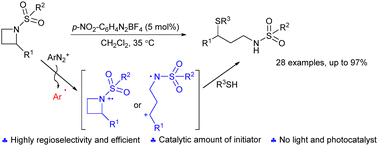
In most reported cases, aryldiazonium salts serve as radical sources that react with external substrates. However, we envisioned an alternative pathway: if a single-electron transfer event occurs directly between an aryldiazonium salt and an azetidine, the resulting radical cation intermediate could trigger a ring-opening process in the presence of a suitable reaction partner. This approach might enable novel, metal-free radical transformations of azetidines under mild conditions. Herein, we report a novel methodology employing aryldiazonium salts as efficient initiators for the regiocontrolled ring-opening of azetidine derivatives (Scheme 1c). Remarkably, this transformation proceeds under mild conditions without requiring photoredox catalysts.
Our investigation commenced using 2-phenyl-1-tosylazetidine 1a and benzo[d]thiazole-2-thiol 2a as model substrates to evaluate the catalytic role of aryldiazonium salts. Initial control experiments revealed that the desired ring-opening product 3aa was not obtained in the absence of aryldiazonium initiators (Table 1, entry 1). Notably, the introduction of merely 5 mol% phenyldiazonium tetrafluoroborate as a catalyst afforded the target product 3aa in 88% yield with complete regioselectivity (entry 2). Subsequently optimization studies focused on examining substituted aryldiazonium tetrafluoroborate derivatives. Electron-donating substituents demonstrated almost unchanged catalytic efficacy (entries 3 and 4). In contrast, electron-withdrawing groups further enhanced the reaction efficiency. The para-ethoxycarbonyl derivative achieved 90% yield (entry 6), while comparable results were obtained with para-bromo (88%, entry 5), and para-trifluoromethyl (92%, entry 7) substituents. Optimal performance was observed with para-nitrophenyldiazonium, delivering an exceptional 93% yield (entry 8). Control experiments confirmed that photocatalytic conditions were unnecessary, as comparable results were obtained in the absence of light (entry 9). Then several different solvents were tested in the reaction, which all proved inferior to the originally used solvent of dichloromethane (entries 10–15).
| Entry | ArN2BF4 | Solvent | t (h) | Yieldb (%) |
|---|---|---|---|---|
| a Reactions were performed with 1a (0.1 mmol) and 2a (0.12 mmol) in 1.0 mL of solvent. b Isolated yield is reported. NR = no reaction. c In the dark. | ||||
| 1 | — | CH2Cl2 | 16 | 0 |
| 2 | PhN2BF4 | CH2Cl2 | 16 | 88 |
| 3 | p-CH3-C6H4N2BF4 | CH2Cl2 | 16 | 88 |
| 4 | p-CH3O-C6H4N2BF4 | CH2Cl2 | 16 | 86 |
| 5 | p-Br-C6H4N2BF4 | CH2Cl2 | 16 | 87 |
| 6 | p-COOC2H5-C6H4N2BF4 | CH2Cl2 | 16 | 90 |
| 7 | p-CF3-C6H4N2BF4 | CH2Cl2 | 16 | 92 |
| 8 | p-NO2-C6H4N2BF4 | CH2Cl2 | 16 | 93 |
| 9c | p-NO2-C6H4N2BF4 | CH2Cl2 | 16 | 92 |
| 10 | p-NO2-C6H4N2BF4 | ClCH2CH2Cl | 16 | 89 |
| 11 | p-NO2-C6H4N2BF4 | CHCl3 | 16 | 85 |
| 12 | p-NO2-C6H4N2BF4 | Toluene | 20 | 64 |
| 13 | p-NO2-C6H4N2BF4 | EtOAc | 20 | 34 |
| 14 | p-NO2-C6H4N2BF4 | THF | 20 | 28 |
| 15 | p-NO2-C6H4N2BF4 | DMF | 20 | NR |
Next, we explored the reaction scope using different azetidines with benzo[d]thiazole-2-thiol 2a (Table 2). The transformation exhibited broad compatibility with various substituents, including both electron-donating and electron-withdrawing substituents, affording the desired products in high yields with excellent regioselectivities (3ba–3ja). The reaction was also effective with a series of azetidines derived from different N-sulfonyl groups and electron-rich 2-aryl or heteroaryl groups, delivering products 3ka–3ma, 3oa and 3qa in moderate to high yields. However, a diminished yield was observed for 2-alkyl azetidine 1l, due to the extremely slow reaction rate and the structure of the ring-opening product, as determined by NMR and X-ray crystallography, which confirms that the reaction occurs at the site of lower steric hindrance. The reaction was not feasible with 1p as the substrate.
Subsequently, the effect of various thiol nucleophiles on the reaction with azetidine 1a was examined (Table 3). The reaction proceeded efficiently with good yields regardless of whether the benzene ring of 2 bore electron-withdrawing or electron-donating substituents (3ab–3ah). However, distinct electronic effects were observed depending on the substitution patterns: (1) the presence of a strong electron-withdrawing group at the 5-position significantly prolonged the reaction time (3ad); (2) substrates containing electron-withdrawing groups at the 6-position required reflux conditions to achieve completion (3ae, 3af). Notably, the transformation proved feasible with thiazole-2-thiol, albeit with moderate conversion efficiency (3ai). To one's delight, benzenethiols, ethanethiol, and ethyl 2-mercaptoacetate are all well-tolerated, which enables the efficient progression of the reaction (3aj–3am).
To demonstrate the synthetic utility of this transformation, a scale-up reaction between 1a and 2a was conducted, affording the product in comparable yield (Scheme 2). Given the pharmaceutical industry's preference for user-friendly, metal-free synthetic methods, this transformation is especially valuable. Moreover, the benzothiazole moiety γ-amino thioether 3aa demonstrated further transformability. Subjecting this compound to MeONa/MeOH at reflux predominantly yielded methyl thioether 4 (Scheme 2a). Mechanistic analysis suggests that this transformation proceeds through initial formation of a sulfide anion (IM1) and methyl aryl ether (IM2) intermediates, followed by an SN2-type nucleophilic substitution.4 As demonstrated in Scheme 2c, exposure of the sulfur-containing heterocycles 3aa to m-CPBA at room temperature resulted in efficient oxidation of the thioether group, yielding the sulfoxide derivative 5 in 90% isolated yield (Scheme 2b).
To further elucidate the radical mechanism, we performed trapping studies using 2,2,6,6-tetramethylpiperidin-1-oxyl (TEMPO) as a radical scavenger (Scheme 3). Treatment of p-NO2-C6H4N2BF4 with 2 equiv. TEMPO in CH2Cl2 for 16 h gave p-NO2-C6H4-TEMPO in 48% yield. Under stoichiometric conditions with para-nitrophenyldiazonium and two TEMPO equivalents, we isolated aryl-TEMPO adducts with 57% yield from azetidine 1a and 49% yield from benzo[d]thiazole-2-thiol 2a. Remarkably, when employing catalytic para-nitrophenyldiazonium with TEMPO in our standard reaction system, we observed significant inhibition. According to the suggested references on azetidine radical cation formation,16 this suggests a mechanistic pathway involving single electron transfer from either azetidine to aryldiazonium, generating radical cations and aryl radical intermediates that are subsequently trapped by TEMPO. The ring-opening of 2a with enantioenriched (S)-1a led to significant erosion of enantiopurity, whereas the azetidine alone racemized much more slowly under identical conditions. This dichotomy points to a dual mechanism, involving both an SN2 pathway via intermediate 6 and a competing SN1 pathway through the loose ion pair/carbocation 7.
In conclusion, we have developed an efficient and versatile method for the ring-opening of azetidines mediated by aryldiazonium tetrafluoroborate under mild conditions. This metal-free protocol operates via a radical chain mechanism and offers several advantages, including broad substrate scope, scalability, and compatibility with mild reaction conditions. Given the significance of amines in pharmaceutical and natural product synthesis, we expect this methodology to find widespread utility in the preparation of biologically relevant amides.
CCDC 2498432 (3na) contains the supplementary crystallographic data for this paper.17
| This journal is © The Royal Society of Chemistry 2026 |