


 PLATFORM UPDATE:


Ni- and Co-doped TiO2 nanofibers for enhanced antibacterial and antibiofilm activities, and mechanistic insights

Abstract
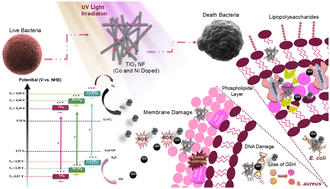
Nowadays, with the growing need for alternative antibacterial materials for the treatment of bacterial infections, TiO2 with antibacterial properties has attracted attention as a potential antibacterial agent. Ni-TiO2 and Co-TiO2 nanofibers (NFs) were synthesized via an electrospinning process. The antibacterial activities of these NFs against S. aureus and E. coli were evaluated under UV-light illumination using optical density measurements. Co-TiO2 exhibited superior antibacterial activity against both S. aureus and E. coli under UV-light irradiation. The antibacterial mechanism was further investigated through a glutathione (GSH) oxidation assay and morphological analysis using scanning electron microscopy (SEM). Hydrophilicity was evaluated by contact angle measurement. The antibiofilm activities of TiO2, Ni-TiO2, and Co-TiO2 NFs were investigated with respect to E. coli and S. aureus biofilms. Ni-TiO2 and Co-TiO2 demonstrated more effective antibiofilm activities than bare TiO2. Under UV-light irradiation, the biofilm inhibition efficacy was increased for both Ni-TiO2 and Co-TiO2 NFs while Co-TiO2 NFs were found to have the greater antibiofilm performance. Additionally, in silico analysis was conducted to explore the molecular interactions of the NFs with S. aureus Immunoglobulin-Binding B Domain (PDB ID: 1BDD) and FimH lectin protein of E. coli (PDB ID: 4XO8). Co-TiO2 exhibited stronger binding to S. aureus, while TiO2 showed stronger binding to E. coli.
 Please wait while we load your content...


