


 PLATFORM UPDATE:


Molecularly imprinted polymers as emerging engineered platforms for precision molecular sensing

Abstract
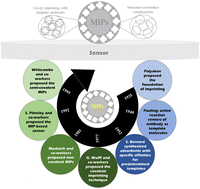
Molecularly imprinted polymers (MIPs) have emerged as robust synthetic alternatives to natural biorecognition elements, offering high selectivity and stability for sensor applications. Advancements in nanotechnology and polymer chemistry in the last few decades positioned MIPs as emergent and promising materials for sensor devices. This review covers various components of a functional MIP structure, including monomers, cross-linkers, and initiators that form the MIP backbone, aided by template molecules and porogens. Chemical interactions involved in polymer imprinting, to critically understand how the various components interact with each other to make functional MIP structures, have been discussed in detail using suitable examples. The different methods of polymerization used to formulate its functional version have also been elaborated in the current article, which includes bulk polymerization, surface polymerization, electro-polymerization, sol–gel, phase inversion, and epitope imprinted polymerization, discussed in detail using suitable examples. This paper also includes precise yet insightful discussions on MIP-based sensing of various molecular categories, viz. small molecules, macromolecules, and environmental pollutants. The tables cover details of sensor fabrication strategies, their limits of detection (LOD) and linear dynamic range (LDR), and the technique used along with the real sample considerations in those studies. The paper brings fundamental insights from synthesis to real-time applications of these materials in order to understand their overall research scope along with translational bottlenecks in a future perspective.
 Please wait while we load your content...


