Modulation of the inflammatory microenvironment after SCI to achieve enhanced nerve regeneration using pteryxin-releasing methylacrylated hyaluronic acid

Abstract

Spinal cord injury (SCI) still lacks effective treatment methods. The inflammatory storm after SCI is one of the critical obstacles to nerve repair. In this study, we aimed to address the critical challenge of the inflammatory storm after SCI—a key driver of exacerbated neural damage—by developing an innovative hydrogel scaffold functionalized with sustained-release pteryxin and encapsulated NSCs. This scaffold is designed to modulate the post-SCI inflammatory response, thereby mitigating inflammation-induced neural injury and enhancing neural repair. Briefly, we first synthesized and characterized a hyaluronic acid methacryloyl (HAMA) hydrogel. Subsequently, a 5% HAMA hydrogel and 10 μM pteryxin were used to prepare a pHAMA hydrogel (pteryxin-loaded HAMA). The pHAMA hydrogel possessed good biocompatibility and promoted the differentiation of NSCs towards neurons. Finally, the pHAMA hydrogel combined with NSCs could significantly enhance SCI repair and functional recovery by reducing the inflammatory responses, decreasing the infiltration of macrophages and microglia, and downregulating the expression of inflammation-related genes.
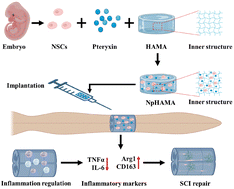
Graphical abstract: Modulation of the inflammatory microenvironment after SCI to achieve enhanced nerve regeneration using pteryxin-releasing methylacrylated hyaluronic acid

Transparent peer review

To support increased transparency, we offer authors the option to publish the peer review history alongside their article.

View this article’s peer review history

Article information

Article type
Paper
Submitted
01 Sep 2025
Accepted
30 Nov 2025
First published
16 Dec 2025

Biomater. Sci., 2026, Advance Article

Modulation of the inflammatory microenvironment after SCI to achieve enhanced nerve regeneration using pteryxin-releasing methylacrylated hyaluronic acid

B. Hu, B. Sun, Y. Zhao, C. Chen, B. Wu, H. Zhang, B. Liu, X. Yang and F. Fang, Biomater. Sci., 2026, Advance Article , DOI: 10.1039/D5BM01322D

To request permission to reproduce material from this article, please go to the Copyright Clearance Center request page.

If you are an author contributing to an RSC publication, you do not need to request permission provided correct acknowledgement is given.

If you are the author of this article, you do not need to request permission to reproduce figures and diagrams provided correct acknowledgement is given. If you want to reproduce the whole article in a third-party publication (excluding your thesis/dissertation for which permission is not required) please go to the Copyright Clearance Center request page.

Read more about how to correctly acknowledge RSC content.

Social activity

Spotlight

Advertisements