


Fabrication of a highly sensitive and stable fluorinated xerogel/cellulose acetate film optical sensor for application in dissolved oxygen detection

Abstract
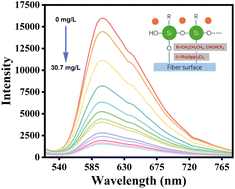
This study reports the development and characterization of a novel optical fiber sensor designed for the sensitive detection of dissolved oxygen. The sensing architecture was fabricated on the distal end of an optical fiber using a dip-coating technique. The core sensing layer consists of the oxygen-responsive luminophore, ruthenium(II)-tris(4,7-diphenyl-1,10-phenanthroline) dichloride (Ru(dpp)3Cl2), physically immobilized within a fluorinated xerogel matrix derived from the co-condensation of 3,3,3-trifluoropropyltrimethoxysilane (TFP-TMOS) and propyltriethoxysilane (PTEOS). To enhance durability and prevent indicator leakage, a secondary layer of cellulose acetate was applied as a protective barrier over the sensing film. Comprehensive structural and morphological analyses of the resulting composite film were conducted utilizing Fourier transform infrared spectroscopy (FTIR) and scanning electron microscopy (SEM), while optical properties were evaluated via fluorescence spectrophotometry. The sensor operates on the principle of fluorescence quenching, demonstrating a robust response to oxygen in aqueous environments. Analytical performance testing revealed excellent linearity in the Stern–Volmer plot (I0/I) across a broad dissolved oxygen concentration range of 0 to 30.7 mg L−1. The device achieved a low detection limit of 0.05 mg L−1 and a rapid response time of 5 seconds. Furthermore, the prepared sensor exhibited superior stability and resistance to dye leaching, confirming its significant potential for reliable, long-term monitoring of dissolved oxygen in diverse aquatic applications.
 Please wait while we load your content...


