


Balancing sensitivity and environmental safety in fluorescent probe design: improved ethanol-thermal carbon dots enable a leap in mercury(ii) detection and zebrafish-assessed safety
 *b
*b
Abstract
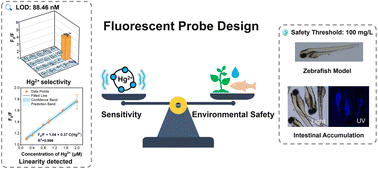
This study presents an improved ethanol-mediated solvothermal method for synthesizing malic acid/urea-derived carbon dots (MUCDs) for the highly selective and sensitive detection of mercury ions (Hg2+). The detection limit was enhanced by over an order of magnitude compared to previous methods employing similar precursors, achieving a limit of detection of 88.46 nmol L−1, which meets the European Union standard for mercury discharge in industrial wastewater (250 nmol L−1). Pyrophosphate (P2O74−) has been used as a highly effective masking agent for Fe3+, substantially boosting the probe's performance in complex matrices. With practical application in mind, the environmental safety of these carbon dots was proactively evaluated using a zebrafish model. The assessment demonstrated no significant toxicity at concentrations up to 100 mg L−1, establishing a 10-fold safety margin relative to the operational dosage. Fluorescence imaging revealed accumulation specifically in the intestinal tract, with no distribution to vital organs, confirming their environmental safety. Under optimized conditions, the MUCDs achieved a quenching efficiency of 0.82 in the presence of 25 µmol per L Hg2+ at a concentration of 10 mg L−1, while also demonstrating thermal stability and pH tolerance. Spike-recovery tests in tap water, river water, and metallurgical wastewater samples yielded satisfactory recoveries ranging from 93.85% to 101.86%. Based on the characterization of MUCDs and the MUCDs–Hg2+ complex, the observed quenching mechanism was explained by chelation between Hg2+ and surface functional groups, leading to aggregation, static quenching, and enhanced Rayleigh scattering. This study highlights the critical importance of incorporating comprehensive environmental safety assessments into the development of functional nanomaterials.
 Please wait while we load your content...


