


Laser-induced fluorescence for detecting thermal degradation of a biological fluid model: a systematic study applying chemometrics
 *a
and
*a
and
Abstract
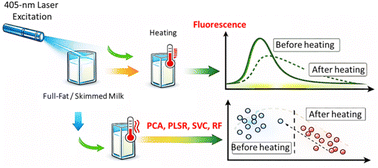
The sensitivity of laser-induced fluorescence (LIF) to slight biochemical changes has made it an effective tool for non-invasive biomedical diagnostics. Since milk is a biological fluid that is both optically and biochemically complex, we employed it as a model sample to evaluate how effectively LIF senses thermally induced molecular changes. Full-fat and skimmed milk samples were systematically examined under 405 nm excitation both before and after controlled heating. The collected fluorescence spectra were then subjected to chemometric analysis using Principal Component Analysis (PCA) for unsupervised classification and Partial Least Squares Regression (PLSR), Support Vector Classifier (SVC), and Random Forest (RF) for predictive modeling. The statistical significance of the observed spectral changes was validated using paired t-tests. Following thermal processing, the emission band at around 533 nm, which corresponds to riboflavin, was significantly reduced, based on fluorescence spectra. The statistical significance of this decrease was validated by paired t-tests (p <0.0001). The discriminative power of LIF was further confirmed by chemometric evaluation: PCA successfully classified samples based on both fat content and thermal treatment, with the first two principal components predicting almost 85% of the total variance. The robustness of the approach was verified by the high calibration and cross-validated prediction accuracy (R2 >0.95) achieved by PLSR. Excellent classification performance was achieved by the SVM classifier with RBF kernels, correctly classifying 100% of data sets. Good model generalization without overfitting is indicated by the close agreement between the test set and cross-validation accuracies. Furthermore, the robustness and generalizability of the model were confirmed by the low out-of-bag error rate in RF implementations. These results show the potential of LIF as a sensitive, non-destructive method for assessing thermal and metabolic changes in biomedical contexts and validate milk as a practical surrogate system for comparing fluorescence-based methods.
 Please wait while we load your content...


