


 PLATFORM UPDATE:

A highly sensitive LC-MS/MS method for quantification of AB-38b in rat plasma, liver and kidney tissues: application to a pharmacokinetic study
 c
Tingting
Yang
†*a
c
Tingting
Yang
†*a
Abstract
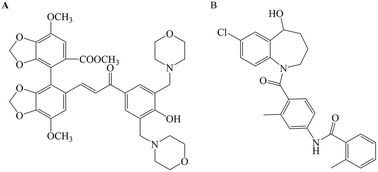
Our research team developed AB-38b, a biphenyl diester derivative containing α,β-unsaturated carbonyl groups, inspired by investigations into the pharmacological prevention and pathophysiology of diabetic kidney disease (DKD). We have completed the synthesis and pharmacodynamic evaluation of AB-38b in preclinical DKD studies. For pharmacokinetic analysis, we established a high-performance liquid chromatography-tandem mass spectrometry (HPLC-MS/MS) method for quantifying AB-38b in rat plasma, as well as in liver and kidney tissues. Sample preparation involved protein precipitation using methanol, with tolvaptan employed as the internal standard (IS). Chromatographic separation was achieved on a Shim-pack VP-ODS C18 column (2.0 × 150 mm, 5 µm), with mobile phase A (5 mM ammonium acetate) and mobile phase B (methanol) under gradient elution at a flow rate of 0.2 mL min−1. AB-38b and the IS were detected and quantified using positive electrospray ionization in multiple reaction monitoring (MRM) mode at transitions of m/z 705.30 → 618.20 for AB-38b and m/z 449.30 → 252.20 for the IS. The method demonstrated excellent linearity, stability, accuracy, precision, recovery, and a non-significant matrix effect within the validated range. A one-compartment model with rapid absorption and distribution, quicker elimination, and clear tissue distribution was demonstrated by the mean blood concentration–time curve of AB-38b in rat plasma. The liver tissue contained high levels of AB-38b, with no evidence of tissue accumulation observed. These findings offer a reference for further research into the pharmacological mechanisms and potential therapeutic applications of AB-38b in metabolically related diseases, especially DKD.
- This article is part of the themed collection: Analytical Methods HOT Articles 2026
 Please wait while we load your content...


