


 PLATFORM UPDATE:


Colloidal gold immunochromatographic assay for mycophenolic acid in human plasma

Abstract
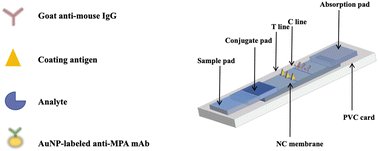
Mycophenolic acid (MPA), an immunosuppressive metabolite of Penicillium fungi with a narrow therapeutic window, poses significant clinical risks of toxicity or transplant rejection if its concentration is not strictly controlled. Therefore, it is crucial to establish an accurate and sensitive detection method for monitoring MPA levels. In this study, carboxyl-containing MPA was employed to synthesize complete antigens, leading to the preparation of a monoclonal antibody (mAb) with high sensitivity and specificity via cell fusion. The half-maximal inhibitory concentration of the mAb was determined to be 0.22 ng mL−1, and the limit of detection of ic-ELISA was 0.05 ng mL−1, with a linear range of 0.03–1.4 ng mL−1. This mAb was subsequently employed to develop a colloidal gold immunochromatographic assay (CG-IA) strip using gold nanoparticles (AuNPs) for therapeutic drug monitoring of MPA in human plasma. The visual limit of detection (vLOD) and the cut-off value were 0.1 ng mL−1 and 10 ng mL−1 in PBS, respectively. For plasma samples, the vLOD was 10 ng mL−1, and the cut-off value was 50 ng mL−1. In addition, CG-IA strip results for clinical MPA detection correlated strongly with liquid chromatography-tandem mass spectrometry data, validating the strip as an effective tool for rapid plasma MPA monitoring.
- This article is part of the themed collection: Analyst HOT Articles 2026
 Please wait while we load your content...


