


Study on low temperature enrichment-headspace sampling-proton transfer reaction-mass spectrometry (LTE-HS-PTR-MS) for highly sensitive analysis of trace exhaled VOCs
 *b
Xun
Bao,
b
Qiangling
Zhang,
b
Chaoqun
Huang,
b
Xue
Zou,
*b
Chengyin
Shen
*b
and
Yannan
Chu
b
*b
Xun
Bao,
b
Qiangling
Zhang,
b
Chaoqun
Huang,
b
Xue
Zou,
*b
Chengyin
Shen
*b
and
Yannan
Chu
b
Abstract
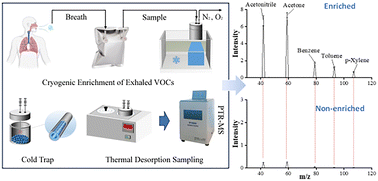
To address the challenge of detecting low concentrations of trace volatile organic compounds (VOCs) in exhalation with high humidity, this study developed a highly sensitive detection technique named low temperature enrichment-headspace sampling-proton transfer reaction-mass spectrometry (LTE-HS-PTR-MS). During low temperature enrichment, the enrichment module was maintained at a constant low temperature using liquid nitrogen, effectively condensing and trapping VOCs from exhalation while excluding components such as nitrogen and oxygen. During thermal desorption sampling, the enrichment module is heated in a water bath, enabling rapid thermal desorption of the trapped VOCs, which are then introduced via headspace sampling into a proton transfer reaction-mass spectrometer (PTR-MS) for detection. This study optimized parameters of the LTE-HS-PTR-MS system, including the type, total volume, particle size of the enrichment material, and pre-concentration flow rate. The system's performance in terms of enrichment efficiency, sensitivity, limit of detection (LOD), and recovery rate was evaluated. The results showed that this technique could reduce the instrument's LOD by 23.4 to 28.8 times. Finally, comparative analysis of breath samples from healthy individuals using two detection techniques revealed that, compared to conventional PTR-MS, LTE-HS-PTR-MS significantly enhanced the signal intensity of 17 product ions from exhaled VOCs, with an average enrichment efficiency exceeding 29 times. The highly sensitive detection technique developed in this study facilitates the detection of trace VOCs in exhalation and holds potential for the discovery of breath biomarkers for diseases.
 Please wait while we load your content...


