



Smartphone-assisted PEI@Eu-MOF lateral flow immunosensor for dual-modal POC detection of carbendazim
 *ad
*ad
Abstract
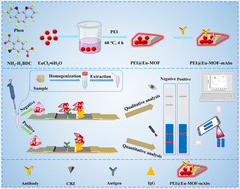
Sensitive detection of carbendazim (CBZ), a widely monitored bactericidal pesticide globally, is critical to reduce risks to human health. In this study, Eu ions were embedded into a rigid metal–organic framework (MOF), to prepare Eu-MOF as a fluorescence signal source, which was subsequently post-modified with polyethyleneimine (PEI) for efficient coupling with anti-CBZ monoclonal antibodies (mAbs). On this basis, a PEI@Eu-MOF-mAbs fluorescent probe-based lateral flow immunosensor (LFIS) was developed for CBZ analysis, enabling dual-mode detection: rapid visual qualitative observation by the naked eye and intelligent fluorescence quantitative analysis by using a smartphone. PEI modification not only effectively improved the zeta potential, fluorescence intensity, quantum yield, and biological coupling ability of the Eu-MOF to mAbs, but also significantly enhanced the stability and anti-interference performance of PEI@Eu-MOF. The introduction of PEI@Eu-MOF-mAbs probes characterized by strong fluorescence emission, long fluorescence lifetime, and low background interference, markedly improved the detection sensitivity of the LFIS platform for trace CBZ. Under optimal conditions, the detection limit for smartphone-assisted fluorescence analysis was as low as 1.3 pg mL−1 with a wide linear detection range of 0.25–125 ng mL−1 for CBZ. The recoveries in spiked Panax notoginseng samples were 93.40–106.0% with RSD <1.69%, indicating outstanding reliability of the newly developed LFIS platform for accurate detection of CBZ. In comparison with seven other common pesticides, CBZ produced significantly weakened and stable fluorescence, indicating good specificity and stability of the developed platform over 4 weeks. Compared with current analytical methods, the smartphone-assisted PEI@Eu-MOF-mAbs dual-modal LFIS platform exhibited advantages of simple construction, easy operation, rapid response, obvious visualization to the naked eye, and intelligent quantitative analysis, highlighting its broad application potential for rapid screening and accurate point-of-care detection of CBZ in a large number of foods and agricultural products.
- This article is part of the themed collection: Analyst HOT Articles 2026
 Please wait while we load your content...


