


 PLATFORM UPDATE:


Targeted chemo-photodynamic therapy in pancreatic cancer: influence of Ir(iii)-complex and ion chelating N^N-ancillary ligand on cell death mechanism

Abstract
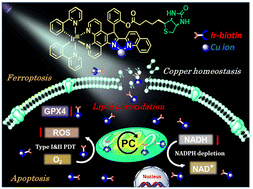
Ir(III)-based metallo-anticancer complexes offer promising therapeutic strategies with their efficacy fine-tuned through structural modifications, leveraging multitargeted mechanisms of action to reduce resistance compared to traditional chemotherapeutics. Herein, we report a photoactive Ir(III)-complex [Ir-biotin] designed with an ion-chelating ancillary ligand to disrupt copper homeostasis and simultaneously induce oxidative stress, aiming to overcome chemotherapeutic drug-resistance in pancreatic cancer. The complex features a nonsymmetrical polytopic ligand covalently linked to phenanthroline and imidazole-quinoline fragments, with a biotin tag for targeted delivery and an open N^N-coordination site for cellular ion interactions. Ir-biotin exhibits potent micro- to nanomolar-level therapeutic efficacy against MIAPaCa-2 and PANC-1 cells under dark and light conditions. We observed that ferroptosis-inducing Ir-biotin significantly downregulated glutathione peroxidase 4 (GPX4) expression, leading to increased lipid peroxidation (LPO) accumulation. Collectively, mechanistic investigations reveal that Ir-biotin translocates into the mitochondria, preferentially coordinates with mitochondrial Cu-ions, and induces a significant increase in reactive oxygen species (ROS), lipid peroxidation (LPO) in the cell membrane, and photoregulated oxidase-mimicking activity. Ir-biotin synergistically triggers apoptosis-linked ferroptosis and therefore represents a promising candidate for overcoming drug resistance via chemo-photodynamic tumor therapy.
 Please wait while we load your content...


