


 PLATFORM UPDATE:

Construction of charge transfer channels in pyrene-based covalent organic frameworks via wall chemistry for efficient photocatalytic hydrogen production

Abstract
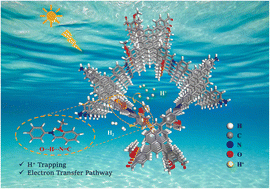
Photocatalytic hydrogen production has gained significant attention as a green, energy-efficient, and environmentally sustainable approach, positioning hydrogen as a promising clean energy source. Covalent organic frameworks (COFs), known for their high stability and structural diversity, exhibit considerable potential in photocatalytic hydrogen production. However, most COF-based photocatalysts are hindered by challenges such as low charge separation and transfer efficiency, as well as rapid charge recombination, which limit their practical application in photocatalysis. In this study, oxygen-containing side chains (–OCH3) are introduced into the pore walls of imine-linked pyrene-based COFs to enhance photocatalytic performance for hydrogen production. The oxygen atoms in the side chains interact synergistically with the nitrogen atoms in the imine bonds, promoting H+ capture from the environment and resulting in the formation of an intramolecular hydrogen bond (O⋯H⋯N![[double bond, length as m-dash]](https://www.rsc.org/images/entities/char_e001.gif) C). This interaction significantly improves charge separation and migration, thereby enhancing the photocatalytic hydrogen production efficiency. The modified methoxy-functionalized TF(OCH3)-Py photocatalyst achieves a hydrogen production rate of 29.37 mmol g−1 h−1, which is 6.8 times higher than that of the unmodified TF-Py. Experimental and theoretical investigations further reveal the mechanism responsible for this performance enhancement. This work offers new insights into enhancing the photocatalytic performance of COFs, with promising implications for practical applications.
C). This interaction significantly improves charge separation and migration, thereby enhancing the photocatalytic hydrogen production efficiency. The modified methoxy-functionalized TF(OCH3)-Py photocatalyst achieves a hydrogen production rate of 29.37 mmol g−1 h−1, which is 6.8 times higher than that of the unmodified TF-Py. Experimental and theoretical investigations further reveal the mechanism responsible for this performance enhancement. This work offers new insights into enhancing the photocatalytic performance of COFs, with promising implications for practical applications.
 Please wait while we load your content...


