


 PLATFORM UPDATE:


A durable superhydrophobic composite sponge for efficient oil/water separation in harsh marine environments: integrating corrosion resistance and photothermal functionality
 *ab
*ab
Abstract
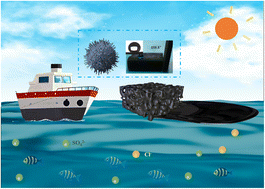
Frequent oil spills drive the demand for durable oil/water separation materials in harsh marine environments. This study introduced a superhydrophobic composite sponge (PDMS–CuS@PMS), addressing the limitations of traditional hydrophobic materials like poor saline durability and inefficient high-viscosity crude adsorption. Fabricated via an interfacial coating strategy, PDMS–CuS@PMS integrated polydopamine (PDA) and polyethyleneimine (PEI) to form a dual corrosion-protection mechanism through electrostatic interactions and covalent crosslinking, enhancing resistance to salt-induced degradation. The sponge also exhibited superior photothermal performance, achieving 101.6 °C within 2 min under 1.0 kW m−2 for viscosity reduction, with stable heating (>95 °C over 7 cycles) and reusability. Corrosion tests in 3.5 wt% sodium chloride (NaCl) solution revealed that the coated surface exhibited a corrosion current density as low as 1.38 × 10⁻⁶ A cm−2 and a relatively high corrosion potential (−0.42 V), confirming reduced corrosion rate, enhanced resistance to extreme salinity, and long-term stability. Additionally, the coating solution, adaptable to various substrates such as zinc (Zn) sheets, copper (Cu) sheets, aluminum (Al) sheets, and carbon cloth, offered broad applicability across different materials. Thus, PDMS–CuS@PMS has provided a robust, versatile solution for high-salinity oil spill remediation, integrating corrosion resistance, photothermal functionality, and mechanical durability.
 Please wait while we load your content...


