Fei
Guo
a,
Lingfeng
Wang
a,
Huixin
Dong
a,
Pengyu
Yan
a,
Shishuo
Wang
a,
Qingquan
Li
a,
Shaohua
Yin
b,
Guoli
Zhou
c,
Ning
Zhang
a,
Wu
Xiao
a,
Yuandong
Jia
*a,
Gaohong
He
a and
Xiaobin
Jiang
*a
aState Key Laboratory of Fine Chemicals, Frontiers Science Center for Smart Materials, School of Chemical Engineering, Dalian University of Technology, Dalian, Liaoning 116024, China. E-mail: xbjiang@dlut.edu.cn
bFaculty of Metallurgical and Energy Engineering, Kunming University of Science and Technology, Kunming, Yunnan 650093, China
cSchool of Chemical Engineering, Zhengzhou University, Zhengzhou, Henan 450001, China
First published on 17th September 2025
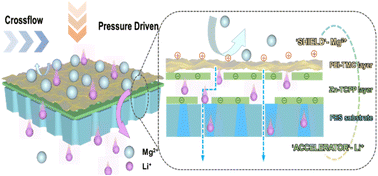
High ion selectivity and robust long-term stability are critical performance metrics for nanofiltration (NF) membranes targeting lithium extraction from high-salinity brines with impurities and high magnesium/lithium ratios. Herein, a positively and negatively charged heterostructure dual-layer NF membrane with a sub-10 nanometer PA layer on 2D Zn-TCPP nanosheets was constructed through an interfacial polymerization method coupled with vacuum assisted filtration. The PA layer with positive charge on the top acted as the ‘shield’ to effectively retain Mg2+, while negatively charged Zn-TCPP coupled with uniform pores acted as the ‘accelerator’ to facilitate Li+ permeation. The addition of Zn-TCPP can increase the membrane free volume fraction and construct effective screening channels. An appropriate amount of Zn-TCPP nanosheets can construct PA layers as thin as 5 nm and lead to the best Li+/Mg2+ separation performance (water permeance of 6.79 L m−2 h−1 bar−1 over 360 hours of continuous operation when the Mg2+/Li+ ratio is 50
:
1 and the Li+/Mg2+ separation factor is 80.79). In the ternary metal ion solution tests (Li+, Mg2+, and X+, where X = Na+ or K+ with doubled concentration), the Li+/Mg2+ separation factor remains still above 40. DFT simulations and molecular dynamics reveal that the transmembrane energy barrier for Mg2+ significantly exceeds that for Li+ across the membrane. The adsorption heights of ions on Zn-TCPP in a stable state, different ion perforation energies and ion diffusion rates further explain the reason for the membrane with excellent separation performance.
Therefore, there is an urgent need for lithium enrichment from salt lake brines. In comparison with conventional separation processes such as solvent extraction and ion adsorption,23–27 which have many issues such as high pollution and high costs, membrane separation technology28–33 attracts considerable interest owing to its advantages, including low energy consumption,34 ease of scale-up35 and environmental friendliness.36 Among these, nanofiltration technology has already been successfully applied in many fields.37–41 Conventional nanofiltration membranes face a persistent permeability-selectivity trade-off, exhibiting either insufficient water permeance or inadequate Li+/Mg2+ separation factors.42,43 Therefore, modifying nanofiltration membranes by introducing inorganic fillers to enhance ion sieving and surface charge modifications to strengthen the Donnan effect are effective methods to improve the separation performance.44–48 Therefore, modifying nanofiltration membranes to enhance the surface charge effect and pore size control is currently an important development direction for lithium/magnesium separation.
At present, most of the Li+/Mg2+ separation nanofiltration membranes are designed to enhance the positive charge of the membrane surface. For example, Xu et al.49 utilized polyethyleneimine (PEI) containing abundant –NH3+ and –NH2+ groups and trimesoyl chloride (TMC) to achieve positively charged PEI–TMC composite nanofiltration membranes through an interfacial polymerization reaction to separate Li+ and Mg2+. Li et al.50 using aminomalononitrile (AMN) intercalation to PEI–TMC polyamide layers synergistically enhanced water permeance and Li+ selectivity. Peng et al.42 engineered a bidentate amine-functionalized monomer (DAIB) to fabricate polyamide membranes. Compared to traditional membranes, the DAIB-modified membrane demonstrated a fivefold increase in water permeance. Li et al.51 pioneered a reversed interfacial polymerization (RIP) strategy to create nanofiltration membranes with a homogeneous positive surface charge, which demonstrated outstanding Mg2+/Li+ permselectivity. The results indicate that enhancing the Donnan effect through positive surface charge modification of nanofiltration membranes is beneficial for Li+/Mg2+ separation. However, the excessive Donnan effect can increase the rejection of Li+, thereby making it difficult to improve the Li+/Mg2+ separation factor.
An effective strategy is introducing nanomaterials into nanofiltration membranes to construct functional interlayers with enhanced membrane water permeance and selectivity. The introduction of nanomaterials, such as CNTs, PDA, MXene, g-C3N4, etc., modifies the membrane surface properties to modulate the morphology, surface charge, packing density and thickness of the polyamide layer.46,52–55 Additionally, it can alleviate the “groove effect”44,46,56 and shorten the water molecule transmission path.
With their unique combination of ultrahigh porosity, vast surface area, and customizable chemistry, metal–organic frameworks (MOFs) are extensively used in various fields.57–60 Zn-TCPP,61,62 a kind of two-dimensional MOF material, its vertically aligned intrinsic pores and lamellar channels collectively optimize hydrodynamic pathways, yielding enhanced water permeance and provide a larger effective surface area, allowing more ions to contact the surface. The organic ligands of Zn-TCPP contain a large amount of nitrogen (N) element and –COOH groups, which ensure that the material's surface is negatively charged and hydrophilic. Optimization of the vertical resistance distribution can be achieved by introducing MOF nanosheets into the membrane to construct an interlayer, adjusting the MOF nanosheet loadings and changing the thickness of the interlayer. Nevertheless, constructing a suitable MOF coupled with the PA layer structure to achieve high throughput and selectivity while maintaining long-term stability remains a challenge for high-performance Li+/Mg2+ nanofiltration membranes.
In this work, we proposed a positively/negatively charged heterostructure dual-layer nanofiltration membrane constructed by using Zn-TCPP nanosheets as the MOF layer, combined with PEI (high amine density) crosslinked with TMC during interfacial polymerization to form a PA layer. The IP reaction coupled with the vacuum assisted filtration method was developed to facilely fabricate these heterogeneous charge membranes. The amine-rich, sub-10-nanometer positively charged PEI-TMC layer on the top utilizes the Donnan effect to retain Mg2+, while the negatively charged Zn-TCPP layer coupled with its pore effect facilitate Li+ permeation. The membrane effectively separates Mg2+/Li+ mixed solutions and ensures long-term stable operation for up to 360 hours, and M1.25 has the best separation performance over divalent metal ions (stable water permeance of 6.79 L m−2 h−1 bar−1 when the Mg2+/Li+ ratio is 50
:
1, and the Li+/Mg2+ separation factor exceeds 80). Additionally, we introduced a third monovalent metal ion, Na+ or K+, at the same mass concentration into a LiCl/MgCl2 mixture to analyze the influence of the three monovalent metal ions on the separation performance. The ionic membrane penetration dynamic simulations were used to elucidate the mechanism by which introducing the 2D MOF layer enhances both membrane water permeance and selectivity. The Li+ and Mg2+ transmembrane energy barriers, as well as the adsorption energies at equilibrium through the membrane, were also analyzed to investigate the Li+/Mg2+ separation mechanism.
The membrane cross-sectional morphology is shown in Fig. 1(d). The figures show the thickness of the PA selective layer and Zn-TCPP layer. It can be seen that as the amount of Zn-TCPP increases, the thickness of the Zn-TCPP layer within the membrane gradually increases, while the PA layer thickness gradually decreases. In M1.5 (Fig. 1(d6)), the MOF nanosheets have already exceeded the limits of the PA layer and are exposed on the membrane surface because of the presence of Zn-TCPP, which inhibits the diffusion of PEI monomers during the interfacial polymerization process, leading to a reduced release rate.56,64,65 The abovementioned results indicate that incorporating a Zn-TCPP layer reduces PA thickness, consequently minimizing the water transport distance, thereby significantly enhancing the water permeance.
XPS spectra of different membranes are presented in Fig. 2(a)–(c), S4, S5 and Table S1. The N 1s spectra showed that as the Zn-TCPP nanosheet loading increased, the content of N–C
O groups in the PA layer initially increased then decreased (from 37.93% to 64.49% and finally 37.96%). This indicates that the crosslinking degree of the PEI-TMC network first increased, then slightly decreased, and finally showed a sudden change due to the extrusion of Zn-TCPP from the PA layer. This can also be confirmed by the changes in the C–N peak (initial decrease and then increase). It can be understood that with the introduction of the Zn-TCPP layer, Zn-TCPP nanosheets enhanced the PEI monomer adsorption, promoting the IP process and increasing the reaction rate, which is beneficial for the crosslinking of the PA network.
The FTIR spectra are shown in Fig. 2(d); the spectra of all the prepared membranes exhibit a C
O stretching vibration peak at 1623 cm−1, indicating the successful IP reaction of PEI and TMC. A broad peak in the range of 3200–3550 cm−1 confirms the presence of –NH2 groups from PEI. However, with the addition of Zn-TCPP, the intensity of this peak significantly decreases. This reduction can be ascribed to electrostatic interaction between PEI and Zn-TCPP, involving the attraction of –NH2 groups in the PEI monomer to –COOH groups in the Zn-TCPP nanosheets, thereby partially occupying the –NH2 sites and reducing the peak intensity. The zeta potential data are shown in Fig. 2(e). Since Zn-TCPP is negatively charged, the electrostatic interaction with PEI reduces the positive charge. With the introduction of the Zn-TCPP layer, the zeta potential decreases as the amount of added Zn-TCPP solution increases, but it remains positive at pH <7. The water contact angle gradually decreases from 53.6° for M0.25 to 41.1° for M1.5, as shown in Fig. 2(f). The hydrophilicity of Zn-TCPP nanosheets explains this result, with their loading providing a clear enhancement in membrane hydrophilicity. In addition, as shown in Fig. 2(g), the MWCO values of the NF membranes with different addition amounts are 487 Da, 427 Da, 372 Da, 350 Da, 347 Da and 323 Da. The calculation results indicate that increasing the Zn-TCPP loading progressively reduces the membrane's average pore size, as evidenced by Fig. 2(h). This is because the porous windows of the Zn-TCPP nanosheets and the interlayer channels formed by their layer-by-layer stacking can provide additional sieving effects for organic solutes.66 Therefore, membranes with relatively high loading amounts have relatively smaller pore sizes and MWCO values.
Next, mixed salt separation performance was tested using 3 g per L LiCl/MgCl2 solution with a Mg2+/Li+ ratio of 50. As shown in Fig. 3(a), with increasing Zn-TCPP nanosheet incorporation, Mg2+ rejection increased from 94.9% for M0.25 to 97.3% for M1.25 and then decreased to 93% as the Zn-TCPP content increased, confirming enhanced divalent ion selectivity. In addition, the rejection of Li+ decreased from −30% for M0.25 to −84% for M1.5.67 As shown in Fig. 3(b)–(f) and S6, the separation factor of M0.25 was relatively small, stabilizing around 48.5 after 360 hours of operation. With increasing Zn-TCPP nanosheet addition amounts, the separation factor gradually increased from 48.54 to 80.79 for M1.25, but sharply decreased to 25.76 for M1.5. The introduction of Zn-TCPP nanosheets weakened the positive charge, and the negatively charged layer could attract Li+ to quickly pass through. The positive charge on the PA layer effectively slowed the passage of divalent Mg2+ due to the Donnan effect. As the Zn-TCPP nanosheet addition amount increased, the thickness of the PA layer gradually decreased, resulting in a gradual decrease in the Li+ rejection rate, while the rejection rate of Mg2+ remained almost unchanged, thereby increasing the separation factor. The sharp decrease in the separation factor for M1.5 was due to the excessive incorporation of Zn-TCPP, causing some nanosheets to exceed the limits of the PA top layer, and the exposure of negatively charged functional groups lowers the zeta potential. At this point, the separation process gradually transitioned from being dominated by the PA layer to being dominated by the Zn-TCPP layer, thus reducing the separation performance while increasing the water permeance.
Besides the excellent selectivity, the stabilized NF membranes' water permeance showed almost no decline after 360 hours of operation compared to the initial state. The water permeance increased from 7.00 L m−2 h−1 bar−1 for M0.25 to 10.61 L m−2 h−1 bar−1 for M1.5. The increased water permeance results from a larger effective filtration area, greater surface roughness, and a thinner PA layer, which collectively lower the resistance to water flow. Considering all factors, M1.25 has the best water permeance and Li+/Mg2+ separation factor, with a stabilized water permeance of 6.79 L m−2 h−1 bar−1 after 360 hours of operation and a Li+/Mg2+ separation factor exceeding 80.79. This dual layer membrane structure possesses the required stability in Li+/Mg2+ mixed solution systems and exhibits the promising application prospects.
Additionally, the Li+/Mg2+ separation factor of each NF membrane gradually increased after 70 hours of operation, eventually stabilizing and maintaining this state up to 360 hours. This phenomenon might result from the formation of an Mg2+-enriched layer to further enhance the positive charge on the top of the PA layer, thus ensuring a high rejection rate for Mg2+.68 Based on the above testing conditions, we added equal mass concentrations of KCl and NaCl and ensured an Mg2+/Li+ ratio of 50 at the same time to test the impact of the third ion on membrane separation performance. At a solution concentration of 6 g L−1, as shown in Fig. 4(a) and (b), in the presence of Na+, the water permeance stabilized at 2.33 L m−2 h−1 bar−1 with a separation factor of 40.44. With K+, the water permeance also reached 3.18 L m−2 h−1 bar−1, and the separation factor was 47.38. The data indicate that the introduction of the third ion hinders the membrane's permeance. However, since the two newly added salt solutions have the same mass concentration, the Na+ content is slightly higher than that of K+, which also has a certain impact on the membrane permeance.
As shown in Fig. 4(c), although the presence of the third ion weakens the membrane's separation performance for Li+/Mg2+, a separation factor above 40 is still maintained, with Mg2+ ion rejection above 96% and a high negative rejection for Li ions, confirming that Zn-TCPP can specifically recognize Li+ and ensure excellent Li+/Mg2+ separation performance. The solution permeance and Li/Mg2+ separation factor of the dual-layer membrane in this work were compared with other reported outstanding performances in Li+/Mg2+ separation. As shown in Fig. 4(d) and Table S3, compared with the performance of existing nanofiltration membranes, M1.25 demonstrated the best separation performance, maintaining a stable water permeance of 6.79 L m−2 h−1 bar−1 after long-term use and achieving a Li+/Mg2+ separation factor exceeding 80.79.
From the separation performance, it can be observed that as the Zn-TCPP loading increases, both the water permeance and separation factor gradually increase, while the average pore size and the PA layer thickness gradually decrease. This suggests that there may be some correlation between the permeance and the average pore size as well as PA layer thickness. To explore the relationship among these three factors, the membrane permeance F was taken as the abscissa, and the average membrane pore size (R)a/PA layer thickness (L)b (a, b = 1, 2, 3, 4) as the ordinate for linear fitting. As shown in Fig. S7 and S8, the water permeance has the best correlation result with R/L. Similarly, since the separation factor increases with the decrease in membrane pore size and PA layer thickness, and minor changes in the PA layer significantly influences the separation factor, the reciprocal of the separation factor was chosen as the abscissa for linear fitting as well. Therefore, we take the reciprocal of the separation factor as the abscissa and performed linear fitting, and it can be seen that the selectivity has the best correlation result with R/L4.
We utilized simulation software to analyze and predict the membrane separation performance in a Li+/Mg2+ mixed solution system. The results are presented in Table S4. According to the simulation data, at a Mg2+/Li+ ratio of 50, the membrane's rejection rate for Mg2+ can reach 98.6%, the water permeance can achieve 3.25 × 10⁴ L m−2 h−1 bar−1, and SLi/Mg is 1.38. The membrane was modeled as a single layer in the simulation, whereas in reality the whole membrane thickness is much greater than that set in the simulation, and the actual water permeance may decrease exponentially with the increase in membrane thickness. Similarly, in practical situations, as the PA layer thickness increases and the internal channels of the membrane deviate significantly from the state set in the simulation, the separation factor may also increase exponentially.
Ion diffusion behavior and free volume changes within the membrane were analyzed through molecular dynamics and DFT simulations. As shown in Fig. 5(a), briefly, the membrane was modeled as a box with dimensions of 8 nm × 8 nm × 20 nm, and PEI/TMC/Zn-TCPP was filled into the box. As illustrated in Fig. 5(b) and S9, the fractional free volume of M1.25 (21.7%) is larger than that of M0 (11.1%), demonstrating that the incorporation of Zn-TCPP can significantly increase the membrane free volume.
The different ions traversing the membrane energy barrier data are shown in Fig. 5(c), (d) and Table S5. When ions pass through the polymer and Zn-TCPP layers, the energy consumption for the four types of ions follows the order: EMg > ELi > ENa > EK. This indicates that, given a certain system energy, the smaller the ionic radius and the larger the hydrated radius, more energy is consumed during ion permeation. Meanwhile, Fig. 5(e) shows that the K+ diffusion rate is greater than that of Na+. This result suggests that after the addition of the third component, due to the diffusion rate DK > DNa, the separation performance of the component containing K+ is better than that containing Na+.
The ion permeation pathway and stable adsorption height schematic diagram are shown in Fig. 5(f) and (g). Through simulating the results of steady-state adsorption sites, it is evident that when a third ion, either Na+ (2.283 Å) or K+ (1.125 Å), is introduced, the stable adsorption height of the ions is consistently lower than that of Li+ (2.955 Å) in a stable state. This is because the hydrated ionic radii follow the order Li+ < Na+ < K+, whereas the actual ionic radii exhibit the opposite trend. Since the charge remains the same, we can conclude from radial distribution functions that Li ions bind more strongly to water molecules, while K ions bind relatively weakly, as shown in Fig. S10. Due to the presence of abundant hydrophilic –COOH groups in Zn-TCPP, K ions are more easily dehydrated and dragged toward the pore center.69 In contrast, Li+ ions, with their stronger water-binding affinity, are more difficult to dehydrate and remain farther from the pore center. Consequently, the stable adsorption height of K ions is lower. Based on this, we can infer that when the quantity of the third ion is relatively high, after reaching adsorption stability, the adsorption sites occupied by the ions will partially take up the original pores. This occupancy in the pores may hinder the passage of water molecules and Li ions, leading to a decrease in the separation factor and water permeance.
For water permeance, since the same mass of NaCl and KCl is added, the number of K+ ions in the mixed solution is less than that of Na+ ions. The hindrance of K+ ions to water molecules is weaker than that of Na+ ions. Besides, the K+ diffusion rate is greater than that of Na+ according to the MSD curve. Therefore, in the mixed solution system containing KCl, the water permeance is slightly higher than the one containing NaCl. At the same time, according to the energy barrier (Eb), the Eb for Na+ (0.57 eV) to pass through the membrane is slightly higher than that for K+ (0.54 eV). If the energy in the two separation systems is the same and fixed, the energy consumed when Na+ passes through is higher than when K+ passes through, while the energy consumed by Li+ passing through is relatively reduced. Therefore, the SLi/Mg when Na+ is present is slightly lower than that when K+ is present.
As illustrated in Fig. 6 the positively charged nanofiltration membrane repels Mg2+ with much higher selectivity than Li+ (shield effect for Mg2+). After introducing the Zn-TCPP layer, the positive charge of the membrane was weakened, but this structure facilitates rapid Li+ transport through the PA layer by electrostatic attraction, resulting in negative rejection of Li+ by each nanofiltration membrane (accelerator effect for Li+). The synergistic action of these effects progressively improves the Li+/Mg2+ separation efficiency. This membrane presents strong potential for sustained Mg2+/Li+ separation in challenging high Mg2+/Li+ ratio salt-lake brines, enabling long-term continuous operation.
000), pyrazine (99%), tetrakis(4-carboxyphenyl)porphyrin (TCPP, 97%), N-dimethylformamide (DMF), ethanol (analytical grade), n-heptane (for GC, >99%), polyethyleneimine (PEI, Mw: 10
000), 1,3,5-benzenetricarbonyl chloride (TMC), inorganic salts (NaCl, LiCl, KCl, MgCl2, MgSO4, and Na2SO4) and different molecular weight (200, 300, 400, 600, and 800 Da) polyethylene glycol (PEG) were purchased from Aladdin Reagent Co. Ltd. (Shanghai, China). All solvents and chemicals were employed as received unless otherwise specified, and DI water was utilized for all experimental procedures.
The IP process was carried out after vacuum-assisted filtration by using an in situ polymerization method. First, the Zn-TCPP/PES was immersed in 20 g aqueous solution (PEI/deionized water, 0.5 wt%). Then, the PEI solution was poured out after 5 minutes and the water drops were wiped with a filter paper. Next, the PEI-Zn-TCPP/PES membrane was immersed in 20 g organic phase solution (TMC/heptane solution, 0.2 wt%) for a 1 minute reaction, and then the solution was removed and oven-heated at 60 °C for 20 minutes before storing in deionized water. The resultant membranes were named M0.25, M0.5, M0.75, M1, M1.25 and M1.5, respectively.
Based on a probability density function model, the molecular weight cut-off (MWCO) and pore size distribution of the membranes were calculated. Using PEG aqueous solutions (0.1 g L−1) with various molecular weights (200, 300, 400, 600 and 800 Da) to through the membrane under the pressure of 0.3 MPa and collect the permeate solution. The total organic carbon (TOC) concentration was quantified using a TOC analyzer (Multi N/C 2100S, Germany). The MWCO value of the membrane was defined as the molecular weight of PEG with a rejection of 90%. The Stokes diameter associated with the membrane's molecular weight cut-off (MWCO) can be calculated from the rejection data using formula (1):
| ds = 33.46 × 10⁻³ × M0.557 | (1) |
The pore size and its distribution were determined using formula (2):
![]() | (2) |
The separation performance of the fabricated membranes for LiCl/MgCl2 and LiCl/MgCl2/XCl mixtures was measured by using a cross-flow filtration machine to alleviate concentration polarization. All membranes were tested in a cell with 7.1 cm2 effective area. The feed solution consisted of a concentration of 3 g L−1 and a Mg2+/Li+ mass ratio of 50
:
1. A 0.5 MPa pre-compaction step was applied to all membranes using DI water at 25 °C for 30 min with a performance testing pressure of 0.4 MPa.
The water permeance (F) and Li+/Mg2+ separation factor (SLi/Mg) were calculated based on the following formula:
![]() | (3) |
![]() | (4) |
![]() | (5) |
Supplementary information is available. See DOI: https://doi.org/10.1039/d5ta05031f.
| This journal is © The Royal Society of Chemistry 2025 |