


Voltage-dependent charge compensation mechanism and cathode electrolyte interface stability of the lithium-ion battery cathode materials LiNi0.6Mn0.2Co0.2O2, LiNi0.8Mn0.1Co0.1O2 and LiNi0.80Co0.15Al0.05O2 studied by photoelectron spectroscopy
 a
Marziyeh
Mokhtarpour,
a
Gennady
Cherkashinin,
ab
Wolfram
Jaegermann
*a
and
Jan P.
Hofmann
*a
a
Marziyeh
Mokhtarpour,
a
Gennady
Cherkashinin,
ab
Wolfram
Jaegermann
*a
and
Jan P.
Hofmann
*a
Abstract
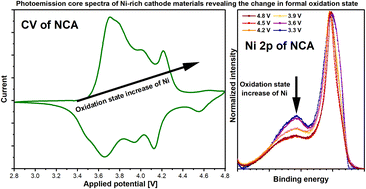
The wide utilization of Ni-rich oxides as cathode materials in lithium-ion batteries (LIBs) for high-energy applications remains a challenge due to their unstable behaviour at high state-of-charge (SOC) increasing the risk of thermal runaway. To understand this instability, in-depth knowledge of the involved redox processes is needed, which depend on the electronic structure of these materials and their interaction with the electrolyte. X-ray photoemission spectroscopy (XPS) is a promising method to provide information on the electronic structure while inherently limited to a low information depth. The latter is especially problematic for LIB materials, due to the formation of interphase layers on both the anode and the cathode. In our previous studies, we developed an in vacuo scratching method, which allowed the removal of a large fraction of the cathode electrolyte interphase (CEI) and applied the method to the cathode materials LiCoO2 (LCO) and LiNi0.3Mn0.3Co0.3O2 (NMC333) to investigate the charge state dependent transition metal core spectra, exhibiting high spectral quality. In this study, the in vacuo scratching method was applied to the Ni-rich layered oxide compounds LiNi0.6Mn0.2Co0.2O2 (NMC622), LiNi0.8Mn0.1Co0.1O2 (NMC811) and LiNi0.80Co0.15Al0.05O2 (NCA). All three materials showed an equally high oxidation state of Ni in their pristine state. The Ni2+/3+ and Ni3+/4+ redox couples were identified by the analysis of the Ni 2p core spectra as a function of voltage. A shift to lower binding energies of the Co 2p and O 1s photoelectron spectra was observed due to the downward shift of the Fermi level. Charging the materials to high voltages up to 4.8 V vs. Li+/Li resulted in fully deintercalated compounds, as shown by the Li 1s photoelectron spectra, while no further change in the Ni 2p photoelectron spectra suggests deviations from the cationic redox process. The cathode-electrolyte interphase (CEI) composition was also analyzed for non-scratched samples at several voltage steps in the typical operational range of 3.0 to 4.2 V vs. Li+/Li. The results indicate a difference in the quantities of semi-carbonates and lithium alkoxides. At high voltages of 4.5/4.8 V vs. Li+/Li, considerable changes were observed in the CEI due to the onset of decomposition reactions of the CEI components.
 Please wait while we load your content...


