


 PLATFORM UPDATE:


A magnet-assisted chaotic pendulum low-frequency piezoelectric energy harvester
 a
and
Lipeng
He
*a
a
and
Lipeng
He
*a
Abstract
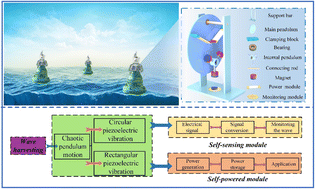
In this paper, we propose a magnet-assisted chaotic pendulum low-frequency piezoelectric energy harvester (MCP-PEH) for wave energy, designed to supply power to ocean wireless sensing equipment. The chaotic pendulum consists of a double pendulum. The main pendulum converts external excitation into internal mechanical swing, while the internal pendulum uses a rotating multistage mass to achieve frequency conversion. This design enables a better output response in the low-frequency ocean environment. The magnet-assisted mechanism allows the harvester to achieve an effective output at 0.4 Hz, reducing the starting frequency and achieving low-frequency broadband performance. Additionally, the electrical signal generated by the bottom piezoelectric sheet can be used to monitor the wave frequency. Theoretical analysis and prototype experiments are conducted to identify the main variables affecting the device, thereby proving its feasibility. Under the optimal load, the magnet-assisted mechanism increases the overall output power by 46.7%, enabling the device to generate 6.57 mW of power. Water tank experiments and energy supply analysis of the sensor further demonstrate the device's practicality and feasibility for powering ocean wireless sensing equipment.
- This article is part of the themed collection: Sustainable Energy & Fuels 2025 HOT Articles
 Please wait while we load your content...


