


 PLATFORM UPDATE:


A sustainable and economical approach for effective adsorption of antibiotics and heavy metal ions using Neolamarckia cadamba-mediated MgO–rGO nanocomposites
 †ab
Rohit S.
Madankar,
†a
Shubham S.
Tripathy,
a
Anirudhha
Mondal,
*c
Aniket S.
Kahate,
a
Pavan R.
Bhilkar,
a
Małgorzata
Norek,
d
Martín F.
Desimone
*ef
and
Ratiram G.
Chaudhary
*a
†ab
Rohit S.
Madankar,
†a
Shubham S.
Tripathy,
a
Anirudhha
Mondal,
*c
Aniket S.
Kahate,
a
Pavan R.
Bhilkar,
a
Małgorzata
Norek,
d
Martín F.
Desimone
*ef
and
Ratiram G.
Chaudhary
*a
Abstract
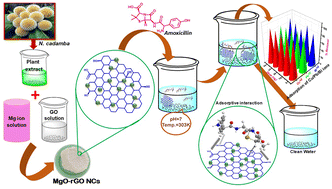
This study investigates the adsorption behavior of antibiotics and heavy metals ions on graphene-based nanocomposites (NCs) and their transport in aqueous systems. MgO–rGO NCs were synthesized using a green route involving Neolamarckia cadamba fruit extract, which served as a reducing agent for both magnesium salts and graphene oxide. The resulting NCs were characterized by XRD, FTIR, Raman, EDS, BET, SEM, and TEM analyses. Adsorption performance was evaluated under variable parameters, including pH, contact period, temperature, dosage, and initial antibiotic and heavy metals ions concentration. The MgO–rGO NCs exhibited high removal efficiencies for amoxicillin (95.51%), cephalexin (90.19%), and penicillin (97.89%), even at a low adsorbent dosage (0.020 g L−1). Similarly, efficient adsorption was observed for Cu2+ (96.51%), Pb2+ (96.86%), and Bi3+ (98.22%). Adsorption kinetics followed the pseudo-second order model, while equilibrium data conformed to both Langmuir and Freundlich isotherms. The NCs exhibited excellent reusability and a high surface area, highlighting their potential as sustainable materials for the removal of antibiotic contaminants from wastewater.
 Please wait while we load your content...


