


 PLATFORM UPDATE:


Thiol-induced in situ synthesis of bifunctional Au-SH/SO3H-COP enables efficient and recyclable alkyne hydration
 *a
*a
Abstract
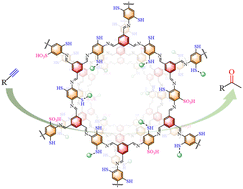
A novel and efficient immobilized Au nanoparticle catalyst, Au-SH/SO3H-COP, has been synthesized via the in situ reduction of Au3+ ions by thiol groups within a thiol-functionalized covalent organic polymer (SH-COP). This approach leverages the thiol groups as intrinsic reductants, eliminating the need for external agents. Simultaneously, during Au nanoparticle formation, anchored sulfonic acid (–SO3H) sites are generated, which function as Brønsted acid co-catalysts to synergistically enhance catalytic performance. Characterization results confirmed the formation of uniformly dispersed Au nanoparticles with a narrow size distribution centered at 2–3 nm. The covalent anchoring of nanoparticles to the SH-COP support through unreacted thiol groups effectively prevents aggregation and leaching. For the model hydration of phenylacetylene, Au-SH/SO3H-COP exhibited excellent catalytic activity, achieving 92% yield without additional acid additives. Moreover, it displayed broad substrate compatibility across diverse alkynes (aryl and aliphatic), affording 84–94% yields. The catalyst also showed high recyclability, retaining 89% yield after six cycles with negligible Au leaching, underscoring its robustness and reusability.
 Please wait while we load your content...


