


 PLATFORM UPDATE:


Bimetallic Cr–Ni–PNP catalysts for enhanced high-selectivity ethylene oligomerization: design, optimization, and DFT insights
 *a
*a
Abstract
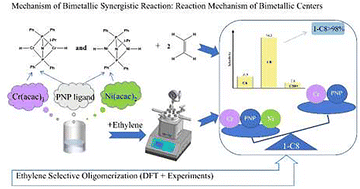
A series of metal-coordinated chromium–bis(diphenylphosphino)amine (Cr–PNP) catalysts were synthesized for highly selective ethylene oligomerization. Catalyst precursors were prepared by incorporating different metal additives (Fe(III), Fe(II), Co(II), and Ni(II)) alongside Cr(III) into PNP ligands, followed by activation with methylalumoxane (MAO) prior to catalytic testing. Structural characterization of the PNP ligand, Cr–PNP, and Ni–Cr–PNP complexes was conducted using NMR, FT-IR, UV-Vis, and ESI-MS spectroscopy to confirm coordination geometries. Comparative evaluation of ethylene oligomerization performance—including catalytic activity and 1-hexene/1-octene (1-C6/1-C8) selectivity—revealed that nickel doping significantly enhanced both total activity and C8 selectivity. Response surface methodology identified optimal process conditions, and reaction kinetics were modeled using the Ni–Cr–PNP catalyst. Density functional theory (DFT) simulations proposed a reaction pathway and exhibited alignment between the kinetic model's apparent activation energy (Ea) and DFT-calculated free energy barriers. This study establishes a bimetallic cooperative catalytic system, providing a foundation for developing advanced oligomerization catalysts.
 Please wait while we load your content...


