


 PLATFORM UPDATE:


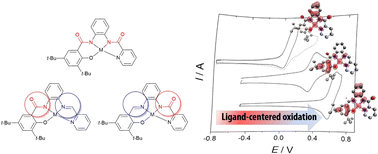
Defining the oxidation site in Cu(ii) and Ni(ii) complexes of ligands combining amido, phenolato and pyridine donors.

Abstract
Three ligands H3L1, H2L2 and H2L3 and their Cu(II) and Ni(II) complexes were prepared. All feature one pyridine and one phenolato donor, one phenylenediamide bridge and differ by the connecting function: Bis(amidate) (1M−), amidophenolate/iminopyridine (2M), salicylidene/amidopyridine (3M), where M = Cu, Ni. The metal ion is essentially square planar, while the coordination bond distances are marginally affected by the linker. In contrast, the redox potential of the oxidative processes (1st reversible wave) are spanning over a 0.62 V window and follow the order: 1M− < 2M < 3M. The oxidation process is mostly ligand-centered, affording X-band EPR-silent Cu(II)-radical, bis(Ni(II)-radicals), or (S = ½) systems (Ni(II)-phenoxyl or diiminosemiquinone). For the monomers 2Ni+ and 3Ni+ the giso of 2.009 and 2.012 deviates from the value of free radicals, due to significant Mulliken spin polulation on the Ni atom (0.12, 0.39). 3Ni+ has a very high propensity to bind exogeneous ligands to form penta or hexa-coordinated Ni(III) species due to the large Mulliken spin population on the metal centre, which can be regarded as a natural predisposition to exist as high valent metal. In contrast to the other nickel complexes, the oxidation of 1Ni− results in EPR-silent species, which might be explained by dimer formation. Finally, the copper complexes exhibits an activity towards benzyl alcohol oxidation: A chemioselectivity is achieved, whereby 1Cu− mostly affords benzoate in contrast to 3Cu, which mostly produced benzaldehyde. Complex 2Cu exhibits an intermediate behaviour.
 Please wait while we load your content...


