Issue 32, 2025

Unexpected bonding ambiguity of the open/closed-shell R2PO ligand family: the case of phosphinoyl vs. phosphoryl if bound to transition metals in their low oxidation state

Abstract

DFT pre-exploration of a broad set of heterocyclic compounds, focusing on 1,3,2-dihetero-phospholanes/phospholidines and open-shell R2P–O iron complexes, reveals a square pyramidal coordination geometry of the resulting iron(+I) centre, in stark contrast to the trigonal bipyramidal structure of the precursor iron(0) complexes. The latter clearly indicates an intramolecular redox process, initiated by a homolytic N–O bond cleavage transforming a phosphanoxyl ligand into a phosphoryl ligand, but not into a stable phosphinoyl ligand. The reaction cascade and the influence of co-ligands on the spin population distribution were studied in detail. Experimentally, the consequence(s) of the homolytic N–O bond cleavage of the first isolated aminoxyl–phosphane iron complex, bearing the 1,3-dimethyl-1,3,2-diazaphospholidine ligand scaffold, was investigated as a case in point using NMR, EPR and Mössbauer spectroscopy. Co-ligand effects were also addressed by DFT analysis.
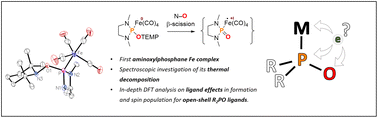
Graphical abstract: Unexpected bonding ambiguity of the open/closed-shell R2PO ligand family: the case of phosphinoyl vs. phosphoryl if bound to transition metals in their low oxidation state

Supplementary files

Article information

Article type
Paper
Submitted
20 Jun 2025
Accepted
14 Jul 2025
First published
18 Jul 2025

Dalton Trans., 2025,54, 12349-12357

Unexpected bonding ambiguity of the open/closed-shell R2PO ligand family: the case of phosphinoyl vs. phosphoryl if bound to transition metals in their low oxidation state

P. C. Brehm, G. Schnakenburg, A. Frontera, E. Bill, O. Schiemann and R. Streubel, Dalton Trans., 2025, 54, 12349 DOI: 10.1039/D5DT01459J

To request permission to reproduce material from this article, please go to the Copyright Clearance Center request page.

If you are an author contributing to an RSC publication, you do not need to request permission provided correct acknowledgement is given.

If you are the author of this article, you do not need to request permission to reproduce figures and diagrams provided correct acknowledgement is given. If you want to reproduce the whole article in a third-party publication (excluding your thesis/dissertation for which permission is not required) please go to the Copyright Clearance Center request page.

Read more about how to correctly acknowledge RSC content.

Social activity

Spotlight

Advertisements