


 PLATFORM UPDATE:


Np(v) double carbonate with magnesium: synthesis, solubility and transformation
 *a
Tatiana V.
Plakhova,
a
Roman D.
Svetogorov,
ab
Elizaveta S.
Kulikova,
b
Alexander L.
Trigub,
ab
Boris V.
Kramar,
a
Vasily O.
Yapaskurt,
a
Andrey S.
Toropov,
a
Maria D.
Shaulskaya,
a
Dmitry M.
Tsymbarenko,
a
Anna Yu.
Romanchuk
a
and
Stepan N.
Kalmykov
a
*a
Tatiana V.
Plakhova,
a
Roman D.
Svetogorov,
ab
Elizaveta S.
Kulikova,
b
Alexander L.
Trigub,
ab
Boris V.
Kramar,
a
Vasily O.
Yapaskurt,
a
Andrey S.
Toropov,
a
Maria D.
Shaulskaya,
a
Dmitry M.
Tsymbarenko,
a
Anna Yu.
Romanchuk
a
and
Stepan N.
Kalmykov
a
Abstract
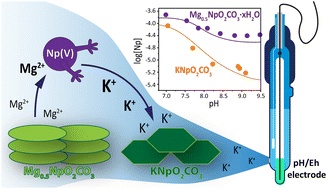
In this study, neptunium(V) double carbonate with magnesium was synthesized by the cation exchange synthesis method. Synchrotron powder X-ray diffraction, X-ray absorption spectroscopy, scanning electron microscopy, and energy-dispersive X-ray spectroscopy were employed for comprehensive solid-phase analysis. Solubility experiments were carried out in 0.01 M and 0.05 M NaClO4 solutions in the pH range 6–10 for the evaluation of the thermodynamic stability of solid magnesium–neptunium(V) double carbonate. Based on these data, the solubility product constant was estimated from the experimental data and established to be log Ksp = −15.9. During the solubility experiments, the initial Np(V)–Mg double carbonate underwent a phase transformation. This transformation led to the formation of a Np(V)–K double carbonate, caused by increasing potassium concentrations in solution primarily from the KCl-filled pH electrode. The solubility constant for the Np(V) double carbonate with potassium was determined to be log Ksp = −16.53 ± 0.10, which is significantly lower than that reported in the literature, confirming the high thermodynamic stability of the KNpO2CO3 solid phase.
 Please wait while we load your content...


