


 PLATFORM UPDATE:


Through-space charge transfer enabled design of nonlinear optical chromophores with balanced absorption and efficiency

Abstract
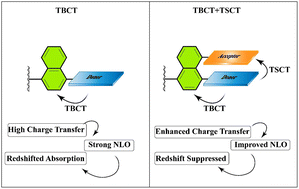
The design of high-performance nonlinear optical (NLO) materials often faces a fundamental trade-off between enhancing the charge transfer and controlling the red shift of the optical absorption. In this study, we employed density functional theory (DFT) and time-dependent DFT (TD-DFT) to investigate a molecular design strategy that introduces a through-space charge transfer (TSCT) pathway in addition to conventional through-bond charge transfer (TBCT). Using a π-conjugated donor–π–acceptor (D–π–A) framework, we demonstrate that the incorporation of TSCT not only intensifies the intramolecular charge transfer (ICT), which is crucial for boosting the NLO response, but also suppresses further red-shifting of the absorption edge, which is typically accompanied by extended conjugation in high-performance NLO chromophores. Our findings reveal that the cofacial arrangement of the donor and acceptor units via a π-bridge plays a crucial role in modulating the excitation characteristics without compromising the NLO efficiency. This approach offers a promising computational design strategy for next-generation NLO materials, where the simultaneous optimisation of spectral transparency and NLO efficiency is required.
 Please wait while we load your content...


