


 PLATFORM UPDATE:

Research on the impact of blood absorption on the photothermal effect of nanoparticles with protein corona

Abstract
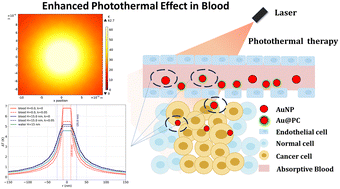
Gold nanoparticles (AuNPs) are promising agents for photothermal therapy (PTT), yet their in vivo performance is strongly modulated by protein corona (PC) formation and blood absorption. The quantitative mechanisms dictating this dual modulation remain insufficiently understood, limiting the rational design of clinically relevant nanomaterials. This study integrates Mie scattering theory and finite element thermal modeling to assess how PC formation and blood absorption jointly regulate the optical cross-section, photothermal conversion efficiency (η), and temperature distribution of bare AuNPs and Au@PC core–shell structures in blood. We find that absorption consistently dominates over scattering, but the influence of PC on η is highly size-dependent. For small particles (r = 10 nm), PC formation suppresses η by ∼90%, with negligible contribution from blood absorption (Δη ≤ 0.2). In contrast, larger particles (r = 35 nm) experience a weaker PC-induced loss (53.6–59.4% for a 15 nm PC layer) yet exhibit a striking amplification of blood absorption effects (Δη = 1.9), 9.5 times higher than in smaller particles. Temperature rise (ΔT) is also size- and environment-dependent. Small AuNPs consistently yield higher ΔT in blood than in water, whereas large AuNPs exceed water only at low absorption (k < 0.03), losing this advantage at higher k. The PC's low thermal conductivity slows heat dissipation, producing gentler temperature gradients in the surrounding medium. These findings reveal a size-dependent interplay between PC formation and blood absorption, offering quantitative design rules for optimizing AuNP-mediated PTT and guiding the development of clinically effective, precision nanomaterials.
 Please wait while we load your content...


