Statistical vs. direct dissociation of molecular dications
Received
13th June 2025
, Accepted 13th September 2025
First published on 31st October 2025
Abstract
Using a combination of theory and experiment, we study the dissociation of molecular dications. We compare trajectory surface hopping (TSH) and statistical (RRKM) calculations of the dissociation with covariance velocity map imaging of fragments from the dication after strong field double ionization. The measurements and calculations highlight the contrast between direct and statistical dissociation dynamics. By comparing the calculations with covariance velocity map imaging measurements, we are able to confirm key aspects of the calculations and validate the insights they provide. Detailed results for 1,4-cyclohexadiene dications are compared with measurements for ethylene and deuterated formaldehyde dications, highlighting differences in how energy is vibrationally redistributed before dissociation. In addition, we discuss measurements for the molecular dications 1,3-cyclohexadiene, 1,1,1-trifluoroacetone, and 1,4-cyclooctadiene.
1. Introduction
The dissociation dynamics of radical cations is of both fundamental and technical interest; it is important for understanding the chemistry of interstellar gas clouds, mass spectroscopy, and the development of time-resolved ionization spectroscopies, such as Coulomb explosion imaging.1–7 The dissociation of radical cations can occur in a statistical (ergodic) manner, with the redistribution of the vibrational energy to all degrees of freedom (intramolecular vibrational redistribution, IVR) before dissociation through a barrier, or directly, leading to a non-statistical behavior.8,9 Ultrafast measurements have allowed for the observation of this second type of dissociation (direct), and much work has been done to examine whether specific radicals decay statistically or non-statistically.10–12
The dissociation of photoionized molecules often occurs after internal conversion to the ground state of the cation/dication.13 If the ground state is not directly dissociative, and barriers exist towards the dissociation limit, the process slows down, allowing for redistribution of the vibrational energy to all degrees of freedom. These processes can be modeled with statistical treatments such as the Rice–Ramsperger–Kassel–Marcus (RRKM) theory,14–16 which can be viewed as a microcanonical version of transition state theory applied to unimolecular reactions. However, photodissociation does not have to occur statistically. If a direct dissociative state is accessed by the excitation (i.e. no barrier to dissociation), or if a conical intersection can lead to a directly dissociative state, dissociation can occur on ultrafast timescales (<1 ps), with the motion directed towards specific degrees of freedom (i.e. along dissociation coordinates) rather than distributed to all degrees of freedom. Modern techniques allow for following the dynamics and exploring these non-statistical (non-ergodic) cases in detail.8 A third mechanism for dissociation was discovered about 20 years ago, and it involves roaming, where large amplitude motion allows the fragments to reorient around the molecule, get trapped in weak potentials, and lead to novel dissociation pathways.6,17–20
In this study we use a combination of theory and experiment to examine the dissociation of dications created via strong field ionization. The molecules were selected to present a gradient in the complexity of the structure and include the dications: deuterated formaldehyde (CD2O++), ethylene (C2H4++), 1,1,1-trifluoroacetone (CF3COCH3++), the isomers 1,3- and 1,4-cyclohexadiene (C6H8++) and 1,4-cyclooctadiene (C8H12++). Theoretically, we use trajectory surface hopping (TSH) and statistical theories (RRKM) to calculate the dissociation dynamics and rates and compare our calculations with experimental velocity map imaging of fragment ions measured in covariance. Our measurements and calculations indicate that while the cyclic dications we studied (1,3- and 1,4-cyclohexadiene as well as 1,4-cyclooctadiene) dissociate statistically, the non-cyclic dications (triflouroacetone and formaldehyde) dissociate directly, with ethylene exhibiting behavior between these two limits.
2. Methodology
2.1. Theory
The dynamics of the 1,4-cyclohexadiene dication were studied in detail using trajectory surface hopping (TSH).21 Trajectories were initiated on four electronic states: the lowest singlet and triplet states, S0 and T1, which lead to low available energy for the dication; higher energy states S4 and S5 which may lead to dissociation more readily given the available energy. The initial conditions were generated using the Wigner harmonic oscillator distribution of the ground state of neutral 1,4-cyclohexadiene, optimized using B3LYP22–25 and the 6-31G(d) basis set.26–28 The temperature was 298K. We ran 5 trajectories each on S0 and T1, as well as 15 trajectories each on S4 and S5. The trajectories on S0 and T1 were run for 1 ps only, since the six-membered ring remained intact during the whole dynamics. The trajectories on S4 and S5, were run for 4 ps. We chose to run dynamics starting from the higher-energy states, because if there is fast dissociation, it is more likely that it will occur from these states. Since fast dissociation did not occur from S4 and S5 (as we will see in the results), it is highly unlikely that it will occur when starting from the lower-energy states.
The fewest switches surface hopping (FSSH) algorithm was used29 employing an in-house interface between the GPU based electronic structure package Terachem30–32 and the trajectory surface hopping package Newton-X version 2.2.33,34 The floating occupation molecular orbital-complete active space configuration interaction (FOMO-CASCI)35,36 theory integrated in Terachem was used to calculate on-the-fly non-adiabatic couplings, electronic energies, and gradients along which the nuclei evolve. 16 electrons in 11 orbitals, (16, 11), were used as an active space. For the nuclei to evolve, the Velocity–Verlet algorithm was used with the time-step of 0.5 fs. A trajectory failed if the total energy at any time-step deviated by more than 0.5 eV from the energy at the previous time-step or time zero. The momentum after a hop was adjusted along the derivative coupling vector to ensure total energy conservation. In frustrated hops (a hop that is rejected because there is not enough kinetic energy to hop to a higher electronic state) the momentum direction remained unchanged. To account for decoherence effects, the method developed by Persico and Granucci37 was applied, incorporating a correction factor of 0.1 Hartree.38 In total, 11 trajectories on S4 and S5 were neglected for the analysis because they failed early, i.e. by 150 fs. None of the trajectories failed on S0 or T1.
Although only 29 trajectories were analyzed, they were enough to convey the message that 4 ps was not enough time for most trajectories to dissociate. Nevertheless, one trajectory starting on S5 did dissociate to form C5H5+ and CH3+. This trajectory was used to further analyze the dynamics. A local minimum corresponding to the ring opening up to an alkene chain and the transition state before dissociation to form C5H5+ and CH3+ were captured from the trajectory and optimized at the B3LYP/6-31G(d) level of theory. To get an estimate of the time to form the product from the local minimum over the transition state, the Rice–Ramsperger–Kassel–Marcus (RRKM) theory was used. The density of states was calculated with the help of the Multiwell Densum package39 for both the transition state and the local minimum, and then used to calculate the rate constant. All the B3LYP optimizations were done with Gaussian09.40
Results from TSH for deuterated formaldehyde are taken from a previous publication.41 In summary, a total of 200 initial conditions were generated using the harmonic oscillator Wigner distribution of the S0 minimum of neutral CD2O, with frequencies at the B3LYP/cc-pV5Z level of theory. The dynamics were run using complete active space self consistent field with an average of 6 states and an active space of 8 electrons in 9 orbitals (6SA-CASSCF(8,9)) and the cc-pVDZ basis set.
2.2. Experiment
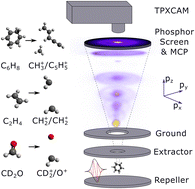
The experimental apparatus has been described in detail in an earlier publication.42 Here we give the salient features of the apparatus. We make use of a commercial Titanium Sapphire laser, which produces 30 fs pulses (FWHM of the intensity) with a central wavelength of 780 nm. The maximum pulse energy is 1 mJ and the repetition rate is 1 KHz. The laser pulses are attenuated with a variable attenuator and focused with a 5 cm focal length mirror into an effusive molecular beam in a velocity map imaging (VMI) apparatus with a background pressure of 5 × 10⁻¹⁰ Torr. Measurements were carried out for several different intensities between 50 and 200 TW cm−2. 3D VMI measurements were facilitated by a TPX3CAM, which records [x, y, t] information for each charged particle incident on the MCP and phosphor screen detector. Coarse variation in time-of-flight can be mapped to mass-to-charge ratio, while finer variation can be mapped to pz. The measured [x, y] corresponds directly to [px, py]. The 1.5 ns time resolution of TPX3CAM allows for sufficient resolution along the time of flight axis for each fragment ion so that the pz information can be extracted without performing an inverse Abel transform. The VMI apparatus is schematically depicted in Fig. 1. Data were analyzed using 3D two-particle covariance between ionic species (A and B) of interest σ(A(
), B(
)), allowing us to determine their angular distribution and total kinetic energy release (KER) from dissociation.43,44
 |
| | Fig. 1 Left: Fragmentation channels of interest for 1,4-cyclohexadiene, ethylene, and deuterated formaldehyde. Right: Schematic diagram of the experimental apparatus. Fragment time of flight encodes both fragment species and z momentum. | |
3. Results
Statistical dissociation typically takes more than 1 ps, with energy flowing between different modes of vibration prior to dissociation, leading to fragment ions with an isotropic momentum distribution as the molecules undergo rotational diffusion prior to dissociation. For the non-cyclic molecules, the dissociation process is rapid and produces fragment ions with pronounced anisotropy, since dissociation takes place before rotational diffusion. The statistical dissociation we observe involves significant rearrangement of the atoms and long-range roaming of hydrogen atoms, whereas the direct dissociation takes place rapidly without major rearrangement of the atoms. Thus, as a starting point and overview, we compare the angle dependent fragment ion yields of 1,4-cyclohexadiene, ethylene and deuterated formaldehyde dications produced via strong field double ionization. These illustrate how dissociation competes with rotational dephasing. As the strong field molecular ionization yield is generally very anisotropic,45,46 we argue that for molecules in which dissociation takes place faster than rotational dephasing, one expects anisotropic angle dependent yields, whereas for molecules in which dissociation takes much longer than rotational dephasing, one expects an isotropic yield for the fragment ions relative to the laser polarization after double ionization. Fig. 2 shows the yields for CH3+/C5HX+ from 1,4-cyclohexadiene, CH2+/CH2+ from ethylene and CD2+/O+ from deuterated formaldehyde as a function of [px, py] (the laser is polarized along the x axis), as well as the yields as a function of angle relative to the laser polarization. It is clear that formaldehyde shows a yield peaked along the laser polarization, 1,4-cyclohexadiene shows a nearly isotropic momentum distribution, while ethylene is in between the two. These measurements suggest that the dissociation of C6H8++ → CH3+/C5HX+ proceeds statistically, while CD2O++ → CD2+/O+ proceeds directly, with ethylene falling somewhere in between these two limits – i.e. dissociating on timescales comparable to rotational dephasing. It is important to note that while an isotropic momentum distribution is strong evidence in favor of statistical dissociation, such considerations have previously produced estimates for dissociation timescales later found to be significantly overestimated.47,48 For this reason, we later corroborate the argument for the type of dissociation with KER measurements.
 |
| | Fig. 2 Yields as a function of angle with respect to the laser polarization axis (shown as a red arrow) for CH3+/C5HX+ from 1,4-cyclohexadiene (top left), CH2+/CH2+ from ethylene (top right), CD2+/O+ from deuterated formaldehyde (bottom left), and 1D plots of the angle dependent yields (integrating over radius) for fragment ion yields of all three molecules (bottom right). The radial coordinate is proportional to the projection of fragment momentum onto the detector plane. | |
In order to verify our interpretation of these angle dependent yields, we consider trajectory surface hopping and RRKM calculations of the dissociation for the molecular dications that show limiting case behavior – 1,4-cyclohexadiene and deuterated formaldehyde. Fig. 3 shows C–C and C–H bond lengths as a function of time for trajectories starting on multiple dicationic states of 1,4-cyclohexadiene and starting on S2 for formaldehyde respectively. Trajectories initiated on other states of the formaldehyde dication (S3–S5 and T1–T4) exhibited similar behavior, and have been analyzed in detail in a previous publication.41 For both molecules, trajectories launched on excited states of the dication showed rapid internal conversion, followed by large amplitude motion on the ground state S0. In formaldehyde, the large amplitude motion leads directly to dissociation – mostly C–H, but some C–O dissociation as well. This is highlighted in Fig. 3, which shows the C–H distances increase rapidly within 20 fs. Calculated KER distributions from these results have been fitted to momentum resolved measurements of the fragment ions in covariance.41 In 1,4-cyclohexadiene, the large amplitude motion leads to ring opening for many trajectories, highlighted with the C–C bond lengths increasing up to 6 Å in Fig. 3, while a single trajectory was shown to dissociate into two fragments, but on much longer timescales. Ring opening occurred after the trajectories reached the ground state. We note that statistical information is limited in the trajectories, since the computational expense of running each trajectory for a long time prevented us from running a sufficient number to draw conclusions about the full ensemble, and motivated the statistical calculations described below.
 |
| | Fig. 3 Top panel: C1–C2 bond lengths for all 1,4-cyclohexadiene trajectories. A total of 40 trajectories are shown, 5 each from S0 and T1, 15 each from S4 and S5. Bottom panel: C–D1 bond lengths for all formaldehyde trajectories starting on S2. Both sets of trajectories start after double ionization of the neutral molecule. | |
The TSH calculations for 1,4-cyclohexadiene highlight the fact that there is large amplitude motion for all of the atoms before dissociation. One salient feature of the dynamics is H migration, where H atoms move rapidly from one C atom to another. This is illustrated in Fig. 4, which shows the energies as a function of time for the trajectory which results in dissociation, along with snapshots of structures along the way (top panel), and the C–H1 distances as a function of time for the dissociative trajectory (bottom panel). The top panel illustrates that there are many oscillations of the potential energy up and down as the molecular wave packet explores the multidimensional ground state potential energy surface following internal conversion. The bottom panel highlights the H migration, showing the motion of H1 from C4 to C1 near 100 fs. H-migration is present in all trajectories and it is not special for this dissociative trajectory. In this trajectory, dissociation occurs after multiple H-migrations. Furthermore, CHELPG partial charges showed that although the positive charge on H increases somewhat compared to the initial FC structure, it is not a proton.
 |
| | Fig. 4 Top: The energies of states along with all the intermediate steps for the trajectory that showed dissociation in 1,4 cyclohexadiene after double ionization. All the energies are with respect to the S0 energy of the dication at the neutral geometry. Bottom: All the C–H bond lengths for the trajectory that showed dissociation, highlighting the role of H migration (at roughly 100 fs, from C4 to C1) in the dissociation dynamics. An animated visualization of the dynamics shown in this figure is available as part of the Supporting Information (SI). | |
Given these dynamics suggested by the trajectories, we look to experimental measurements and RRKM calculations for corroboration of the ideas suggested by the TSH calculations: First, there is ring opening and dissociation, but it takes place on relatively long timescales (>1 ps). Additionally, there is H migration prior to dissociation. As shown in Fig. 2, the measurement of CH3+/C5H5+ from 1,4-cyclohexadiene is consistent with ring opening and dissociation, and the uniform angle dependence of the yield is consistent with this taking place on long timescales. The fact that these fragments are measured in covariance also corroborates the idea that there is H migration prior to dissociation since there is no C atom with three H atoms in the neutral molecule.
In order to test this idea further, we look at a covariance map of the time of flight (TOF) for the fragment ions. This is shown in Fig. 5 for fragment ions from 1,4-cyclohexadiene, with the time of flight converted to mass/charge ratio on one side for easy identification of the fragments. There are clear anti-correlation features which highlight momentum conserving fragment ions produced from two body dissociation of the dication. The slope of the anti-diagonal lines corresponds to the ratio of charges for two body dissociation. The covariance map illustrates the fact that there are many momentum conserving fragment ion pairs produced, in both two-body and three-body dissociation. Two-body dissociation leads to narrow features, while three body dissociation (two charged fragments and one neutral) leads to more distributed features since not all of fragments are measured and only a fraction of the total momentum is captured.
 |
| | Fig. 5 Time of flight – time of flight covariance map for strong field double ionization of 1,4-cyclohexadiene. The bottom and left axes show time of flight, whereas the top and right axes are calibrated for mass to charge ratio. The color axis shows positive covariance, normalized to the maximum value in the relevant range. The inset shows a zoom in on the region around CH3+/C5H5+. Note that the upper anti-diagonal feature corresponds to CH3+/C5H5+, while the lower one corresponds to CH3+/C5H3+/H/H – i.e. three/four body dissociation with neutral hydrogen atoms produced (H or H2). | |
Here we focus on one feature in the graph, which is boxed in Fig. 5 and corresponds to CH3+/C5H5+ and CH3+/C5H3+/H/H. The momentum conservation in covariance points toward these two fragments originating from the same parent molecule in two body dissociation, which confirms that there is indeed H migration prior to dissociation of the 1,4-cyclohexadiene dication (as there are no CH3 fragments in the neutral molecule), supporting the TSH calculations shown above. The absence of CH2+ from both the experimental signal and the TSH calculations can be explained by a large barrier to dissociation, as we confirmed with calculations (see SI). So, dissociation cannot occur unless H migration has occurred first.
The momentum resolved covariance measurements for the 1,4-cyclohexadiene dication support several of the observations from the TSH calculations. However, it was infeasible to run a sufficient number of trajectories to calculate properties of the ensemble, and the trajectories that were run showed statistical behavior. These conditions instead motivate statistical calculations of the dissociation dynamics in order to provide a more comprehensive description including quantitative estimates comparable to measured values, such as KER of fragment ion pairs.
The RRKM calculations for the dissociation of the 1,4-cyclohexadiene dication require as input the initial energy for each state at the Franck–Condon (FC) region, the transition state energy, and the density of states. Although the system undergoes several transformations before dissociating, previous work has identified all the transition states along the way. Zyubina et al.49 calculated pathways for several fragmentations in the dication using B3LYP/6-31G** for optimizations and refining the energies with high level G3 theory. In that paper, several transition states along the way to CH3+/C5H5+ are reported, and it is determined that the last step has the highest barrier and is therefore the rate-determining step.49 In this work, we used this information and optimized a local minimum and the transition state right before C–C dissociation. We used these structures (shown in Fig. 6) in RRKM to obtain a rate for the dissociation as a function of the available energy. The top panel of Fig. 6 shows the energies involved in the RRKM calculations and the expected KERs for fragments produced via direct vs. statistical dissociation. The bottom panel of Fig. 6 shows calculated rates and lifetimes for the different states shown on the left of the top panel. As indicated in the figure, the RRKM calculations predict a KER for two body dissociation of about 2.5 eV (which is equal to the energy difference between the transition state and the dissociation limit), whereas direct dissociation from states S1 through S5 would lead to KER values between 5–7 eV since the energy at FC would not be distributed along other degrees of freedom.
 |
| | Fig. 6 Top panel: Vertical energies of 1,4-C6H8++ at the Franck–Condon (FC) region, and the energy of the local minimum, transition state (TS), and the product (C5H5+/CH3+). The local minimum, TS, and the product (C5H5+/CH3+) geometries were optimized at B3LYP/6-31g(d) level of theory. All these energies are w.r.t to the TS. The vertical energies at the FC region were calculated at FOMO-CASCI(16,11)/cc-pvdz level of theory. Bottom panel: Rate constant (kRRKM, s−1) calculated as a function of available internal energy distributed to the normal coordinates of 1,4-C6H82+ after ring opening. | |
We computed the KER from our VMI measurements of the fragments for the CH3+/C5H5+ from the 1,4-cyclohexadiene dication channel. These results are shown in Fig. 7 below (blue line). As the figure shows, there is a clear and distinct peak at about 3 eV. The peak is slightly higher than the value calculated by RRKM theory, but significantly lower than one would expect for direct dissociation from states S1 to S5 (a vertical dashed line marks the lowest calculated KER for two body dissociation, starting from state S1). This shows that our measurements are consistent with the dissociation proceeding close to the statistical limit.
 |
| | Fig. 7 Fragment ion yields as a function of KER for CH3+/C5HX+ from 1,4-cyclohexadiene (blue) and CD2+/O+ from deuterated formaldehyde (red) after double ionization. The KER for C6H8 is calculated as a histogram from energies obtained for CH3+ assuming 2 body breakup with C5H5+, and the KER for D2CO is calculated for CD2+ and O+ measured in covariance. Vertical lines correspond to the calculated values. | |
Also shown in Fig. 7 are results for deuterated formaldehyde. The dissociation into CD2+/O+ from the dication shows a peak centered at around 6 eV, which is about the mean value of the calculated KER for two body dissociation starting on the lowest lying state of the dication (T1, indicated by the dashed vertical red line), consistent with direct dissociation of CD2O+. The KER for ethylene (not shown) has a peak at 6 eV, with a small low energy shoulder, consistent with a mixture ofstatistical and direct dissociation.
In the limit of the available energy being close to the barrier height, dissociation takes a long time, leading to a symmetric angular distribution and a KER approaching the calculated RRKM value. As the available energy increases, more direct pathways become accessible, leading to an intermediate regime that our measurements and calculations suggest. We find evidence for 1,4-cyclohexadiene being closest to the statistical limit, deuterated formaldehyde being closest to the direct limit, and ethylene being in between the two.
3.1. Comparison of different molecules
Having analyzed the calculations and measurements in detail for 1,4-cyclohexadiene, deuterated formaldehyde and ethylene dications, we now turn to the other molecular dications in order to contrast their behavior. In terms of angular distibutions, 1,4-cyclooctadiene and 1,3-cyclohexadiene showed similar distributions to 1,4-cyclohexadiene (isotropic in angular disitribution, see SI), while trifluoroacetone showed a distribution similar to formaldehyde (peaked along the laser polarization – see the SI). The KER distributions followed a similar pattern, with 1,4-cyclooctadiene and 1,3-cyclohexadiene being similar to 1,4-cyclohexadiene and trifluoroacetone being similar to ethylene. Our observations support the idea that the dissociation of the cyclic dications is statistical, while the other molecules in this study are more direct.
4. Conclusions
These comparative measurements suggest that for molecules where there is a barrier to dissociation (such as the cyclic molecules considered here), the process is a multidimensional one which requires pooling of energy from multiple degrees of freedom to overcome the barrier. This tends to take time and proceed statistically (i.e. not a localized wave packet with a direct path to products), producing isotropic momentum distributions for fragment ions with relatively low KER if energy is redistributed among many degrees of freedom. For molecules that have no barrier to dissociation (such as the non-cyclic ones considered here), the dissociation can take place rapidly, producing fragments with more KER and peaked angular distributions. This is illustrated in Fig. 8 below.
 |
| | Fig. 8 Cartoon figure illustrating statistical vs. direct dissociation. For the statistical case, the redistribution of energy to other degrees of freedom results in both a lower mean KER and lower spread of KER values (first and second moments of the energy distribution both smaller). For the direct dissociation case, one expects both larger first and second moments since all of the potential energy is converted to kinetic and there is a large spread of energies given the steep dicationic potential at Franck–Condon. | |
We note that while this relatively simple picture serves to describe the family of molecules discussed here, it does not describe all systems, since a barrier to direct dissociation may only lead to a few degrees of freedom being involved, and there can be non-statistical dissociation even with a barrier.50,51
Conflicts of interest
There are no conflicts to declare.
Data availability
Data for this article is available through figshare (https://figshare.com/projects/statistical_vs_direct_dissociation_RKKM/252509), including experimental data for 1,4-cyclohexadiene at https://doi.org/10.6084/m9.figshare.29293958.v1 and ethylene at https://doi.org/10.6084/m9.figshare.29310107.v1.
Supplementary information (SI): angular distributions for additional molecules; cartesian coordinates; 1,4-cyclohexadiene dissociation movie. See DOI: https://doi.org/10.1039/d5cp02269j.
Acknowledgements
The authors gratefully acknowledge technical help and fruitful discussions with Loc Ngo and Ivy Huang and the Department of Energy (DOE, Award No. DE-FG02-08ER15983 for V. S. and S. M., DOE Award No DE-SC0024508 for C. T.-H., and DOE, Award No. DE-FG02-08ER15984 for C. C. G. M. and T. W.) for funding. Part of the computational work was performed using the Extreme Science and Engineering Discovery Environment (XSEDE), which is supported by National Science Foundation Grant No. ACI-1548562.
References
- D. Mathur, Phys. Rep., 1993, 225, 193–272 CrossRef CAS
.
- H. Stapelfeldt, E. Constant and P. Corkum, Phys. Rev. Lett., 1995, 74, 3780 CrossRef CAS PubMed
.
- M. Corrales, J. González-Vázquez, R. De Nalda and L. Bañares, J. Phys. Chem. Lett., 2018, 10, 138–143 CrossRef PubMed
.
- I. Luzon, E. Livshits, K. Gope, R. Baer and D. Strasser, J. Phys. Chem. Lett., 2019, 10, 1361–1367 CrossRef CAS PubMed
.
- F. Allum, M. Burt, K. Amini, R. Boll, H. Köckert, P. K. Olshin, S. Bari, C. Bomme, F. Brauße and B. Cunha de Miranda,
et al.
, J. Chem. Phys., 2018, 149, 204313 CrossRef PubMed
.
- D. Mishra, A. C. LaForge, L. M. Gorman, S. Daz-Tendero, F. Martn and N. Berrah, Nat. Commun., 2024, 15, 6656 CrossRef CAS PubMed
.
- T. Severt, E. Weckwerth, B. Kaderiya, P. Feizollah, B. Jochim, K. Borne, F. Ziaee, K. R. P. K. D. Carnes and M. Dantus,
et al.
, Nat. Commun., 2024, 15, 74 CrossRef CAS PubMed
.
- E. W.-G. Diau, J. L. Herek, Z. H. Kim and A. H. Zewail, Science, 1998, 279, 847–851 CrossRef CAS PubMed
.
- T. I. Solling, ACS Omega, 2021, 6, 29325–29344 CrossRef CAS PubMed
.
- T. I. Solling, T. S. Kuhlman, A. B. Stephansen, L. B. Klein and K. B. Moller, Chem. Phys. Chem., 2014, 15, 249–259 CrossRef CAS PubMed
.
- Y. Lee, H. Kim, K.-H. Hong and K. Cho, J. Phys. Chem. C, 2021, 125, 10676–10684 CrossRef CAS
.
- M. Lucas, Y. Qin, L. Yang, G. Sun and J. Zhang, J. Phys. Chem. A, 2024, 128, 5556–5566 CrossRef CAS PubMed
.
- M. Assmann, T. Weinacht and S. Matsika, J. Chem. Phys., 2016, 144, 034301 CrossRef PubMed
.
- O. K. Rice and H. C. Ramsperger, J. Am. Chem. Soc., 1927, 49, 1617–1629 CrossRef CAS
.
- L. S. Kassel, J. Phys. Chem., 1928, 32, 225–242 CrossRef CAS
.
- R. A. Marcus, J. Chem. Phys., 1952, 20, 359–364 CrossRef CAS
.
- D. Townsend, S. A. Lahankar, S. K. Lee, S. D. Chambreau, A. G. Suits, X. Zhang, J. Rheinecker, L. Harding and J. M. Bowman, Science, 2004, 306, 1158–1161 CrossRef CAS PubMed
.
- P. L. Houston, R. Conte and J. M. Bowman, J. Phys. Chem. A, 2016, 120, 5103–5114 Search PubMed
.
- A. G. Suits, Annu. Rev. Phys. Chem., 2020, 71, 77–100 CrossRef CAS PubMed
.
- D. Mishra, J. Reino-González, R. Obaid, A. C. LaForge, S. Díaz-Tendero, F. Martín and N. Berrah, Phys. Chem. Chem. Phys., 2021, 24, 433–443 RSC
.
- J. C. Tully, J. Chem. Phys., 2012, 137, 22A301 Search PubMed
.
- A. D. Becke, Phys. Rev. A: At., Mol., Opt. Phys., 1988, 38, 3098 CrossRef CAS PubMed
.
- A. D. Becke, J. Chem. Phys., 1993, 98, 5648–5652 CrossRef CAS
.
- S. H. Vosko, L. Wilk and M. Nusair, Can. J. Phys., 1980, 58, 1200–1211 CrossRef CAS
.
- C. Lee, W. Yang and R. G. Parr, Phys. Rev. B: Condens. Matter Mater. Phys., 1988, 37, 785 CrossRef CAS PubMed
.
- R. Ditchfield, W. J. Hehre and J. A. Pople, J. Chem. Phys., 1971, 54, 724–728 CrossRef CAS
.
- P. C. Hariharan and J. A. Pople, Theor. Chim. Acta, 1973, 28, 213–222 CrossRef CAS
.
- W. J. Hehre, R. Ditchfield and J. A. Pople, J. Chem. Phys., 1972, 56, 2257–2261 CrossRef CAS
.
- J. C. Tully, J. Chem. Phys., 1990, 93, 1061–1071 CrossRef CAS
.
- I. S. Ufimtsev and T. J. Martinez, J. Chem. Theory Comput., 2008, 4, 222–231 CrossRef CAS PubMed
.
- I. S. Ufimtsev and T. J. Martinez, J. Chem. Theory Comput., 2009, 5, 1004–1015 CrossRef CAS PubMed
.
- I. S. Ufimtsev and T. J. Martinez, J. Chem. Theory Comput., 2009, 5, 2619–2628 CrossRef CAS
.
-
M. Barbatti, G. Granucci, M. Ruckenbauer, F. Plasser, R. Crespo-Otero, J. Pittner, M. Persico and H. Lischka, NEWTON-X: a package for Newtonian dynamics close to the crossing seam, Version 2.2, 2019.
- M. Barbatti, M. Ruckenbauer, F. Plasser, J. Pittner, G. Granucci, M. Persico and H. Lischka, Wiley Interdiscip. Rev.: Comput. Mol. Sci., 2014, 4, 26–33 CAS
.
- E. G. Hohenstein, M. E. Bouduban, C. Song, N. Luehr, I. S. Ufimtsev and T. J. Martnez, J. Chem. Phys., 2015, 143, 014111 CrossRef
.
- P. Slavicek and T. J. Martnez, J. Chem. Phys., 2010, 132, 234102 CrossRef PubMed
.
- G. Granucci and M. Persico, J. Chem. Phys., 2007, 126, 134114 CrossRef
.
- C. Zhu, S. Nangia, A. W. Jasper and D. G. Truhlar, J. Chem. Phys., 2004, 121, 7658–7670 CrossRef CAS PubMed
.
-
J. Barker, T. Nguyen, J. Stanton, C. Aieta, M. Ceotto, F. Gabas, T. Kumar, C. Li, L. Lohr and A. E. A. Maranzanas, Ann Arbor, Michigan, 2017.
-
M. J. Frisch, G. W. Trucks, H. B. Schlegel, G. E. Scuseria, M. A. Robb, J. R. Cheeseman, G. Scalmani, G. A. P. V. Barone, H. Nakatsuji, X. Li, M. Caricato, J. B. A. Marenich, B. G. Janesko, B. M. R. Gomperts, H. P. Hratchian, J. V. Ortiz, A. F. Izmaylov, J. L. Sonnenberg, D. Williams-Young, F. Ding, F. Lipparini, F. Egidi, J. Goings, B. Peng, A. Petrone, T. Henderson, D. Ranasinghe, V. G. Zakrzewski, J. Gao, N. Rega, G. Zheng, W. Liang, M. Hada, M. Ehara, K. Toyota, R. Fukuda, J. Hasegawa, M. Ishida, T. Nakajima, Y. Honda, O. Kitao, H. Nakai, T. Vreven, K. Throssell, J. A. Montgomery, J. E. P. Jr., F. Ogliaro, M. Bearpark, J. J. Heyd, E. Brothers, K. N. Kudin, V. N. Staroverov, T. Keith, J. N. R. Kobayashi, K. Raghavachari, A. Rendell, J. C. Burant, S. S. Iyengar, J. Tomasi, M. Cossi, J. M. Millam, C. A. M. Klene, R. Cammi, J. W. Ochterski, R. L. Martin, K. Morokuma, O. Farkas, J. B. Foresman and D. J. Fox, Gaussian, Inc., Wallingford CT, 2009
.
- C. Cheng, V. Singh, S. Matsika and T. Weinacht, J. Phys. Chem. A, 2022, 126, 7399–7406 CrossRef CAS PubMed
.
- A. Zhao, M. van Beuzekom, B. Bouwens, D. Byelov, I. Chakaberia, C. Cheng, E. Maddox, A. Nomerotski, P. Svihra and J. Visser,
et al.
, Rev. Sci. Instrum., 2017, 88, 113104 CrossRef PubMed
.
- F. Allum, C. Cheng, A. J. Howard, P. H. Bucksbaum, M. Brouard, T. Weinacht and R. Forbes, J. Phys. Chem. Lett., 2021, 12, 8302–8308 CrossRef CAS PubMed
.
- L. Frasinski, K. Codling and P. Hatherly, Science, 1989, 246, 1029–1031 CrossRef CAS
.
- M. Spanner and S. Patchkovskii, Phys. Rev. A, 2009, 80, 063411 CrossRef
.
- A. Alharbi, A. Boguslavskiy, N. Thiré, G. Thekkadath, S. Patchkovskii, B. Schmidt, F. Légaré, T. Brabec, V. Bhardwaj and M. Spanner, Phys. Rev. A, 2017, 96, 043402 CrossRef
.
- T. Okino, Y. Furukawa, P. Liu, T. Ichikawa, R. Itakura, K. Hoshina, K. Yamanouchi and H. Nakano, Chem. Phys. Lett., 2006, 419, 223–227 CrossRef CAS
.
- E. Livshits, I. Luzon, K. Gope, R. Baer and D. Strasser, Commun. Chem., 2020, 3, 49 CrossRef CAS PubMed
.
- T. Zyubina, A. Mebel, M. Hayashi and S. Lin, Phys. Chem. Chem. Phys., 2008, 10, 2321–2331 RSC
.
- X. Ma and W. L. Hase, Philos. Trans. R. Soc., A, 2017, 375, 20160204 CrossRef PubMed
.
- A. Matsugi, J. Phys. Chem. A, 2022, 126, 4482–4496 CrossRef CAS
.
Footnote |
| † These authors contributed equally to this work. |
|
| This journal is © the Owner Societies 2025 |
Click here to see how this site uses Cookies. View our privacy policy here.