Daniel
Jezierski
*a,
Paolo
Barone
b and
Wojciech
Grochala
*a
aCenter of New Technologies, University of Warsaw, 02089 Warsaw, Poland. E-mail: d.jezierski@cent.uw.edu.pl; w.grochala@cent.uw.edu.pl
bSPIN-CNR Institute for Superconducting and Other Innovative Materials and Devices, Area della Ricerca di Tor Vergata, Via del Fosso del Cavaliere 100, 00133 Rome, Italy
First published on 10th October 2025
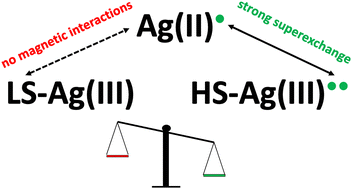
Based on theoretical calculations, we introduce a new AgIIAgIIIF5 monoclinic polymorph with a rare high-spin AgIII. Our analysis of the experimental X-ray diffraction data available in the literature reveals that this polymorph was likely prepared in the past in a mixture with the triclinic form of the same compound. Theoretical calculations reproduce very well the lattice parameters of both forms. Calculations suggest that under ambient conditions, the monoclinic form is the more energetically stable phase of Ag2F5. We predict a strong one-dimensional antiferromagnetic superexchange between silver cations of different valences with superexchange constant of −207 meV (hybrid functional result). The polymorph with high-spin AgIII owes its stability over the one with low-spin AgIII, to these magnetic interactions. Analysis of the electronic band structure shows that it is also a good candidate for an altermagnet.
In 1991, Žemva et al. first synthesized maroon Ag2F5via a precipitation reaction at 20 °C between AgFAsF6 and KAgF4 in anhydrous HF, deducing its formation from a 1
:
1 reagent ratio and mass balance matching Ag2F5 stoichiometry.11 However, only the relative intensities and positions of diffraction reflexes were then reported, with no further structural details provided. In 2002, Fischer and Müller accidentally prepared dark brown Ag2F5via solvothermal reaction in HF and they have determined its crystal structure in the space group P
from single-crystal X-ray measurements.13 Here, Ag2F5 was a byproduct of a solvothermal reaction between Ag2O and RhCl3 (at 1
:
2 ratio and aimed at synthesizing AgRhF613), conducted in a sealed Monel autoclave with anhydrous HF saturated with gaseous fluorine at ∼450 °C for five days. The crystal structure features two distinct metal centers – AgII (d9, s = 1/2) and a low-spin AgIII (d8, s = 0). The AgII cations are linked via fluoride bridges in infinite [AgF+] chains which feature strong antiferromagnetic interactions – a prerequisite for achieving superconductivity in cuprates.14 The low-spin AgIII cations are magnetically silent leading to the formulation of Ag2F5 as [AgIIF][AgIIIF4] with square-planar [AgIIIF4−] anions.
In this work we focus on a new C2/c polymorph of Ag2F5 compound with HS–AgIII. This species is analogous and isostructural to the previously described AgIICoIIIF515 but trivalent cobalt cation is substituted by silver. Our theoretical study is based on quantum mechanical calculations using DFT (density functional theory) approach, and it focuses on the similarities and differences in the crystal, phonon, electronic and magnetic structures of C2/c and P
forms and their relative stability. Furthermore, based on analysis of available X-ray diffraction data, we claim that Žemva et al.11 have obtained a mixture of both polymorphs of Ag2F5 in their experiments rather than a single phase.
structures were obtained with the PHONOPY package24 following the detailed protocol provided on its official website. Zero-point energies and Γ-point vibrational frequencies were then extracted either via density functional perturbation theory (DFPT) or by the finite-displacement scheme implemented in VASP.
All figures of the structures were visualized with the VESTA software.25
![]() | ||
Fig. 1 Unit cells of two polymorphic forms of Ag2F5: monoclinic C2/c (left) and triclinic P 12 (right). LS and HS denote a low-spin or a high-spin configuration of Ag3+, respectively. For both cells there are four formula units in the unit cell (Z = 4). | ||
12 and for C2/c (following our own analysis of experimental data,11 see below). Angle values are given in Table S1 in SI
| Method | C2/c |
P![]() |
|||||||
|---|---|---|---|---|---|---|---|---|---|
| a [Å] | b [Å] | c [Å] | V [Å3] | a [Å] | b [Å] | c [Å] | V [Å3] | ||
| DFT+U | U Ag = 5 eV | 7.35 | 7.86 | 7.84 | 409.35 | 4.96 | 11.03 | 7.29 | 381.62 |
| U Ag = 6 eV | 7.33 | 7.86 | 7.84 | 409.61 | 4.95 | 11.00 | 7.27 | 378.67 | |
| U Ag = 8 eV | 7.28 | 7.77 | 7.74 | 397.95 | 4.95 | 10.93 | 7.23 | 373.33 | |
| SCAN | 7.39 | 8.24 | 8.07 | 444.23 | 4.84 | 11.05 | 7.32 | 377.24 | |
| HSE06 | 7.40 | 7.99 | 7.98 | 427.62 | 4.96 | 11.07 | 7.34 | 385.66 | |
| Exp.11,12 | 7.32–7.44 | 7.73 | 7.83–7.98 | 404.4–413.1 | 5.00 | 11.09 | 7.36 | 390.88 | |
We begin the discussion with the triclinic polymorph, which has been well characterized in experiment. The geometry optimizations performed within both the SCAN and DFT+U methods, as well as the HSE06 hybrid functional yield unit cell volumes which are very close to the experimental value. In particular, the optimized cell volume is 3.49%, 2.37% and 1.08% smaller than the experimental value within the SCAN, DFT+U (UAg = 5 eV) and HSE06 methods, respectively (see Table 1). This is a very good agreement especially given the fact that theoretical data correspond to T → 0 K conditions, while experiments correspond to a finite temperature (hence a crystal is subject to a thermal expansion). We will focus further analysis of the Ag2F5 structures in both polymorphic forms on the results obtained within the reliable HSE06 method.
In the triclinic system (P
), two types of the first coordination spheres for each cation oxidation state can be distinguished, namely two for silver(II) and two for silver(III). They differ in the relative bond lengths, bond angles, and consequently in the overall shape of the coordination sphere as described below.
The first type of AgII sphere in P
(Fig. 2, first from the left, top row) is characterized by three longer Ag–F contacts (2.25 Å, 2.36 Å, and 2.38 Å) complemented by three significantly shorter contacts (2.00 Å, 2.01 Å, and 2.02 Å), which yields a distorted octahedral geometry [AgF6]4−. The second type of first coordination sphere for silver(II) (Fig. 2, top row, second from the left) adopts the shape of an elongated octahedron. Here, two axial Ag–F contacts, following HSE06 results, are equal to 2.58 Å and 2.60 Å; while the shorter equatorial Ag–F bonds have lengths of 2.11 Å, 2.10 Å, 2.05 Å, and 2.03 Å. The bond lengths and the overall shape of coordination sphere for this type of AgII cations are consistent with those reported for AgF2.26 In the monoclinic system (C2/c), the geometry of the first coordination sphere of silver(II) can also be described as an elongated octahedron. However, in this polymorph the axial Ag–F bonds are longer than those in the triclinic system, with length 2 × 2.77 Å, while the equatorial Ag–F contacts are equal 2 × 2.00 Å and 2 × 2.05 Å. The distorted geometries of the [AgIIF6]4− coordination spheres in both polymorphs are attributed to the Jahn–Teller effect.27
![]() | ||
| Fig. 2 The first coordination spheres for the Ag(II) and Ag(III) ions in the triclinic and monoclinic systems. Theoretically calculated bond lengths are given in Å, based on HSE06 results. | ||
In the P
system, the first group of AgIII ions (Fig. 2, bottom row, first from the left) exhibits a first coordination sphere with an elongated octahedral geometry, which approached a square-planar one (as typical for low-spin d8 systems). The Ag–F bonds in this group have lengths of 2.73 Å and 2.76 Å, as well as 2 × 1.89 Å and 2 × 1.91 Å. The second group of AgIII ions forms a distorted octahedron with six F− ligands, where the Fax.–Ag–Fax. angle decreases from nearly 180° to 132°, comparing to the first type of coordination spheres. In this case, the Ag–F bond lengths are equal to 2.75 Å and 2.69 Å, along with 4 × (1.88–1.93 Å). In the monoclinic system, AgIII coordinates six fluorine atoms to form an almost ideal octahedron, the Ag–F contacts are 2 × 2.02 Å, 2 × 2.04 Å, and 2 × 2.05 Å, as typical for high-spin cations with a d8 electronic configuration.
The structural difference between coordination spheres of AgIII in both forms are consistent with the calculated magnetic moment at silver centers (0μB for triclinic form and 0.86μB for monoclinic one according to the HSE06 results). Both the local geometry and magnetic moments stem from the occupation of the d(x2−y2) and d(z2) orbitals: 0 + 2 electrons for low-spin and 1 + 1 electrons for high spin form, respectively.
Despite different symmetries of both lattices, the structural motifs in both polymorphs are similar (Fig. 3). Taking into account the interatomic connectivity it is noticeable that in both structures the Ag–F–Ag bridges connect homovalent silver cations; in the P
structure the fluoride ligands connect AgII ions, whereas in the monoclinic structure they link AgIII ions (Fig. 3, right). Therefore, at a hypothetical P
→ C2/c transition, the oxidation states of silver ions at corresponding crystallographic positions interchange. I.e., the site hosting AgII in the triclinic structure is occupied by high-spin AgIII in the C2/c cell (Fig. 3, left), while the low-spin AgIII site in P
is occupied by Ag2+ in the monoclinic form.
![]() | ||
| Fig. 3 Comparison of the structural motifs and interatomic connectivity present in both structural forms of Ag2F5. | ||
| # | Symmetry | Frequency [cm−1] | Activity | # | Symmetry | Frequency [cm−1] | Activity |
|---|---|---|---|---|---|---|---|
| 1 | Bu | 542 | IR | 22 | Bu | 185 | IR |
| 2 | Au | 537 | Silent | 23 | Au | 169 | Silent |
| 3 | Bu | 536 | IR | 24 | Au | 162 | Silent |
| 4 | Au | 467 | Silent | 25 | Ag | 160 | R |
| 5 | Bu | 450 | IR | 26 | Bu | 159 | IR |
| 6 | Bg | 449 | R | 27 | Au | 153 | Silent |
| 7 | Ag | 432 | R | 28 | Bu | 148 | IR |
| 8 | Bg | 428 | R | 29 | Au | 140 | Silent |
| 9 | Ag | 393 | R | 30 | Bu | 125 | IR |
| 10 | Bg | 377 | R | 31 | Bg | 124 | R |
| 11 | Au | 343 | Silent | 32 | Ag | 97 | R |
| 12 | Bu | 324 | IR | 33 | Bu | 86 | IR |
| 13 | Au | 282 | Silent | 34 | Bg | 78 | R |
| 14 | Au | 272 | Silent | 35 | Au | 76 | Silent |
| 15 | Bu | 267 | IR | 36 | Ag | 65 | R |
| 16 | Bg | 252 | R | 37 | Au | 55 | Silent |
| 17 | Ag | 242 | R | 38 | Bg | 46 | R |
| 18 | Ag | 206 | R | 39 | Bu | 46 | IR |
| 19 | Bg | 198 | R | 40 | Bu | 0 | IR |
| 20 | Au | 197 | Silent | 41 | Bu | −1 | IR |
| 21 | Bu | 194 | IR | 42 | Au | −1 | Silent |
The acoustic modes have null frequencies with a small discrepancy up to 1 cm−1. There are no imaginary modes which testifies that the monoclinic polymorph is a genuine minimum on the potential energy surface, and as such is synthesizable. The optical modes stretch up to 542 cm−1 which is a typical value for the Ag–F stretching modes in Ag(II) compounds. A similar analysis for the triclinic polymorph (SI SV), again suggests the absence of any imaginary phonons. The triclinic form has as many as 81 optical modes altogether (with no silent modes), plus three acoustic phonons. The highest (Debye) frequency computed is 584 cm−1. The IR and Raman spectra for both forms will differ considerably, so they could be easily detected in experiments based on the characteristic (fingerprint) vibrations. Regretfully, the vibrational spectra have not been measured for any of the previously reported samples11,12 but our theoretical values could prove to be useful if these experiments are repeated in the future.
Having described structure and lattice dynamics of the known triclinic and the novel monoclinic form of Ag2F5 proposed here, we now confront these results with the experimental data available in the literature.11,12
![]() | ||
| Fig. 4 Comparison of Ag2F5 X-ray patterns: (i) as reported by Žemva11 (blue dots), (ii) generated from the experimental triclinic structure12 (red line), (iii) generated from the monoclinic structure (DFT+U calculations, UAg = 5 eV) (black line). | ||
The comparison reveals a significant difference in the number and positions of reflections measured for the polycrystalline sample obtained by Žemva11 and single crystal measured by Fischer.12 Although the triclinic Ag2F5 is certainly present in Žemva's sample, yet these authors have observed many more unique reflections which cannot be explained by the presence of KAsF6 byproduct nor of any other known Ag–F system. Analysis of these additional reflections (Table 3) reveals a similarity of their positions to the ones expected for the monoclinic C2/c form of Ag2F5.
, forms. Positions of the reflections observed by Žemva et al.11 are also presented. “NO” means “not observed”. Angles correspond to Cu lamp radiation
| Žemva11 | Ag2F5 (C2/c)theoretical | Ag2F5 (P )12 |
|||||
|---|---|---|---|---|---|---|---|
| 2θ [°] | d [Å] | 2θ [°] | d [Å] | Index | 2θ [°] | d [Å] | Index |
| 20.08 | 4.42 | NO | NO | NO | 20.10 | 4.41 | (1−10) |
| 23.00 | 3.86 | 22.60 | 3.93 | (020) | NO | NO | NO |
| 24.43 | 3.64 | 25.12 | 3.54 | (002) | 24.58 | 3.62 | (120) |
| 26.66 | 3.34 | 26.82 | 3.32 | (200) | 26.76 | 3.33 | (10−2) |
| 27.89 | 3.20 | 27.84 | 3.20 | (20−2) | 27.96 | 3.19 | (1−1−2) |
| 29.16 | 3.06 | NO | NO | NO | NO | NO | NO |
| 29.99 | 2.98 | NO | NO | NO | 30.00 | 2.98 | (022) |
| 32.19 | 2.78 | NO | NO | NO | 32.22 | 2.78 | (040) |
| 34.05 | 2.63 | 34.04 | 2.63 | (022) | NO | NO | NO |
| 35.60 | 2.52 | 35.35 | 2.54 | (220) | 35.62 | 2.52 | (102) |
| 37.45 | 2.40 | 37.02 | 2.43 | (22−2) | 37.52 | 2.40 | (200) |
| 41.43 | 2.18 | NO | NO | NO | 41.44 | 2.18 | (042) |
| 45.02 | 2.01 | 44.66 | 2.03 | (202) | 44.98 | 2.01 | (2−30) |
| 46.68 | 1.94 | 46.64 | 1.95 | (20−4) | NO | NO | NO |
For example, the strong reflection observed at ca. 23° is very similar to the most intense (020) reflex characteristic of the theoretically predicted monoclinic Ag2F5 structure – around 22.6°. Similarly, the reflection seen at ca. 27.9° cannot be explained solely by the (quite weak) (1−1−2) reflex coming from the P
, form but it may also stem from the strong (20−2) reflex of the C2/c cell, etc. Looking at the low-angle part of the diffractogram (where the measured intensities are the strongest) we were able to identify several strong reflections in the pattern published by Žemva11 which may be explained by the presence of the monoclinic polymorph in their samples. Fortunately, the (hkl) indexes for these reflections are not redundant and we were able, based on their experimental positions, to estimate approximate unit cell vectors for the C2/c cell coming from our analysis of the previous experiments. We have used several independent sets of the four reflections needed to calculate three lattice constant parameters and a β angle, and the obtained sets of lattice parameters have been listed in Table 4. The corresponding generated powder patterns are shown on Fig. S1 in SI.
| Selected reflexions from Žemva | Estimated lattice parameters and unit cell volume | ||||||
|---|---|---|---|---|---|---|---|
| Set | d [Å] | hkl | a [Å] | b [Å] | c [Å] | β [°] | V [Å3] |
| I | 3.86, 3.64, 3.34, 2.01 | 020, 002, 200, 202 | 7.71 | 7.73 | 8.40 | 119.9 | 433.4 |
| II | 3.86, 3.34, 3.20, 1.94 | 020, 200, 20−2, 20−4 | 7.37 | 7.73 | 7.83 | 114.9 | 404.4 |
| III | 3.86, 3.20, 2.63, 1.94 | 020, 20−2, 02−2, 20−4 | 7.44 | 7.73 | 7.85 | 113.7 | 413.1 |
| IV | 3.86, 3.64, 3.34, 3.20 | 020, 002, 200, 20−2 | 7.32 | 7.73 | 7.98 | 114.1 | 411.7 |
| Ranges of theoretical values (except for SCAN results) | 7.28–7.40 | 7.77–7.99 | 7.74–7.98 | 114.8–115.3 | 398.0–427.6 | ||
It seems that set I of four reflections is incorrect, as it may be judged from lattice parameters a and c too much departing from the values expected from theoretical calculations. However, sets II, III and IV all give lattice parameters and volumes which are reasonably similar to the values predicted by theory. Therefore, the associated ranges of the lattice parameter values from sets II–IV have been introduced to the previously discussed Table 1. Regretfully, since Žemva et al. did not provide a full powder pattern, we could not perform any fits to see whether any of the sets II–IV performs better than the others in the Rietveld fit. Nevertheless, the abovementioned results suggest that the sample obtained by Žemva was, in fact, a polycrystalline mixture. It consisted of a triclinic Ag2F5 (only eleven years later characterized by Fischer), and the then-overlooked monoclinic Ag2F5. Importantly, the diffractogram reported by Žemva contains also additional reflexes that are absent in the diffraction patterns of both considered polymorphic forms of Ag2F5 (e.g., at 2θ of 37.2° and 42.3°). This may imply that at least three phases were present in Žemva's sample, which naturally explains their difficulties to solve the crystal structure for such complex sample. The fact that these authors11 did not report magnetic susceptibility data for their sample of Ag2F5 is also characteristic, as they characterized all other compounds in their study using this method.
Taking into account the coexistence of two polymorphs of Ag2F5 in Žemva's sample, the following section will address the relative stability of these structural forms.
| AgF2 + AgF3 → Ag2F5 | (1) |
| dE = EAg2F5 − (EAgF2 + EAgF3) | (2) |
| dV = VAg2F5 − (VAgF2 + VAgF3) | (3) |
| DFT+U | dE [meV per FU] | dV [Å3] | −TdS [meV per FU] | dE − TdS [meV per FU] | ||||
|---|---|---|---|---|---|---|---|---|
| U Ag parameter |
P![]() |
C2/c |
P![]() |
C2/c |
P![]() |
C2/c |
P![]() |
C2/c |
| 5 eV | −69 | −85 | −0.69 | +6.24 | +4 | −34 | −65 | −119 |
| 6 eV | −66 | −86 | −0.97 | +6.76 | +5 | −37 | −61 | −123 |
| 8 eV | −62 | −99 | −0.89 | +8.18 | +5 | −44 | −57 | −143 |
Here, the values of E for the individual systems represent the electronic plus spin total energy in their magnetic ground state, as obtained from DFT+U calculations. It should be noted that AgF2 substrate in its ground state exhibits strong antiferromagnetic coupling between silver(II) ions within the layers.1,28 In contrast, AgF3 in its ground state contains low-spin AgIII, therefore it is diamagnetic.
The energy effect (dE) is negative and quite substantial for both types of Ag2F5 (from −62 to −99 meV per FU), regardless of the value of UAg parameter. This alone suggests that both forms might be prepared in experiment. However, in the case of the C2/c structure, the value of the formation energy is more negative than for the triclinic form by ca. 16–37 meV per FU. Thus, the energy term stabilizes the monoclinic structure, the triclinic one being a metastable form at T → 0 K.
Significant differences in dV values are also computed between the two structural forms of Ag2F5. In the triclinic system, the unit cell volume is only slightly smaller than the sum of the unit cell volumes of AgF2 and AgF3, ranging from 0.69 to 0.89 Å3 per formula unit (FU), depending on the chosen UAg parameter. In contrast, the unit cell volume of the monoclinic system is 6.24 to 8.18 Å3 larger than the sum of the unit cell volumes of precursors (eqn (1)). Given the substantial differences in volumetric effects between the synthesis reactions of monoclinic and triclinic Ag2F5, the entropic contribution was estimated using a semi-empirical method, where volume expansion (dV) is linked to entropy increase (dS).21 The negative dS value for the synthesis of the triclinic phase results in a positive TdS contribution to the Gibbs free energy expression. At room temperature is approximately +4 to +5 meV per FU. This effect becomes increasingly significant as the temperature rises. Consequently, considering only this contribution to the entropy, the formation of the triclinic phase from the binary substrates becomes progressively less favorable. For this reason, it is not surprising that under Fischer's synthesis conditions of T = 720 K,12 reproducibility issues were encountered both in the synthesis reaction and in the isolation of crystals of the triclinic form.
Conversely, the positive dS of formation for the monoclinic Ag2F5 phase indicates the opposite tendency. Assuming a temperature of 298 K (room temperature), the entropy contribution (−TdS) is expected to considerably stabilize the monoclinic form, reducing the Gibbs free energy by approximately −34 or −44 meV per FU, depending on the chosen UAg.
It should be noted, that temperature is not the only factor influencing the relative stability of the two structural forms of Ag2F5. The conditions of elevated pressure (p = 0.04 GPa12 was used by Fischer) must also be considered. Our results show, that with increasing pressure, the triclinic form becomes energetically more favorable (see SI SIII). This is evident in the energy difference (EP
− EC2/c) between the structural forms as pressure increases (exact values are presented in SI, Fig. S2). At p = 2 GPa, EP
− EC2/c is −83 meV per FU, and at 10 GPa, it reaches −446 meV per FU, indicating that the triclinic form is increasingly favored under higher pressures. Preference for the low-volume triclinic form under elevated pressure is of course expected taking into account the pV term.
The analysis suggests that the triclinic (P
) Ag2F5 structure reported in the literature is energetically less stable than the C2/c one under conditions of p → 0 and T → 0. Monoclinic form enhances its stability as T increases, while the triclinic one could become a ground state at elevated pressure.
The above-mentioned calculations do not account for the contribution of lattice vibrations, as these are usually negligible for elements heavier than boron. Nevertheless, we performed zero-point energy (ZPE) calculations to evaluate phonons’ contribution to the total energy (EZPE) and the relative stability of the structures (dEZPE), considering p → 0 conditions. The comparison of calculation results is presented in the Table 6 below.
| Parameter | DFT+U | |
|---|---|---|
| U = 5 | U = 8 | |
| dE [meV per FU] | +16 | +37 |
| dEZPE [meV per FU] | +36 | +38 |
| dV [Å3 per FU] | −6.93 | −6.15 |
| dS [meV per K per FU] | −0.126 | −0.112 |
| T eq [K] | −285 | −339 |
| p eq [GPa] | 0.83 | 0.99 |
Table 6 presents selected reaction parameters for the hypothetical structural transformation reaction of Ag2F5 from the monoclinic to the triclinic form (eqn (4)). The energy difference between the two Ag2F5 forms was determined both without (dE) and with (dEZPE) the inclusion of zero-point vibrational energy (eqn (5)), along with the volumetric effect of the reaction (eqn (6)).
Ag2F5(C2/c) → Ag2F5(P ) | (4) |
dE = EP − EC2/c | (5) |
dV = VP − VC2/c | (6) |
The entropy change arising from the volume difference between to Ag2F5 systems (eqn (6)) was estimated using a semi-empirical method, where dS/dV = 18.24 meV K−1 FU−1 per 1 nm3 of volume change.21 By including the entropic contribution associated with volume expansion, the equilibrium temperature for the coexistence of both phases was determined according to the eqn (7) below.
![]() | (7) |
One may also compute the corresponding equilibrium pressure:
![]() | (8) |
It turns out that phonons’ contribution to dE is ca. 1 meV (U = 8 eV) or 20 meV (U = 5 eV); however, relative stability of polymorphs is not qualitatively altered as compared to results which do not take phonons into account. This is reflected in the formally negative value of Teq (eqn (7)), which considers both entropy change (dS) and the energy difference including contribution from zero-point vibrations (EZPE). In other words, this indicates that the P
form should not be favored at any finite temperature. On the other hand, the triclinic form could be stabilized at slightly elevated pressure of the order of 0.8–1.0 GPa for T → 0 conditions.
Interestingly, considering DFT+U calculations without spin polarization, the energy difference between the triclinic and monoclinic structures is −141 meV per FU in favor of the former. This suggests that magnetic interactions between spins play a dominant role in favoring C2/c over the P
. This is a highly unusual situation, as most often the contribution of magnetic interactions to the free energy of polymorphic transformation reaction is negligible; here, the low-to-high spin transformation for Ag(III) allows for the appearance of many new superexchange (SE) pathways characterized by strong SE coupling constants, as it will be detailed in the next section.
phase has a band gap of 0.74 eV. When UAg is increased to 8 eV, the band gap increases to 1.47 eV for the C2/c phase and to 1.27 eV for the P
phase. For both polymorphs, a significant similarity is observed in the character of the valence band near the Fermi level, where the dominant contribution arises from fluorine p states. In contrast, the conduction band is primarily composed of unoccupied metal d states. Consequently, the band gap in both structures is of the charge-transfer (CT) type, according to Zaanen–Sawatzky–Allen (ZSA) classification.30
![]() | ||
Fig. 5 Comparison of the density of states (DOS) for the P (left) and C2/c (right) structures. “LS” denotes the low-spin state, while “HS” denotes the high-spin state. Results within DFT+U, where UAg = 8 eV.3 | ||
However, in the C2/c system, the conduction band exhibits a pronounced separation between the silver(II) and silver(III) states. The unoccupied states closest to the Fermi level (at 0 eV; see Fig. 5) arises from the d(x2−y2) and d(z2) high-spin AgIII states; while the Ag d(x2−y2) states of AgII are located by 1 eV higher in energy scale. This observation suggests that HS AgIII exhibits a more oxidizing character than AgII. This conclusion is significant for potential electron-doping of the monoclinic polymorph, as it suggests that additional electron density would preferentially populate the AgIII d(x2−y2) and/or d(z2) rather than the AgII d(x2−y2) states. Essentially, the C2/c structure could facilitate the attainment of an intermediate oxidation state between II and III for silver cation – a requirement postulated as key to achieving superconductivity in Ag–F systems.7,9
For the triclinic P
phase, the conduction band is predominantly composed of unoccupied Ag d(yz) states from both silver(II) and silver(III). The calculated magnetic moment LS-AgIII cation in P
form equals 0μB, as expected, so entire magnetism of this phase comes from AgII. Unfortunately, despite multiple attempts, Fisher and Muller were unable to obtain sufficiently pure Ag2F5 samples required for magnetic analysis.12 Based on the calculation we propose, that this compound can be regarded as a diluted magnet with rather weak magnetic interactions between AgII cations due to the low angle of the AgII–F–AgII bridge (128°) and the alternating Ag–F distances within the linkage (2.1 Å/1.9 Å). For this reason, in the following part only magnetic properties of C2/c form will be described.
DFT+U calculations conducted for the C2/c phase using a cell presented in Fig. 6 reveal that the magnetic ground state corresponds to a state designated as AFM2 (see SI); same as the one proposed for isostructural AgCoF5 compound.15 Therefore, the magnetic structure of Ag2F5 can be classified as a G-type antiferromagnet (see SI).
To examined the magnetic interaction strengths in new polymorph of Ag2F5 we calculated five superexchange constants (J) using the Heisenberg Hamiltonian, based on the energies of the corresponding spin configurations (broken-symmetry method) within DFT+U method. The Hamiltonian employed for the calculation of the superexchange constants is presented in SI.
The calculated superexchange constants, together with the most relevant structural parameters – the distance between the centers of the paramagnetic species and the F–Ag–F bond angle specific to each exchange pathway – are presented in Table 7 below.
| Direction | Parameter (A = Ag2+, B = Ag3+) | DFT+U (UAg = 5 eV) | DFT+U (UAg = 6 eV) | DFT+U (UAg = 8 eV) |
|---|---|---|---|---|
| a The exact value was not determined because the required magnetic states did not converge satisfactorily well. | ||||
| [010] | J b 1(A–B) [meV] | −186 | −137 | −101 |
| d [Å] | 3.93 | 3.93 | 3.88 | |
| Angle [°] | 154.0 | 153.2 | 152.3 | |
| [100] | J a 2(A–B) [meV] | −51 | −24 | −22 |
| d [Å] | 3.67 | 3.66 | 3.64 | |
| Angle [°] | 126.5 | 126.4 | 126.0 | |
| [001] | J c 3(B–B) [meV] | −93 | −72 | |
| d [Å] | 3.91 | 3.92 | 3.87 | |
| Angle [°] | 153.0 | 153.7 | 151.1 | |
| [001] | J c 4(A–A) [meV] | −13 | ±0 | |
| d [Å] | 3.91 | 3.92 | 3.87 | |
| Angle [°] | 110.7 | 110.3 | 109.6 | |
| [101] | J 5(A–B) [meV] | −7 | −5 | −2 |
| d [Å] | 4.06 | 4.09 | 4.05 | |
| Angle [°] | 117.7 | 118.4 | 119.1 | |
It is worth to note, that the HSE06 method for reference system, AgF2, yields the superexchange constant reaches 75% of the experimental value,1 indicating good agreement with experiment. In the C2/c structure of Ag2F5 a pronounced anisotropy in the strength of magnetic interactions, dependent on the crystal direction, is observed. The superexchange constant between AgIII and AgII is −186 meV (along b direction, Jb1(A–B), where A = AgII, B = AgIII), while the second strongest coupling, Jc4(A–A), which characterizes the magnetic interaction between AgIII ions, is −93 meV (along c direction, UAg = 5 eV). In both cases, the A–F–B and B–F–B bridge angles along specific pathways (1 and 4) are among the closest to 180° (154°/153°) of all five pathways, which favors antiferromagnetic interactions according to the Goodenough–Kanamori–Anderson rules.31–33 The predominant type of interactions are further evidenced by visualization of the magnetization density as well as analysis of the major hopping terms following the wannierization procedure (see the SI, Sections SVII, SVIII and SIX).
To provide a broader context for our findings, Table 8 sets the three most significant (in terms of their absolute value) superexchange constants calculated for representative homodimetallic(II/III) pentafluoride systems. Two of them, Cu2F534,35 and Ni2F5,36 have been proposed as potentially novel compounds featuring high-spin TM-cations with mixed valence(II/III); however, neither has yet been experimentally obtained. Additionally, Table 8 presents the superexchange constants in the hypothetical compound AgIICuIIIF5, which, according to the DFT+U calculations,15 is energetically stable relative to potential substrates, AgF2 and CuF3.34 We also calculated J values for Ag2F5 using a CPU-demanding HSE06 method. This method suggests that one-dimensional antiferromagnetic interaction between mixed-valence silver centers, Jb1(A–B), to reach impressive −207 meV (see Table 8).
| AIIBIIIF5 | U M | J b 1(A–B) [meV] | J a 2(A–B) [meV] | J c 3(B–B) [meV] |
|---|---|---|---|---|
| a C2/m form following Rybin et al.34 b C2/c form from this work with HS cation B.‡ | ||||
| AgIIAgIIIF5 | 5 eV | −186 | −51 | −93 |
| 8 eV | −101 | −22 | −72 | |
| HSE06 | −207 | −50 | −87 | |
| CuIICuIIIF5 | 4 eV35 a |
−33 | −7 | −34 |
6 eV35 a |
−35 | −7 | −40 | |
| 10 eVb | −39 | −10 | −33 | |
| NiIINiIIIF5 | 6 eV | −12 | −5 | −11 |
| AgIICuIIIF5 | Ag, Cu = 5 eV | −111 | −27 | −48 |
The J values indicating the strength of A–B and B–B interactions in Cu2F5, Ni2F5 and AgCuF5 are several times smaller in absolute terms, compared to analogous values for Ag2F5. This suggests that the mixed-valent Ag–F system is the most promising candidate among those HTSC precursors, while taking into account J vs. Tc correlation in parent undoped cuprates.37 The monoclinic form of Ag2F5 discussed here belongs to a small group magnetic materials with exceptionally high superexchange constants which may surpass the J2D and J1D values observed for a number of experimentally-characterized cuprates.38
Interestingly, analysis of the band structure suggest that the C2/c form of Ag2F5 is a possible altermagnet39,40 (see SI, Section SX).
Our calculations predict that the new form is slightly more stable than the known triclinic one at p → 0 conditions and at any temperature; the triclinic form featuring LS AgIII has a smaller molar volume than the monoclinic one and as such is preferred under elevated pressure of ca. 1 GPa. Consequently, the triclinic form accidentally prepared by Fischer (during crystallization attempts of AgRhF6 at p = 400 bar, T = 720 K),13 and further characterized at ambient (p,T) conditions, may have formed as a metastable phase. On the other hand, Žemva and Muller,11 employing synthesis conditions distinct from those of Fischer, did not unequivocally identify all the constituents of the final powder. Our analysis of the reflex positions in the X-ray diffractogram reported by these authors indicates the presence of two distinct polymorphs (P
and C2/c) in their samples, together with an unknown impurity. As these authors used the source of LS AgIII for their synthesis (KAgF4), the formation of some amount of the C2/c form suggests that it is more stable at synthesis conditions that the triclinic one, as LS-to-HS transition has occurred to some extent (supposedly hindered only by insufficiently fast kinetics). This phenomenon is described in the literature as spin-crossover,42,43 and broadly represented by many d8 Ni2+ systems, among others. However, the LS-to-HS transition for isoelectronic AgIII has not yet been explicitly mentioned in the literature, and the case described here seems to be the first of its kind.
Interestingly, following our quantum mechanical calculations, the monoclinic form turns out to be less stable than the triclinic one if magnetic interactions are not accounted for. Therefore, magnetic interactions are a pivotal determinant in stabilizing the monoclinic form. This is because monoclinic form hosts very strong magnetic superexchange interactions between d9 and d8 silver cations mediated by fluorine ligand (which are absent for the triclinic form with LS AgIII). The SE constants for this interaction may exceed −200 meV as calculated using HSE06 functional. The monoclinic Ag2F5 is therefore a very rare case when magnetic interactions decide the fate of relative stability of diverse polymorphic forms. Moreover, taking into account the immensely strong magnetic interaction between d9 and d8 silver cations mediated by fluorine ligand, and simultaneously the strong d9⋯d9 interactions, a potential doping of the quasi-2D C2/c phase may result in superconductivity with a high critical temperature.
Additional data may be obtained from the authors upon request.
Footnotes |
| † Dedicated to Professor Resnati, celebrating a career in fluorine and noncovalent chemistry on the occasion of his 70th birthday. |
| ‡ Interestingly our calculations reveal that the C2/c polymorph Cu2F5 is by −56 meV per FU more stable, following DFT+U with U = 10 eV, than previously proposed C2/m one. |
| This journal is © the Owner Societies 2025 |