


 PLATFORM UPDATE:

Deep learning interatomic potential for boron phosphide: accurate prediction of mechanical and thermal properties
 †a
Chao
Zhang
*b
and
†a
Chao
Zhang
*b
and
Abstract
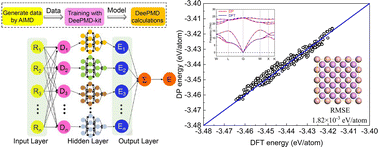
Boron phosphide (BP) is a promising high temperature thermoelectric material with good thermal stability and chemical inertness. Recently, interatomic potentials based on machine learning methods with neural networks have attracted a lot of attention due to their high accuracy and efficiency in atomistic simulations. In this work, a deep potential (DP) of BP was trained using machine learning (ML) methods. The structure and properties of BP were investigated using the trained DP. It was found that the DP simulation accurately reproduces the radial and angular distribution functions of BP, and that the lattice constants and density are in good agreement with the first-principles calculations and experimental results. It accurately reproduces the key physical properties of boron phosphide, including radial and angular distribution functions, lattice constants, density, structural properties, mechanical properties (such as elastic constants and hardness), fracture toughness, and thermal properties (such as entropy, enthalpy, free energy, heat capacity, thermal conductivity, and phonon spectrum). These results show that the trained BP deep learning potential can accurately describe BP materials.
 Please wait while we load your content...


