


 PLATFORM UPDATE:


Developing microfluidic purification techniques for biodiesel production from recycled grease trap waste†

Abstract
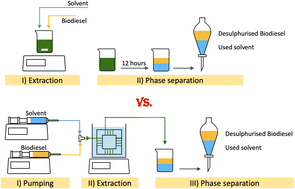
This study aimed to investigate the desulphurisation process of model biodiesel containing thiophene (Th) using 3 different solvents (sulfolane, ionic liquids (ILs) – [BMIM]AlCl4, [BMIM]MSA, and deep eutectic solvents (DESs) – choline chloride (ChCl) : phenol (Ph), ChCl : polyethylene glycol (PEG)). The investigation focused on evaluating the impact of solvent-to-fuel (S : F) ratio, mixture flow rate, and temperature to optimize the process using a central composite design. The results indicated that the optimal conditions for desulphurisation were achieved by employing ChCl : PEG at a high S : F ratio of 2 : 1, a low mixture flow rate of 1.55 mL min−1, and a temperature of 30 °C, resulting in a removal efficiency of 65.81%. To meet the economical requirements, the desirability function suggested operating the system at a S : F ratio of 1.85, mixture flow rate of 1.77 mL min−1, and temperature of 25 °C, with the predicted yield of 55.38%. The conditions were experimentally checked, resulting in 44% of removal for a single stage and 80% of removal for 5 stages. However, the chosen purification technique would increase the total operational cost by $12.77 per litre. This financial barrier can be overcome by further considering the ability to regenerate the solvent and the use of different configurations of the microfluidic device for higher efficiency.
 Please wait while we load your content...


