


 PLATFORM UPDATE:


S-vacancy-assisted fast charge transport and oriented ReS2 growth in twin crystal ZnxCd1−xS: an atomic-level heterostructure for dual-functional photocatalytic conversion†

Abstract
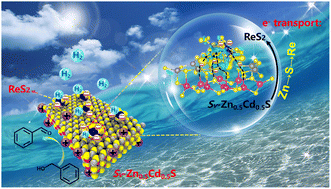
The achievement of dual-functional photocatalytic technology requires a photocatalyst with accelerated charge flow and purposeful active-site arrangement. In this study, we developed an oriented embedding strategy to induce ReS2 growth at the S vacancy in twin-crystal Zn0.5Cd0.5S solid solution (Sv-ZCS), obtaining an atomic-level heterostructure (ReS2/Sv-ZCS). The electronic structure calculations demonstrate that the charge density of the Zn atom around the S vacancy is higher than for other Zn atoms and the introduced S vacancy establishes a high-speed channel for electron transport via formed Zn–S–Re bonds at the interface between ReS2 and Sv-ZCS. Photogenerated electrons and holes gathered on Re atoms and Sv-ZCS, respectively, which achieves spatial charge separation and separated arrangement for redox sites. As a result, the optimized ReS2/Sv-ZCS heterostructure possesses high efficiency of electron injection (2.6-fold) and charge separation (8.44-fold), as well as excellent conductivity capability (20.16-fold). The photocatalytic performance of the ReS2/Sv-ZCS composite exhibits highly improved dual-functional activity with simultaneous H2 evolution and selective oxidation of benzyl alcohol. The reaction rate of benzaldehyde and H2 evolution reaches 125 mmol gcat−1 h−1 and 159 mmol gcat−1 h−1, which is the highest efficiency achieved so far for simultaneous coproduction of H2 fuel and organic chemicals on ReS2-based composites. This work enriches the application of ReS2-modified composites in a dual-functional photoredox system and also gives insight into the role of defects in electronic structure modification and activity improvement.
- This article is part of the themed collection: #MyFirstMH
 Please wait while we load your content...


