


Ni-loaded Co-NC catalysts for promoting electrocatalytic nitrate reduction to ammonia†

Abstract
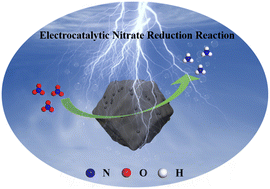
The Haber–Bosch process, the traditional method of ammonia synthesis, uses hydrogen derived from steam reforming of hydrocarbons; and involves harsh operating conditions of high temperatures (300–600 °C) and pressures (200–400 atm), expending a vast amount of energy each year. Recently, there has been a lot of interest in the electrochemical nitrogen reduction process (NRR) to NH3, which is inspired by natural microbial nitrogen fixation. However, the stable N![[triple bond, length as m-dash]](https://www.rsc.org/images/entities/char_e002.gif) N violent hydrogen evolution reaction hindered the development of the NRR. In comparison, the electrocatalytic nitrate reduction reaction (NO3RR) has significant advantages. The much lower dissociation energy of N
N violent hydrogen evolution reaction hindered the development of the NRR. In comparison, the electrocatalytic nitrate reduction reaction (NO3RR) has significant advantages. The much lower dissociation energy of N![[double bond, length as m-dash]](https://www.rsc.org/images/entities/char_e001.gif) O (204 kJ mol−1) is required; nitrate is widespread in surface water. Herein, an electrocatalyst loaded with Ni onto CoZn@ZIF by a simple impregnation method is reported, which possesses a nitrogen-doped graphitic carbon structure after pyrolytic carbonization. Detailed experiments showed that the NiCo-NC catalyst significantly accelerated the NO3RR compared to Co-NC. NiCo-NC exhibited remarkable NO3RR activity. At −0.6 V and −1.1 V, ammonia yields of 5.01 mg cm−2 h−1 and 10.12 mg cm−2 h−1 were obtained, with FEs reaching 92.75% and 96.65%, respectively. The catalyst showed excellent electrochemical stability in 24-hour electrolysis experiments and five-cycle stability tests. Meanwhile, 15N isotope labeling experiments further verified the source of N in NH4+ from NO3−.
O (204 kJ mol−1) is required; nitrate is widespread in surface water. Herein, an electrocatalyst loaded with Ni onto CoZn@ZIF by a simple impregnation method is reported, which possesses a nitrogen-doped graphitic carbon structure after pyrolytic carbonization. Detailed experiments showed that the NiCo-NC catalyst significantly accelerated the NO3RR compared to Co-NC. NiCo-NC exhibited remarkable NO3RR activity. At −0.6 V and −1.1 V, ammonia yields of 5.01 mg cm−2 h−1 and 10.12 mg cm−2 h−1 were obtained, with FEs reaching 92.75% and 96.65%, respectively. The catalyst showed excellent electrochemical stability in 24-hour electrolysis experiments and five-cycle stability tests. Meanwhile, 15N isotope labeling experiments further verified the source of N in NH4+ from NO3−.
 Please wait while we load your content...


