


 PLATFORM UPDATE:

Enhancing the osmotic energy conversion of a nanoporous membrane: influence of pore density, pH, and temperature†
 a
and
Jyh-Ping
Hsu
*a
a
and
Jyh-Ping
Hsu
*a
Abstract
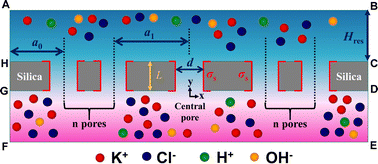
Salinity gradient power, which converts Gibbs free energy of mixing to electric energy through an ion-selective pore, has great potential. Towards practical use, developing membrane-scaled nanoporous materials is desirable and necessary. Unfortunately, the presence of a significant ion concentration polarization (ICP) lowers appreciably the power harvested, especially at a high pore density. To alleviate this problem, we suggest applying an extra pressure difference ΔP across a membrane containing multiple nanopores, taking account of the associated power consumption. The results gathered reveal that the application of a negative pressure difference can improve the power harvested due to the enhanced selectivity. In addition, if the pore density of a membrane is high, raising its pore length is necessary to make the energy harvested economic. For example, if the pore length is 2000 nm and the pore density is 2.5 × 10⁹ pores per cm2, an increment in the power density of 213 mW m−2 can be obtained by applying ΔP = −1 bar at pH 11 and 323 K, where a net positive power density can be retrieved. The performance of the system considered under various conditions is examined in detail, along with associated mechanisms.
 Please wait while we load your content...


