


 PLATFORM UPDATE:


Infrared multiple-photon dissociation spectroscopy of cationized glycine: effects of alkali metal cation size on gas-phase conformation†

Abstract
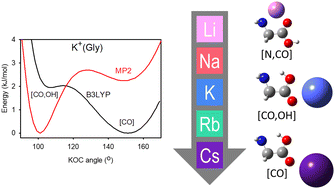
The gas-phase structures of cationized glycine (Gly), including complexes with Li+, Na+, K+, Rb+, and Cs+, are examined using infrared multiple-photon dissociation (IRMPD) spectroscopy utilizing light generated by a free electron laser, in conjunction with ab initio calculations. To identify the structures present in the experimental studies, measured IRMPD spectra are compared to spectra calculated at B3LYP/6-311+G(d,p) for the Li+, Na+, and K+ complexes and at B3LYP/def2TZVP for the Rb+ and Cs+ complexes. Single-point energy calculations were carried out at the B3LYP, B3P86, and MP2(full) levels using the 6-311+G(2d,2p) basis set for Li+, Na+, K+ and the def2TZVPP basis set for Rb+ and Cs+. The Li+ and Na+ complexes are identified as metal cation coordination to the amino nitrogen and carbonyl oxygen, [N,CO]-tt, although Na+(Gly) may have contributions from additional structures. The heavier metal cations coordinate to either the carbonyl oxygen, [CO]-cc, or the carbonyl oxygen and hydroxy oxygen, [CO,OH]-cc, with the former apparently preferred for Rb+ and Cs+ and the latter for K+. These two structures reside in a double-well potential and different levels of theory predict very different relative stabilities. Some experimental evidence is provided that MP2(full) theory provides the most accurate relative energies.
 Please wait while we load your content...


