


 PLATFORM UPDATE:


Dynamical heterogeneity in the gelation process of a polymer solution with a lower critical solution temperature†

Abstract
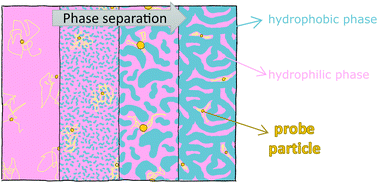
The gelation of a hydrophobically modified hyaluronic acid aqueous solution which shows a lower critical solution temperature of about 25 °C was investigated by multi-particle tracking microrheology. The linear viscoelasticity of the gelling system is converted from the microrheological data. The critical gelling temperature Tgel = 36.3 °C was determined from the loss tangent by the Winter–Chambon criterion. The critical exponent n = 0.62 was determined from the shift factors of the time–cure superposition. The length scales of the dynamic heterogeneity of the gelling system were analyzed using a proposed framework where single-particle and multi-particle non-Gaussian parameters were compared. The length scale of the dynamic heterogeneous regions monotonically decreases during the gelation process, consistent with the nucleation-and-growth mechanism of phase separation. Distributions of local viscosity in the gelling system were extracted from the observed distributions of particle displacement as a time-dependent fingerprint of the dynamic heterogeneity of the gelling system. The results and analyzing methods proposed in the present work can be applied to other microrheological studies.
 Please wait while we load your content...


