


Sensing ultra-trace dopamine by restoration of fluorescence on locally acidified gold nanoparticles†
Feichi
Hu,  ab
ab
ab
Abstract
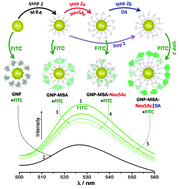
An ultra-sensitive sensor was fabricated to measure dopamine through quenching and restoring FITC fluorescence by the competitive binding of dopamine and N-acetylneuraminic acid with mercaptophenylboronic acid anchored on the gold nanoparticles. Assessed by quantifying dopamine in human urine samples, it reached a limit of detection of as low as 50 pM dopamine over a linear range from 10−10 M to 10−7 M. It also features low technical barriers and operation cost, and the strategy proposed could be extendable to other analytes and not restricted to the gold nanoparticles.
 Please wait while we load your content...


