


Efficient ring-opening polymerization (ROP) of ε-caprolactone catalysed by isomeric pyridyl β-diketonate iron(iii) complexes†

Abstract
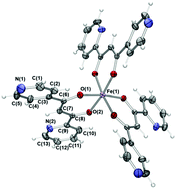
A series of Fe(III) complexes of β-diketonate ligands, 1-(2-pyridyl)-3-(3-pyridyl)-1,3-propanedione (L1), 1-(2-pyridyl)-3-(2-pyridyl)-1,3-propanedione (L2), 1-(2-pyridyl)-3-(4-pyridyl)-1,3-propanedione (L3), 1-(3-pyridyl)-3-(4-pyridyl)-1,3-propanedione (L4), 1-(3-pyridyl)-3-(3-pyridyl)-1,3-propanedione (L5) and 1-(4-pyridyl)-3-(4-pyridyl)-1,3-propanedione (L6), viz. [Fe(L1)3] (1), [Fe(L2)3] (2), [Fe(L3)3] (3), [Fe(L4)3] (4), [Fe(L5)3] (5) and [Fe(L6)3] (6) have been structurally characterized. All but one complex (1) catalyzed the ring-opening polymerization (ROP) of ε-caprolactone (ε-CL) in near quantitative yield at 110 °C to give polymers with relatively narrow polydispersities (PDI). The comparison of in situ reaction and a reaction with preformed 1 indicated that the latter was a better catalyst, giving a higher molecular weight. Complex 2 catalyzed this reaction in a more modest yield reflecting its greater thermal stability, shorter Fe–O bonds and minimal distortion in fold angle among the isomeric complexes, suggesting that ligand dissociation is important for catalytic activity.
 Please wait while we load your content...


