


Degradation of organic contaminants by activated persulfate using zero valent copper in acidic aqueous conditions
Abstract
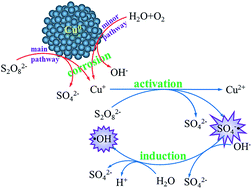
Recently, persulfate (PS) has fascinated practitioners of water treatment as a promising oxidant for in situ chemical oxidation. In this study, zero valent copper (nZVC) particles were employed as an activator for PS to degrade organic contaminants. Benzoic acid (BA) was almost completely degraded in 25 min, and the nZVC/PS process exhibited a ubiquitous oxidizing capacity on various organic contaminants (including acid orange 7, nitrobenzene, dimethyl phthalate, diethylstilbestrol, bisphenol A, and 2,4-dichlorophenol). The mechanism investigation showed that PS can accelerate the corrosion of nZVC to release Cu+ in acidic aqueous conditions, and the reactive radicals were generated through the further activation of PS by intermediate Cu+ via a Fenton-like reaction. Both sulfate radical (SO4−˙) and hydroxyl radical (˙OH) were considered as the primary reactive radicals in the nZVC/PS process due to the intense inhibition with the addition of methanol (MA) and tert-butyl alcohol (TBA). Moreover, the degradation rate of BA increased gradually with an increase of nZVC dosage, and the decrease of the initial pH range from 5.4 to 2.0.
 Please wait while we load your content...


