

Fe0 and Fe0 fully covered with Cu0 (Fe0 + Fe/Cu) in a fixed bed reactor for nitrate removal†
Yi Ren,
Jinfan Zhou,
Bo Lai*,
Wenjing Tang and
Yan Zeng
Department of Environmental Science and Engineering, School of Architecture and Environment, Sichuan University, Chengdu 610065, China. E-mail: laibo@scu.edu.cn; Fax: +86 18682752302; Tel: +86 18682752302
First published on 8th November 2016
Abstract
To develop a cost-effective, feasible and robust technology for nitrate removal by chemical degradation, a Fe0 and Fe0 fully covered with Cu0 (i.e., Fe0 + Fe/Cu) fixed reactor was set up in this study. The performance and mechanism of the Fe0 + Fe/Cu system for nitrate reduction were investigated thoroughly. First, the initial pH of the solution and the mass ratio of Fe0 and Fe/Cu (i.e., M(Fe0)/M(Fe/Cu) ratio) in the medium materials were optimized, and then two control experiments (Fe0 + quartz sand system and Fe0 + Cu0 system) were set up to confirm the superiority of the Fe0 + Fe/Cu system. The results suggest that high NO3−–N removal (>99.0%), Kobs (0.403 min−1) and low NH4+–N generation rate (61.1%) could be obtained by the developed system (Fe0 + Fe/Cu) with a short hydraulic retention time (HRT = 16 min). In addition, the operational life of the Fe0 + Fe/Cu system and Fe0 + quartz sand system were investigated comparatively, which shows that the operational life of the former was much longer than that of the latter. Finally, characteristics of the medium materials in the Fe0 + Fe/Cu system and Fe0 + quartz sand system were also observed by scanning electron microscopy (SEM) and energy dispersive spectrometry (EDS) before and after long-term operation. Therefore, the developed system in this study is a promising technology for nitrate contaminated water treatment.
1. Introduction
Nowadays, with deepening research into the hazards of inorganic salts, nitrate, as a main contaminant in natural waters and wastewater, has become a focus of concern in the environmental field. NO3−–N could be discharged by agricultural runoff, landfill leachate, animal feeding operations and industrial waste.1–3 Higher NO3−–N concentration than Maximum Concentration Level (MCL) in drinking water, ground water and direct contact water could cause significant risk to public health, such as blue baby syndrome, liver damage, methemoglobinemia and the development of cancer when it is reduced in the form of nitrite.4–7 Reverse osmosis,8 electrodialysis,9 biological denitrification10 are usually used to treat nitrate contaminated waters. However, all of these processes suffer from the limitation of high costs or low effect.Zero valent iron (ZVI or Fe0), a kind of common material for contaminated water treatment, has been used to treat the water contaminated with chlorihated organic compounds (COCs), nitroaromatic compounds (NACs), arsenic, heavy metals, nitrate, dyes, phenol etc.5,6,11 Also, ZVI system was developed as the medium materials in fixed bed due to the high effect and low costs. In particular, nitrate was a kind of typical pollutant which could be effectively treated by fixed bed by chemical degradation with ZVI based system.12,13 Nitrate can mainly be reduced to NH3, N2 and NH4+ by ZVI, and the ZVI may be oxidized to Fe2+, Fe3+, Fe2O3, or Fe3O4.14,15 In literature, it has been reported that due to the high potential difference (0.78 V) between Cu0 and Fe0, mixture of Fe0 (ZVI) and Cu0 can enhance the rates of pollutants reduction remarkably.16,17 These have been studied by previous authors, and the results show that catalytical metal can assist the electron transfer from Fe0 to NO3− by forming galvanic cell, which can enhances the effect.4
Furthermore, the treatment efficiency of ZVI system is relatively low, and it is also limited extremely by the pH value.18 In addition, Fe0 particles could be passivated after long-term operation because of the production of iron oxides.19 Even though the inert materials, such as sand were added in the system, this problem still exists. In order to mitigate these defects of Fe0 system, Fe0 + transition metal (e.g., Cu0, Ni0 and Pd0) system were investigated,20–22 which could not only enhance treatment effect and broaden pH range for application, but also restrict the phenomenon of harden and caking. For example, in Fe0 + Cu0 system, due to the high potential difference (0.78 V) between Cu and Fe and the galvanic corrosion reacted on the surface of particles,22–25 the treatment efficiency could be enhance extremely, and the pH range for application could also be broaden. In addition, because the Cu0 particles do not react with pollutants (such as nitrate), the phenomenon of harden and caking could also be restricted.21 However, the high cost of these transition metals is a significant limiting factor of this system for practical application.
To resolve the high cost problem of these transition metals, the Fe/Cu bimetallic particles (i.e., Fe0 fully covered with Cu0) was prepared in this study. Since only a thin copper film was deposited on Fe0 surface, the cost of Fe/Cu bimetallic particles is much lower than that of Cu0 particles. Furthermore, mixture of Fe0 and Fe/Cu bimetallic particles was used as medium materials to develop a Fe0 + Fe/Cu system in this study with high potential difference (between Cu0 on Fe/Cu bimetallic particles and Fe0 on Fe particles)26,27 and inert materials. In particular, Fe0 + Fe/Cu system for NO3−–N removal and NH4+–N generation were investigated thoroughly. Effects of initial pH and mass ratio of Fe0 and Fe/Cu (i.e., M(Fe0)/M(Fe/Cu) ratio) on the treatment efficiency were studied, respectively. Meanwhile, to confirm the superiority of Fe0 + Fe/Cu system, two control experiments (Fe0 + Cu0 system and Fe0 + quartz sand system) were setup, and the operational life of Fe0 + Fe/Cu system and Fe0 + quartz sand system were investigated. Finally, the particles in Fe0 + Fe/Cu system and Fe0 + quartz sand system were observed by scanning electron microscope (SEM) and energy dispersive spectrometer (EDS) after operational life experiments.
2. Experimental
2.1 Reagents
NaNO3 (analytical reagent), CuSO4·5H2O (analytical reagent), ethylene diamine tetraacetic acid disodium salt (Na2EDTA·2H2O) (analytical reagent), copper powders (Cu0) and zero valent iron (ZVI or Fe0) powders purchased from Chengdu Kelong chemical reagent factory were used in the experiments. ZVI powders have a mean particle size of approximately 120 μm, and their Fe content is above 99%. Cu powders have a mean particle size of approximately 50 μm, and their Cu content reaches above 99%. Two kinds of quartz sand have different particle size of 200 μm and 1 mm, respectively, and their SiO2 content reaches above 95%. Other chemicals used in the experiment were of analytical grade. Deionized water was used in all experiments.2.2 Preparation of Fe0 fully covered with Cu0 (i.e. Fe/Cu) particles
The micron-scale ZVI powder was used as the substrate material for the preparation of Fe/Cu bimetallic particles. The Fe/Cu bimetallic particles were prepared by displacement plating, via adding 400 mL solution with CuSO4·5H2O (29.30 g L−1) and Na2EDTA·2H2O (8.72 g L−1) to Fe particles (30 g L−1) and keeping certain plating temperature (30 ± 1 °C) and stirring speed (250 rpm).28 Then the prepared Fe/Cu bimetallic particles were separated from the supernatant immediately after plating process. Finally, the separated Fe/Cu bimetallic particles were rinsed three times with deionized water, three times with ethanol, and then they were dried under vacuum protection at 50 ± 1 °C for 2 hours.2.3 Experimental procedures
The experiments of nitrate reduction were conducted in a column reactor with a diameter of 30 mm and total length of 150 mm. Coarse quartz sand with particle size of 1 mm was used as fillers on the bottom height of 50 mm, and 60 g medium materials (i.e., Fe0 and Fe/Cu, Fe0 and Cu0, or Fe and quartz sand) were fully mixed, and then they were added above the coarse quartz sand in the column, respectively. Thus three experimental systems with different medium materials were set up, respectively. 200 mL NaNO3 solution ([NO3−–N] = 50 mg L−1) was used as model contaminated water, and the initial pH was adjusted by adding NaOH or H2SO4 solution (0.1 mol L−1). The feed water was circulated through the packed column by a peristaltic pump, and the empty bed hydraulic retention time was calculated by the medium materials volume and treatment time. The column reactor was performed at 25 ± 1 °C by water batch heating, and the flow rate of pump was 50 mL min−1. The configuration of reactor is shown in Fig. S1.† To investigate the Fe0 + Fe/Cu system thoroughly, the NaNO3 solution with different initial pH and the medium materials with different mass ratio of Fe0 and Fe/Cu (i.e., M(Fe0)/M(Fe/Cu) ratio) were studied. Furthermore, the effect was evaluated by the results of hydraulic retention time versus NO3−–N removal and hydraulic retention time versus NH4+–N generation. In addition, to confirm the superiority of Fe0 + Fe/Cu system, two control experiments, (a) Fe0 + quartz sand system and (b) Fe0 + Cu0 system were setup. The mass ratio of Fe0 of medium materials and initial pH of NaNO3 solution in the control experiments were same to the optimal conditions of Fe0 + Fe/Cu system. Samples were taken from the system at intervals by withdrawing 1 mL of sample solution, and NO3−–N concentration and NH4+–N concentration were detected. Furthermore, the operational life of Fe0 + quartz sand system and Fe0 + Fe/Cu systems was also investigated comparatively. A certain amount of NaNO3 solution was used as feed water once, and it was treated according to the best hydraulic retention time, which could reach 99.0% NO3−–N removal (obtained in above experiments). The operational conditions were same as them in the control experiments. Feed water was changed, and NO3−–N concentration and released iron ions concentration in solution were detected after each circulation. Finally, the particles were taken of SEM and EDS after operational life experiments.2.4 Analytical method
Nitrate measurement was achieved by the ultraviolet spectrophotometric method at 220 nm and 275 nm. Ammonium was measured using its reaction with Nessler to form complex compound at 420 nm.14 The released Fe2+ was determined as phenanthroline method at 510 nm. The released iron ions (Fe2+ and Fe3+) was analyzed as Fe2+ after its reduction using hydroxylamine hydrochloride.14The particles were observed by JSM-7500F scanning electron microscopy (SEM, JEOL, Japan). In addition, the surface elementary composition of the particles was analyzed by energy dispersive spectrometry (EDS). EDS analysis was carried out by a permanent thin film window link (Oxford Instruments) detector and WinEDS software in a JEOL JSM-7500F scanning electron microscope (SEM). At the end, this instrument was operated at 25 kV and emission current of 60–70 μA. The pH was measured by a pHS-3C meter (Rex, China).
3. Results and discussion
3.1 Effect of initial pH of solution
In literature, it is reported that the performance of ZVI system can be affected seriously by the initial pH.29,30 Effect of the initial pH (3.0–9.0) on the NO3−–N removal and NH4+–N generation by Fe0 + Fe/Cu system were evaluated thoroughly. Meanwhile, M(Fe0)/M(Fe/Cu) ratio was 1.00 in Fe0 + Fe/Cu system. Fig. 1(a) shows the logarithmic plots of residual concentration of NO3−–N in solution versus the hydraulic retention time with different initial pH, and a good linear fitting was observed in the treatment system. The results indicate that the rates of NO3−–N removal with different initial pH of the solution were described by the observed pseudo-first-order as shown as follows:
 | (1) |
| Kobs = −0.037pH + 0.447 | (2) |
 | ||
| Fig. 1 Reduction kinetics (a) and Kobs values (b) for NO3−–N removal, and [NH4+–N]/[NO3−–N removal] ratio (c) obtained by Fe0 + Fe/Cu system with different initial pH (experiment conditions: initial NO3−–N concentration of 50 mg L−1, M(Fe0)/M(Fe/Cu) ratio of 1.00, and total mass of Fe0 and Fe/Cu of 60 g). | ||
Eqn (2) can be used to estimate the potential effect of initial pH variability on Kobs of PNP reduction. However, the slope of this equation was lower compared with that in Fe0 system for pollutant degradation in previous studies.31 Fig. 1(c) shows that there is no obvious difference about NH4+–N generation among the systems with different initial pH of solution, and [NH4+–N]/[NO3−–N removal] ratio of all of these systems reached 63.0% to 65.0% at the end of the treatment processes.
The low initial pH could support enough [H+] which could accelerate the corrosion rate of Fe particles in the Fe0 + Fe/Cu system and keep their fresh surface. Suzuki et al.32 and Xiaomeng et al.33 reported that NO3−–N directly received electrons from ZVI through an iron corrosion product layer and ions in ZVI system. In addition, the existence of Fe2+ could enhance the reduction effect of nitrate remarkably,15,34 and high H+ concentration can accelerate the generation of Fe2+. According to the conclusions from the studies of previous authors,33,35 the main reaction equations of nitrate reduction was shown in eqn (3)–(8) as follows:
| 10Fe0 + 6NO3− + 3H2O + 6H+ → 5Fe2O3 + 3H2O + 3N2 | (3) |
| 5Fe0 + 2NO3− + 12H+ → 5Fe2+ + N2 + 6H2O | (4) |
| 4Fe0 + NO3− + 10H+ → 4Fe2+ + NH4+ + 3H2O | (5) |
| 2.82Fe0 + NO3− + 0.75Fe2+ + 1.75H2O + 0.50H+ → 1.19Fe3O4 + NH4+ | (6) |
| 4Fe0 + NO3− + 10H+ → 4Fe2+ + NH4+ + 3H2O | (7) |
| 8Fe2+ + NO3− + 10H+ → 8Fe3+ + NH4+ + 3H2O | (8) |
The equations show that the reduction processes consume H+, which could also explain the better effect under lower initial pH condition. However, initial pH influences the NO3−–N removal effect remarkably with Fe particles treatment32,36 while relatively slightly in Fe0 + Fe/Cu system. This result could be explained by the theory that the existence of Fe/Cu bimetallic particles formed lots of Fe–Cu cells, and the catalytic performance of Cu could make the galvanic corrosion happen on the surface, which could obtain relatively high reactivity even though the initial pH is high in the solution.37 The similar results were also concluded in our previous studies.38
Also, researchers reported that the selectivity of nitrate reduction (ammonia or nitrogen) could be influenced by the initial pH of solution in iron based system, because nitrate is first reduced to nitrite as an intermediate product, and then nitrite was converted to nitrogen or ammonia.39,40 Therefore, the hydrogenation of NO2− is a key process in determining the selectivity, and researchers have found that lower pH contribute to less ammonia generation. On the contrary, in Fe0 + Fe/Cu system, initial pH of the solution was not influence the selectivity remarkably, which could be explained by that the main influence factor of hydrogenation process was Fe0 and Fe/Cu particles conditions,40 and thus initial pH in this system influences the selectivity relatively slightly. Lower pH in solution accelerates the corrosion rate of Fe particles, which can enhance the consumption rate of the Fe particles, and thus the costs of this system will increase. In addition, the initial pH of natural water and wastewater water is usually neutral, and adjusting to lower pH can also increase the costs and cause secondary pollution. The H+ in waters also need to be neutralized after the system treatment. Consequently, considering these factors, initial pH of 7.0 was selected as the optimal condition in the subsequent experiments to investigate the effect of M(Fe0)/M(Fe/Cu) ratio on NO3−–N removal and NH4+–N generation.
3.2 Effect of M(Fe0)/M(Fe/Cu) ratio of medium materials
The M(Fe0)/M(Fe/Cu) ratio of medium materials is also a significant factor influencing the efficiency of NO3−–N removal in Fe0 + Fe/Cu system, and thus the effect of M(Fe0)/M(Fe/Cu) ratio of medium materials on NO3−–N removal and NH4+–N generation was evaluated keeping the initial pH of 7.0 ± 0.1 in solution. Fig. 2(a) and (b) shows the NO3−–N removal with different M(Fe0)/M(Fe/Cu) ratio, which demonstrates that all followed the pseudo first-order kinetics model. It is clear that Kobs increased gradually to the maximum (0.404 min−1) when M(Fe0)/M(Fe/Cu) ratio increased from 0.50 to 0.67. And then it began to decrease with the further increase of M(Fe0)/M(Fe/Cu) ratio (from 0.67 to 2.00). The hydraulic retention time was 16 min reaching 99.0% NO3−–N removal with M(Fe0)/M(Fe/Cu) ratio of 0.67. Also, the system with Fe0 alone (i.e. Fe particles system) had low Kobs value, which was only 0.0749. In addition, as shown in Fig. 2(c), at the end of the treatment processes, the ratio of [NH4+–N]/[NO3−–N] decreased (0.50 to 0.85), increased (0.85 to 1.00) and then kept steady (1.00 to 2.00) with the M(Fe0)/M(Fe/Cu) ratio increase. The lowest ratio obtained from the experiments is 56.4% with the M(Fe0)/M(Fe/Cu) ratio of 0.85. Higher ratio of [NH4+–N]/[NO3−–N removal] was detected with Fe0 alone (72.3%). | ||
| Fig. 2 Reduction kinetics (a) and Kobs values (b) for NO3−–N removal, and [NH4+–N]/[NO3−–N removal] ratio (c) obtained by Fe0 + Fe/Cu system with different M(Fe0)/M(Fe/Cu) ratios (experiment conditions: initial NO3−–N concentration of 50 mg L−1, initial pH of 7.0 ± 0.1, and total mass of Fe0 and Fe/Cu of 60 g). | ||
The influence of theoretical Cu mass loading on ZVI in Fe/Cu bimetallic particles system for wastewater treatment has been investigated thoroughly in our previous studies.28 In this study, the influence of M(Fe0)/M(Fe/Cu) ratio of medium materials has the similar theory with that. Due to the dense, uniform and fully covered Cu on the Fe/Cu bimetallic particles, the galvanic couple formation and electron transfer were between Cu layer on Fe/Cu metallic particles and Fe particles. The results can be explained as follows. When M(Fe0)/M(Fe/Cu) ratio is higher (more than 0.67), the decrease of the ratio can enhance the contact area between Cu and Fe0 by enhancing the proportion of Cu (on Fe/Cu metallic particles), which can form more Fe–Cu cell and improve the rate of electron transfer, and thus the reduction rate of nitrate can also be increased. When M(Fe0)/M(Fe/Cu) ratio is lower (less than 0.67), with the decrease of this ratio, the contact area between Cu and Fe0 will be decreased gradually, which goes against the electron transfer. Also, the Fe particles mass was not enough for the reaction of the nitrate reduction process when the M(Fe0)/M(Fe/Cu) ratio was little, which also caused the decrease of the efficiency of NO3−–N removal. The efficiency of NO3−–N removal was low with Fe0 alone, which concluded that Fe0 + Fe/Cu system was much superior to Fe particles system on nitrate reduction.
Furthermore, the kind of reduction product of nitrate could be controlled by optimizing M(Fe0)/M(Fe/Cu) ratio of medium materials. The change of this ratio might influence the path of nitrate reduction, and thus influence the generation of ammonia, which has the similar result with the (Pd–Cu)–nFe0 system investigated by the previous authors.41 It has been known that the activated hydrogen adsorbed producing by electron transfer process on the active sites of catalytic metal can abstract oxygen from nitrite, and then two nitrogen atoms are consecutively bonded to form nitrogen gas in bimetallic particles system.39 When the amount of Fe/Cu bimetallic particles were increased, the concentration of atomic hydrogen adsorbed on active sites of Cu layer might be increased, resulting in the enhancement of nitrogen gas selectivity. However, too low ratio of M(Fe0)/M(Fe/Cu) can cause the decrease of the amount of reactant, Fe particles, which could restrict the reaction rate and path, and thus increased the ratio of [NH4+–N]/[NO3−–N removal]. According to the results, with the M(Fe0)/M(Fe/Cu) ratio of 0.85, the degradation process achieved better path for less NH4+–N generation. Considering the results of NO3−–N removal and NH4+–N generation, M(Fe0)/M(Fe/Cu) ratio of 0.67 was chosen as the optimal condition in the following experiments.
3.3 Control experiments
As a traditional system for nitrate contaminated water treatment in fixed bed, Fe0 + quartz sand system has been used in industry for several years. In recent years, the Fe0 + transition metal systems was also developed, and this new system (i.e. Fe0 + Fe/Cu system) was based on the Fe0 + transition metal systems (Fe0 + Cu0 system). Therefore, to investigate the superiority of Fe0 + Fe/Cu system, two control experiments, (a) Fe0 + Cu0 system and (b) Fe0 + quartz sand system were setup. Both of these two control experiments have same initial pH (7.0 ± 0.1) in solution and M(Fe0)/M(Fe/Cu) ratio (0.67) of medium materials. Fig. 3 shows that best efficiency of nitrate reduction was obtained by Fe0 + Fe/Cu system treatment. The Kobs value of NO3−–N removal of Fe0 + Fe/Cu system (0.404) was much higher than that obtained in Fe0 + Cu0 system (0.109) and Fe0 + quartz sand system (0.0282). The NO3−–N removal reached 99.0% with the hydraulic retention time of 16 min by Fe0 + Fe/Cu system, however, which of that reached 99.0% with the hydraulic retention time of 32 min and 128 min by Fe0 + Cu0 particle system and Fe0 + quartz sand system, respectively. Furthermore, the NH4+–N generation in solution was also detected in these three systems. As shown in Fig. 3(c), the ratio of NH4+–N generation versus NO3−–N removal was lowest in the solution treated by Fe0 + Fe/Cu system, [NH4+–N]/[NO3−–N removal] ratio of which were only 61.07% at the end of treatment. And that of the solution by Fe0 + Cu0 system and Fe0 + quartz sand system were 70.2% and 72.3%, respectively. | ||
| Fig. 3 Reduction kinetics (a) and Kobs values (b) for NO3−–N removal, and [NH4+–N]/[NO3−–N removal] ratio (c) obtained by different treatment systems (experiment conditions: initial NO3−–N concentration of 50 mg L−1, initial pH of 7.0 ± 0.1, M(Fe0)/M(other materials) of 0.67, and total mass of Fe0 and other materials of 60 g). | ||
The results show stronger efficiency of NO3−–N removal and less NH4+–N generation in the solution by Fe0 + Fe/Cu system. Compared with Fe0 + quartz system, the superiority of that was obvious. The reaction rate increased with the existence of Cu layer by forming Fe–Cu galvanic cell, which could enhance the rate of electron transfer.26,42 In addition, the contribution of more nitrogen and less ammonia generation by catalytic metal with the formation of galvanic cell in bimetallic particles system has been reported.39,43,44 The reaction path could change with the Cu as catalyst, which cause reduction of NH4+–N generation. And compared with the Fe0 + Cu0 system, the Fe0 + Fe/Cu system also shows better effect of NO3−–N removal and NH4+–N generation. These results could be explained by the following theories. (i) Because particle size of the Cu particles is relatively small, the Cu particles and Fe particles have different mechanics characteristics, which could cause the uneven mixture between Fe0 and Fe/Cu bimetallic particles, and thus could cause the decrease of contact between Fe0 and Cu0 and goes against the electron transfer. (ii) The Cu layer on Fe/Cu particles was fresh, and little of it was oxidized by oxygen or other oxidant. However, Cu particles might have copper oxide and lower reactivity on their surface, which reduce the amount of Cu particles with catalytic activity, and thus worse effect was obtained by Fe0 + Cu0 system.
3.4 The operational life of Fe0 + quartz sand system and Fe0 + Fe/Cu system
In order to confirm the superiority of operational life of Fe0 + Fe/Cu system, the operational life of Fe0 + Fe/Cu system and Fe0 + quartz sand system were investigated. A certain amount of NaNO3 solution was used as feed water once, and it was treated with the obtained best hydraulic retention time in Fe0 + Fe/Cu system (64 min per circulation) and Fe0 + quartz sand system (512 min per circulation), respectively. The operational conditions were same as them in the control experiments (initial pH of 7.0 ± 0.1 and M(Fe0)/M(Fe/Cu) ratio of 0.67). Feed water was changed, and NO3−–N concentration and released iron ions concentration in solution were detected after each circulation. 200 mL solution treatment is perceived as one time.The results are shown in Fig. 4. The Fe0 + Fe/Cu system was operated 180 times, and the Fe0 + quartz sand system was operated 85 times. The NO3−–N removal and released iron ions concentration in effluent were 95.3% and 9.72 mg L−1 after first 4 times treatment, decreased to 49.2% (less than 50%) and 7.09 mg L−1 at 56 times, and decreased to 8.2% (less than 10%) and 3.38 mg L−1 at 80 times in solution by Fe0 + sand quartz system treatment, respectively. And they were 95.8% and 10.98 mg L−1 after first 4 times treatment, decreased to 44.7% (less than 50%) and 5.92 mg L−1 at 96 times, and decreased to 9.5% (less than 10%) and 2.27 mg L−1 at 160 times in solution by Fe0 + Fe/Cu system treatment, respectively. The total nitrate (NO3−–N) reduction was 615 mg by Fe0 + quartz sand system and 1127 mg by Fe0 + Fe/Cu system, respectively. The Cu2+ or Cu1+ was not detected in whole experiments.
 | ||
| Fig. 4 NO3−–N removal and released iron ions concentration in the effluent obtained by two treatment systems (i.e., Fe0 + Fe/Cu and Fe0 + quartz sand) with different frequency wastewater circulation (experiment conditions: initial NO3−–N concentration of 50 mg L−1, initial pH of 7.0 ± 0.1, M(Fe0)/M(other materials) of 0.67, and total mass of Fe0 and other materials of 60 g). | ||
According to the results, the Fe0 + Fe/Cu system also shows much longer operational life than the Fe0 + quartz sand system. The released iron in solution could indicated the corrosion degree of Fe particles, and the previous authors have reported that Fe2+ and Fe3+ in solution could increase the effect of nitrate reduction remarkably,45,46 and thus, the theories could explain the better performance of Fe0 + Fe/Cu system and the positive correlation change law of NO3−–N removal and released iron ions concentration in effluent. During the late treatment, the caking and weaker reactivity could cause the reduction of released iron ions concentration in the solution.
In addition, the results about NO3−–N removal effect could be explained by following theories. (i) The Fe0 + Fe/Cu system could change the rate and path of electron transfer,4 which could influence the path of nitrate reduction. The process in Fe0 + quartz sand system might cause the production of iron oxides cover the Fe particles, and the existence of Cu might reduce the amount of iron oxides on the surface of Fe particles. (ii) Due to the difference mechanics characteristics of Fe particles and quartz sand, the treatment process can cause the uneven mixture between Fe0 and quartz sand, and thus the system became harden and caking and formed solidified zone after several times treatment.47 However, the Fe particles and Fe/Cu bimetallic particles in Fe0 + Fe/Cu system have similar mechanics characteristics, and dense, uniform and fully covered Cu layer is also inert material in this system. Therefore, it could relief that phenomenon and increases the operational life of this system. (iii) Fig. 4 shows that released iron ions concentration in solution treated by Fe0 + Fe/Cu system were higher than that treated by Fe0 + quartz sand system at the same number of treatment, and thus better performance was shown in Fe0 + Fe/Cu system.15,45 (iv) During the late treatment process, the Cu layer could abscise, and the Fe/Cu bimetallic particles also could react with the NO3−. Consequently, the Fe0 + Fe/Cu system has more activated Fe0, and could support longer operational life. (v) The Fe0 + Fe/Cu system has much higher rate for nitrate reduction which cut the treatment time of this system, and thus the extra corrosion consumption of Fe particles could be reduced. The total amount of nitrate reduction could hence be enhanced.
3.5 SEM and EDS analyses
In order to identify the morphologies and composition of particles in Fe0 + Fe/Cu system and Fe0 + quartz sand system, SEM and EDS analysis were used in this study. The SEM and EDS of fresh Fe particles and quartz sand and Fe particles in Fe0 + quartz sand system after 50 times reacted and 85 times reacted are shown in Fig. 5 and them of fresh Fe/Cu bimetallic particles and Fe particles and Fe/Cu bimetallic particles in Fe0 + Fe/Cu system after 50 times reacted and 180 times reacted are shown in Fig. 6. | ||
| Fig. 5 SEM-EDS spectra of (a) fresh Fe particles before reacted, (b) quartz sand particles and (b*) Fe particles from Fe0 + quartz sand system after 50 times reacted, and (c) quartz sand particles and (c*) Fe particles from Fe0 + quartz sand system after 85 times reacted. | ||
 | ||
| Fig. 6 SEM-EDS spectra of (a) fresh Fe/Cu bimetallic particles before reacted, (b) Fe particles and (b*) Fe/Cu bimetallic particles from Fe0 + Fe/Cu system after 50 times reacted, and (c) Fe particles and (c*) Fe/Cu bimetallic particles from Fe0 + Fe/Cu system after 180 times reacted. | ||
As shown in Fig. 5(a), no O element was detected on Fe particles before reacted. In Fig. 5(b*) the composition of the Fe particle in Fe0 + quartz sand system after 50 times reacted was shown and the punctiform iron oxides could be observed in SEM imaging. The particle-state Fe particles in Fe0 + quartz sand system after 85 times reacted were difficult to find, and thus the Fig. 5(c) is imaging and composition of quartz sand with iron oxides on its surface, and Fig. 5(c*) is them of Fe particles from caking.
Fig. 6(a) shows the fresh Fe/Cu bimetallic particle in Fe0 + Fe/Cu system. No O element was detected on the particle, and the particle was spongy, the shape of which was same as that of Fe particles.28 This could also confirm that the Fe/Cu bimetallic particles have fresh, dense, uniform and fully covered Cu layer on it. Fig. 6(b) is about the Fe particle and Fig. 5(b*) is about the Fe/Cu metallic particles in Fe0 + Fe/Cu system after 50 times reacted. 6.56% Cu and 39.55% O was detected on the Fe particle, respectively. The Fe/Cu metallic particle still keep spongy and O was also detected on it. Fig. 5(c) and (c*) are Fe particle and Fe/Cu bimetallic particle in Fe0 + Fe/Cu system after 180 times reacted, respectively. More than 40% of O was detected and oxides can be observed on both of these two particles. In addition, Fe particles shows more Cu on it while Fe/Cu shows less compared with them in Fe0 + Fe/Cu system after 50 times reacted.
In Fe0 + Fe/Cu system, the Fe/Cu bimetallic particles after 50 times reacted are still spongy and little Cu abscised. Little O element was detected on the surface of Fe/Cu bimetallic particles, which could be explained by that the O element might be from the formed iron oxides adsorbed on the surface of Fe/Cu bimetallic particles. The Cu layer could relief the formation of solidified zone, which has been mentioned above. The main heterogeneous reaction by Fe0 for NO3−–N at this phase are shown in Fig. 7(a). Therefore, most Fe and Fe/Cu still kept particle-state after 50 times reacted, while the Fe particles were harden and caking with same times treatment. The O element weight (%) was higher on the Fe particles in Fe0 + Fe/Cu system than them in Fe0 + quartz sand system. The total NO3−–N removal was much higher in Fe0 + Fe/Cu system, which cause more iron oxides formed. However, the Fe0 + Fe/Cu system still had better performance compared with the Fe0 + quartz sand system, which could be explained by that Cu layer in this system could assist the transfer of electron, and thus indicated better effect.
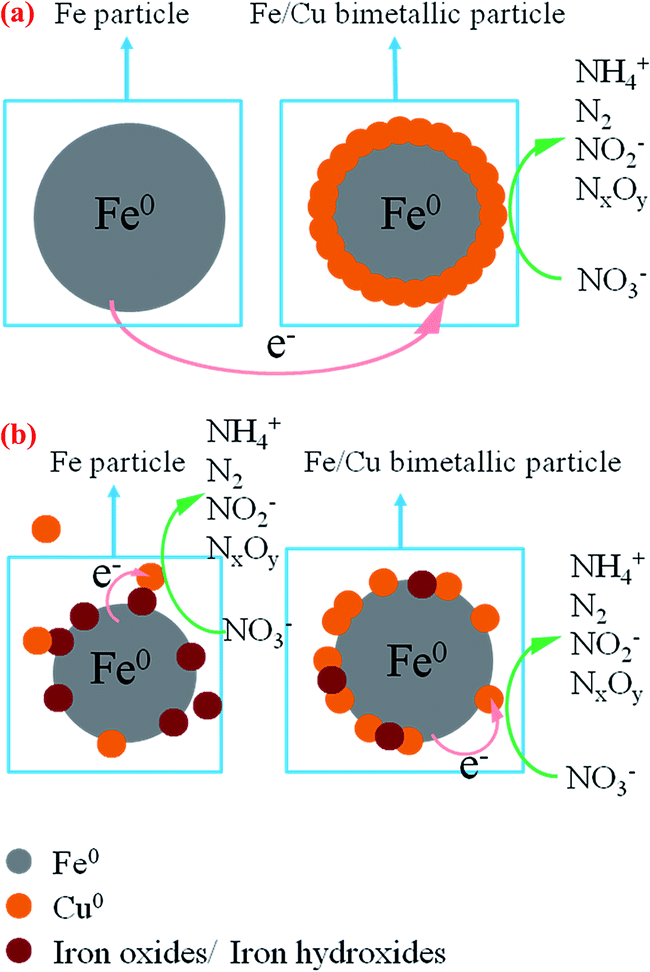 | ||
| Fig. 7 The main heterogeneous reaction mechanism of the Fe0 + Fe/Cu system (Fe0 for NO3−–N removal). | ||
Furthermore, some Cu layer on Fe/Cu bimetallic particles has abscised during the reacted process, and this caused some Fe0 of Fe/Cu metallic particles bare, and some Cu adhering on Fe particles. Consequently, the process of electron transfer for nitrate reduction with the catalysis of Cu could finish on one particle, and thus the rate of NO3−–N removal could further increase. In other word, the galvanic cell could also form between Cu layer of Fe/Cu bimetallic particles and Fe0 form Fe/Cu bimetallic particles (as shown in Fig. 7(b)). Also, the electron transfer process still could happen between Cu layer (abscised or on Fe/Cu bimetallic particles) and Fe0 from Fe0 particles. The main heterogeneous reaction by Fe0 for NO3−–N at this phase are shown in Fig. 7(a) (at first) and (b) (at later). And thus, much better performance were still kept in this phase compared with Fe0 + quartz sand system. However, with longer times treatment (more than 180 times), most of Cu was abscised and some iron oxide and iron hydroxide might adhered on the surface of Fe particles and Fe/Cu bimetallic particles, which could restrict the reactivity of this system extremely. The particles in Fe0 + Fe/Cu system have higher degree of oxidation compared with them in Fe0 + quartz sand system. This result could be explained by that the nitrate reduction in Fe0 + Fe/Cu system might mainly be achieved by iron ions, which have better performance than Fe0 and generate less iron oxides.14 In Fe0 + Fe/Cu system, the released iron ions were higher according to Fig. 4, and the precipitation of iron hydroxides might also be more. And in contrast, the Fe particles in Fe0 + quartz sand system might mainly reduce nitrate by producing iron oxides on their surface, and thus caused the formation of solidified zone. The fluidized state Fe particles were difficult to find in Fe0 + quartz sand system after 85 times reacted, because residual Fe particles have formed caking, which cannot continue to react for nitrate reduction. Considering above explanations, better performance for once reacted and longer operational life of Fe0 + Fe/Cu system could be explained.
3.6 Analysis of preparation cost
The cost of Fe particles, Cu particles and CuSO4·5H2O are about 200 USD per t, 4000 USD per t and 1500 USD per t, respectively. EDTA–2Na was not consumed in the Fe/Cu preparation process. The cost of Fe/Cu bimetallic particles are about 1370 USD per t. Therefore, the costs of medium materials of Fe0 + Fe/Cu and Fe0 + Cu0 were about 900 USD per t and 2480 USD per t, respectively. Also the Fe0 + Fe/Cu system showed better performance than Fe0 + Cu0 system and Fe0 + quartz sand system. Consequently, Fe + Fe/Cu system was a cost-effective technology for nitrate contaminated water treatment.4. Conclusions
The model nitrate contaminated water was effectively treated by the Fe0 and Fe0 fully covered Cu0 (Fe0 + Fe/Cu system) by chemical degradation. The optimal conditions (initial pH of 7.0 in solution and M(Fe0)/M(Fe/Cu) ratio of 0.67 of medium materials) were obtained, and under the optimal conditions, this system could obtain high NO3−–N removal (>99.0%) with short hydraulic retention time (HRT = 16 min), high Kobs value (0.403 min−1) and low NH4+–N generation rate (61.1%). In addition, its treatment ability was much higher than that of two control experiments. Furthermore, Fe0 + Fe/Cu system also shows the superiority of operational life. Finally, according to the analysis of SEM and EDS, the results could be confirmed. As conclusions, this system can be considered as a cost-effective, feasible and robust technology for nitrate contaminated water treatment.Acknowledgements
The authors would like to acknowledge the financial support from National Natural Science Foundation of China (No. 21207094), Fundamental Research Funds for the Central Universities (No. 2015SCU04A09) and Funds for Innovation and Entrepreneurship Training for College Students (Sichuan University).References
- K. Hiscock, J. Lloyd and D. Lerner, Water Res., 1991, 25, 1099–1111 CrossRef CAS.
- V. Joekar-Niasar and B. Ataie-Ashtiani, Environ. Geol., 2009, 57, 1785–1798 CrossRef CAS.
- S.-J. Liu, Z.-Y. Zhao, J. Li, J. Wang and Y. Qi, Water Res., 2013, 47, 5977–5985 CrossRef CAS PubMed.
- S. M. Hosseini, B. Ataie-Ashtiani and M. Kholghi, Desalination, 2011, 276, 214–221 CrossRef.
- A. B. Cundy, L. Hopkinson and R. L. Whitby, Sci. Total Environ., 2008, 400, 42–51 CrossRef CAS PubMed.
- F. Fu, D. D. Dionysiou and H. Liu, J. Hazard. Mater., 2014, 267, 194–205 CrossRef CAS PubMed.
- B. T. Nolan, B. C. Ruddy, K. J. Hitt and D. R. Helsel, Environ. Sci. Technol., 1997, 31, 2229–2236 CrossRef CAS.
- R. Rautenbach, W. Kopp, G. Van Opbergen and R. Hellekes, Desalination, 1987, 65, 241–258 CrossRef CAS.
- M. Bosko, M. Rodrigues, J. Z. Ferreira, E. Miró and A. Bernardes, J. Membr. Sci., 2014, 451, 276–284 CrossRef CAS.
- V. Vavilin and S. Rytov, Chemosphere, 2015, 134, 417–426 CrossRef CAS PubMed.
- M. Stefaniuk, P. Oleszczuk and Y. S. Ok, Chem. Eng. J., 2016, 287, 618–632 CrossRef CAS.
- R. Thiruvenkatachari, S. Vigneswaran and R. Naidu, J. Ind. Eng. Chem., 2008, 14, 145–156 CrossRef CAS.
- F. Obiri-Nyarko, S. J. Grajales-Mesa and G. Malina, Chemosphere, 2014, 111, 243–259 CrossRef CAS PubMed.
- C. Tang, Z. Zhang and X. Sun, J. Hazard. Mater., 2012, 231, 114–119 CrossRef PubMed.
- J. Xu, Z. Hao, C. Xie, X. Lv, Y. Yang and X. Xu, Desalination, 2012, 284, 9–13 CrossRef CAS.
- A. Koutsospyros, J. Pavlov, J. Fawcett, D. Strickland, B. Smolinski and W. Braida, J. Hazard. Mater., 2012, 219, 75–81 CrossRef PubMed.
- L. M. Ma and W. X. Zhang, Environ. Sci. Technol., 2008, 42, 5384–5389 CrossRef CAS PubMed.
- S. M. Hosseini and T. Tosco, J. Contam. Hydrol., 2015, 179, 182–195 CrossRef CAS PubMed.
- B. Lai, Y. X. Zhou and P. Yang, Ind. Eng. Chem. Res., 2012, 51, 7777–7785 CrossRef CAS.
- L. Yin, Y. Dai, J. Niu, Y. Bao and Z. Shen, J. Hazard. Mater., 2012, 209, 414–420 CrossRef PubMed.
- H. Lin, Y. Lin and L. Liu, J. Taiwan Inst. Chem. Eng., 2016, 58, 148–154 CrossRef CAS.
- L. M. Ma, Z. G. Ding, T. Y. Gao, R. F. Zhou, W. Y. Xu and J. Liu, Chemosphere, 2004, 55, 1207–1212 CrossRef CAS PubMed.
- S. J. Bransfield, D. M. Cwiertny, K. Livi and D. H. Fairbrother, Appl. Catal., B, 2007, 76, 348–356 CrossRef CAS.
- A. Ghauch and A. Tuqan, Chemosphere, 2008, 73, 751–759 CrossRef CAS PubMed.
- Z. Zheng, S. Yuan, Y. Liu, X. Lu, J. Wan, X. Wu and J. Chen, J. Hazard. Mater., 2009, 170, 895–901 CrossRef CAS PubMed.
- L. Sun, H. Song, Q. Li and A. Li, Chem. Eng. J., 2016, 283, 366–374 CrossRef CAS.
- A. Koutsospyros, J. Pavlov, J. Fawcett, D. Strickland, B. Smolinski and W. Braida, J. Hazard. Mater., 2012, 219–220, 75–81 CrossRef CAS PubMed.
- B. Lai, Y. Zhang, Z. Chen, P. Yang, Y. Zhou and J. Wang, Appl. Catal., B, 2014, 144, 816–830 CrossRef CAS.
- Y. Sun, J. Li, T. Huang and X. Guan, Water Res., 2016, 100, 277–295 CrossRef CAS PubMed.
- Y. Nakatsuji, Z. Salehi and Y. Kawase, J. Environ. Manage., 2015, 152, 183–191 CrossRef CAS PubMed.
- B. Lai, Z. Y. Chen, Y. X. Zhou, P. Yang, J. L. Wang and Z. Q. Chen, J. Hazard. Mater., 2013, 250, 220–228 CrossRef PubMed.
- T. Suzuki, M. Moribe, Y. Oyama and M. Niinae, Chem. Eng. J., 2012, 183, 271–277 CrossRef CAS.
- F. Xiaomeng, G. Xiaohong, M. Jun and A. Hengyu, J. Environ. Sci., 2009, 21, 1028–1035 CrossRef.
- J. Zhang, Z. Hao, Z. Zhang, Y. Yang and X. Xu, Process Saf. Environ. Prot., 2010, 88, 439–445 CrossRef CAS.
- C. Della Rocca, V. Belgiorno and S. Meriç, Desalination, 2007, 204, 46–62 CrossRef CAS.
- J. Rodríguez-Maroto, F. García-Herruzo, A. García-Rubio, C. Gómez-Lahoz and C. Vereda-Alonso, Chemosphere, 2009, 74, 804–809 CrossRef PubMed.
- W. Han, F. Fu, Z. Cheng, B. Tang and S. Wu, J. Hazard. Mater., 2016, 302, 437–446 CrossRef CAS PubMed.
- Y. Ren and B. Lai, RSC Adv., 2016, 6, 58302–58314 RSC.
- J. Shi, C. Long and A. Li, Chem. Eng. J., 2016, 286, 408–415 CrossRef CAS.
- Y. Lubphoo, J. M. Chyan, N. Grisdanurak and C. H. Liao, J. Taiwan Inst. Chem. Eng., 2016, 59, 285–294 CrossRef CAS.
- Y. Lubphoo, J.-M. Chyan, N. Grisdanurak and C.-H. Liao, J. Taiwan Inst. Chem. Eng., 2015, 57, 143–153 CrossRef CAS.
- J. Jung, S. Bae and W. Lee, Appl. Catal., B, 2012, 127, 148–158 CrossRef CAS.
- U. Prüsse and K.-D. Vorlop, J. Mol. Catal. A: Chem., 2001, 173, 313–328 CrossRef.
- I. Mikami, Y. Sakamoto, Y. Yoshinaga and T. Okuhara, Appl. Catal., B, 2003, 44, 79–86 CrossRef CAS.
- D. Shiers, D. Ralph and H. Watling, Hydrometallurgy, 2014, 150, 259–268 CrossRef CAS.
- J. Shi, S. Yi, H. He, C. Long and A. Li, Chem. Eng. J., 2013, 230, 166–171 CrossRef CAS.
- L. Carniato, G. Schoups, P. Seuntjens, T. Van Nooten, Q. Simons and L. Bastiaens, J. Contam. Hydrol., 2012, 142, 93–108 CrossRef PubMed.
Footnote |
| † Electronic supplementary information (ESI) available. See DOI: 10.1039/c6ra24014c |
| This journal is © The Royal Society of Chemistry 2016 |