Sufang Songabc,
Zhenhua Haoa,
Libo Donga,
Junguo Lia and
Yitian Fang*a
aState Key Laboratory of Coal Conversion, Institute of Coal Chemistry, Chinese Academy of Sciences, Taiyuan, 030001, P. R. China. E-mail: fyt@sxicc.ac.cn; Tel: +86 0351 4040492
bSchool of Chemical and Biological Engineering, Taiyuan University of Science and Technology, Taiyuan 030021, P. R. China
cUniversity of Chinese Academy of Sciences, Beijing 100049, China
First published on 8th November 2016
A bubble-based EMMS model for a Pressurized Fluidized Bed (PFB) was revised on the basis of an energy minimization multi-scale (EMMS) method. In the new revised model, in order to calculate the heterogeneous index accounting for the hydrodynamic disparity between heterogeneous and homogeneous fluidization, a bubble size correlation derived from experiments on a pressurized jetting fluidized bed with a conical distributor was introduced. With given operating pressure and gas superficial velocity, a heterogeneous index was calculated by integrating the bubble size correlation under elevated pressure with the EMMS model. The heterogeneous index, which decreased with the height above the distributor and also had its lowest lever when the mean voidage is in the range of (εmf, 1.0), was fitted into a surface and incorporated into Fluent as a user-defined function (UDF). The new bubble-based EMMS/PFB drag model was validated by predicting successfully the solid concentration distribution, the velocity of particles near the wall above the distributor, the radial profiles of particles' vertical motion and the average bubble size.
With the development of high performance computers and numerical algorithms, computational fluid dynamics (CFD) has become an effective way to study the gas–solid flow behaviors in fluidized bed. The two-fluid model (TFM), which assumes that the gas and solid flows were continuous, statistically averaged and fully interpenetrated into each other within each control volume,8 has been widely employed in various gas–solid flow researches. The physical assumption implies that homogeneous suspensions exist below the grid size and accordingly the meso-scale structures such as bubbles and clusters using TFM is much larger than the computational grid.9 But the fact is that the meso-scale structures described can be smaller than a coarse grid in many simulations. As a result, the accuracy of TFM with the homogeneous assumption and the scalability of simulations has been called into question.10
To take account for the influence of the heterogeneity structure of the flow, many methods are adopted in combination with the TFM, such as the energy minimization multi-scale (EMMS) model11 and filtered two-fluid model.12–16 The EMMS model developed by Li et al.11 resolved the heterogeneous structure of particle–fluid flows into a particle-rich dense phase in form of clusters or aggregates and a gas-rich dilute phase in form of dispersed particles. Through solving the equations about the two phases above and their inter-phase, an EMMS drag coefficient can be obtained and accordingly coupled with TFM in simulation. A great deal of researches with the employment of the EMMS model have derived reasonable results which agree with the experiments well.17–24 The original EMMS model was based on the concept of particles cluster and mainly applied to high-velocity circulating fluidized beds. The subsequent bubble-based EMMS model10 with replacement of particles clusters by bubbles was proposed for applications in bubbling fluidizations. Though the bubbles and clusters belong to the same family of non-uniform hydrodynamic solutions,25 it's easier to describe bubbles compared with the cluster. Many correlations of bubble size in the literatures26–28 are available for bubble-based EMMS model solution, among which Moro's correlation is adopted by Hongkun29 to simulate the flow in a CFB riser. However, the correlations mentioned above did not take the effect of operating pressure into consideration and little research pays attention to simulation of pressurized fluidized bed with the EMMS model. Bubble behaviors such as the size in pressurized fluidized bed determine the fluidization quality and therefore, a suitable correlation is of great importance for the accuracy of the simulation. In this paper, a bubble-based EMMS/PFB model is revised by introducing a bubble size correlation derived from experiments on a pressurized jetting fluidized bed with conical distributor. Gas–solid flow behavior of a pressurized jetting fluidized bed is simulated by coupling the new revised bubble-based EMMS/PFB model with the TFM and the results are compared to experimental data for verification.
| ρe = ρgεge + ρp(1 − εge) | (1) |
μe = μg[1 + 2.5(1 − εge) + 10.05(1 − εge)2 + 0.00273 exp(16.6(1 − εge))
| (2) |
![]() | (3) |
Table 1 summarizes the relevant parameters and formula of this model. For a given system with specified conditions (Ug, Up and εg), the flow states can be described by the eight parameters mentioned above (δb, εge, Ub, Uge, Upe, db, ae, ab). A whole set of balance equations can be built through the multi-scale analysis method to solve the parameters. It is assumed that the structure-dependent drag coefficient is isotropic when EMMS drag is coupled with TFM model, but only the scalars of vertical components are used in the bubble-based EMMS model analysis.
| Emulsion phase | Inter-phase | |
|---|---|---|
| Characteristic diameter | dp | db |
| Voidage | εge | δb |
| Superficial slip velocity | ![]() |
Uslip,i = (1 − δb)(Ub − Ue) |
| Characteristic Reynolds number | ![]() |
![]() |
| Standard drag coefficient28 | ![]() |
![]() |
| Effective drag coefficient31 | Cde = Cde0εge−4.7 | Cdi = Cdi0(1 − δb)−0.5 |
| Number density | ![]() |
![]() |
| Drag force on each particle or bubbles | ![]() |
![]() |
| Drag force in unit volume | Fde = meFe | Fdi = miFi |
![]() | ||
| Fig. 2 Bubble size varies with pressures and velocity by P. Cai.32 | ||
Thanks to the enhanced gas–solid interactions in the region above the jet, pressurized jetting fluidized beds are widely used in many industries such as chemical, pharmaceutical, and petrochemical. Different purposes can be accomplished by adjusting the designed velocity introduced from jets: to enhance mixing and heat transfer, supplement the reactant, control the reactions, or prevent slugging in the bed.1 In the pressurized jetting fluidized bed, the fluidization gas enters from the conical distributor and the jetting gas from the central jet. Flowing through the bed, the jetting gas will spread to the surrounding area from the centre of the bed and at the same time get the fluidization gas mixed up in the central gas. For most process such as coal gasification, the interaction between the fluidization gas and the jetting gas will promote the mass and heat transfer and strength the gas–solid contact. Furthermore, the conical distributor has the advantages of better anti-slagging compared with the plate distributor. However, everything has two sides, it also makes the bubble behaviors in the pressurized jetting fluidized bed more complex, which means more effort is needed to get reliable flow information in the bed.
In order to achieve the bubble size correlation, a bubble dynamics experiment was performed on a pressurized jetting fluidized bed.33 The experimental device is mainly composed of a two-dimensional jetting fluidized bed fluidized bed, a liquid nitrogen gas supply system, a pressure chamber, a mass flow meter, a probe fiber velocity measuring system and a camera system as shown in Fig. 3. A transparent Plexiglas jetting fluidized bed with 300 × 30 mm is put into the pressure chamber to study the movement of the particles. The fluidization gas supply for fluidized bed and pressurization gas supply for pressure chamber is provided by liquid nitrogen supply system. Flow control is accomplished by a parallel mass flow meter setup. The pressure chamber (Φ 1200 × 1600 mm) is capable of operating at design pressure up to 3.3 MPa. The velocity of particles is measured by PV-6 probe fiber velocimetry. Several CCD cameras are set into the chamber to record the flow information inside the bed.
The bubble information including shape, size, position and velocity is obtained by data treatment of the bubble images captured by CCD cameras. First, the fluidization in the bed is obtained on the desired pressure provided by the pressure vessel through the liquid nitrogen supply system. Then, several CCD cameras are employed to record the bubble information as a video, which is converted into a series of single image for subsequent data analysis. The size and position coordinate of bubbles can be extracted by image analysis software through the gray scale difference between bubbles and their surroundings. At the same time, the bubble rising velocity is calculated by the position change of the same bubble in two adjacent images.
Many correlations has been built for prediction of bubble size in the literature, among which P. Cai32 developed a generalized correlation which fitted the experimental data quite well for pressurized fluidized bed combustors. However, the influences of the angled distributor and the jetting gas velocity were not taken into account in P. Cai's correlation. As the same form of P. Cai's correlation, a new revised correlation with consideration of the factors mentioned above was achieved based on the experimental data obtained, as follows:
![]() | (4) |
Theoretically, the correlation is applicable to pressurized systems with central jetting and angled distributor gas inlet, in both bubbling and turbulent fluidization for group B particles like P. Cai's correlation. Correspondingly, the correction terms may change with the size and operation parameters of pressurized systems. Fig. 4 shows the bubble diameters from experiment in this study (P = 0.7 MPa, Uf − Umf = 0.3(0.35) m s−1) and calculation through eqn (4) fitted by averaged experimental data. The computed value is slightly higher than the measured value, the reason for which may lie in the inevitable errors in the extraction and measurement of bubbles. The average errors of the fitting are ±12.6% for relative values, which is acceptable to use in the solution of the nonlinear equations in the EMMS model below.
![]() | ||
| Fig. 4 Bubble size varies with height above distributor through experiment on the pressurized jetting fluidized bed and calculation from the correlation of eqn (4). | ||
![]() | (5) |
Force balance for the inter-phase: the drag force on the inter-phase counterbalance the effective gravity.
![]() | (6) |
Mass balance for the gas and particles: the net mass flow rate of the gas phase through any cross-section of the bed should be equal to the sum of the gas flow rate through both the dilute and dense phases. And the net mass flow rate of the particles through any cross-section should be equal to the sum of the particle flow rate through both the dilute and dense phases.
| Ug = Uge(1 − δb) + Ubδb | (7) |
| Up = Upe(1 − δb) | (8) |
The overall voidage of the system is calculated through the voidage of the dense phase and dilute phase as follows:
| εg = εge(1 − δb) + εgbδb | (9) |
![]() | (10) |
![]() | (11) |
From the analysis above, we can find that all the parameters involved (δb, εge, Ub, Uge, Upe, db, ab) can be solved by introducing the stability condition as an optimization function. Once the structural parameters in the model are determined, the effective drag coefficient can be calculated as:17
![]() | (12) |
A heterogeneous index is defined to describe the influence of heterogeneous structure on the drag coefficient as follows:
![]() | (13) |
![]() | (14) |
(1) For the given system with the operating pressure P, the superficial gas velocity Ug and physical parameters (ρp, ρg, μg), assign a big value for Nst and traverse the vertical height from the distributor H within the whole height of the bed, then calculate db from eqn (4).
(2) Sweep εg within the range of (εmf, 1.0). Sweep εge within the range of (εmf, εg).
(3) Calculate δb from eqn (9).
(4) Calculate Uslip,e from eqn (5), then Uge from the definition equation of Uslip,i in Table 1.
(5) Calculate Ub from eqn (7), then calculate Ue from eqn (3), calculate Uslip,i from the definition equation of Uslip,i in Table 1.
(6) Calculate ab from eqn (6).
(7) Calculate Nst from eqn (10), store it and the relevant set of six parameters if Nst is smaller than the previous values.
(8) Complete the sweeps of H, εg and εge, and then output the set of six parameters corresponding to minimum Nst.
(9) Calculate each βe-bubble and Hd, then correlate the parameters into Hd = f(H,εg).
The analysis presented in this work is based on the pressurized bubbling fluidized bed experiment system (P = 0.7 MPa, ρg = 7.87 kg m−3, ρs = 1020 kg m−3, dp = 132 μm, Ug = 0.74m s−1 and 2.1 m s−1, Umf = 0.19 m s−1, H = 0–1 m).
Fig. 5 shows the variation of heterogeneity index Hd with mean voidage εg and vertical distance from distributor H. In comparison with the Shi et al.'s scheme and correlation,10 Hd shows a drop with increase of the vertical distance from distributor H as shown in Fig. 5, the reason for which possibly be that when H becomes large, the size of bubble becomes bigger and the heterogeneity effect is strengthened. The heterogeneity index gap due to the vertical distance from distributor H is not negligible and it's very necessary to consider the influences of parameter H for the drag in the simulation. Another distinguished feature of Fig. 5 is that Hd has its lowest lever when the mean voidage is in the range of (εmf, 1.0). The reason may be that the bed gradually transforms into a uniform fluidization state near two ends of the curve Hd. Associate Hd with mean voidage εg and vertical distance from distributor H, a surface map can be derived as shown in Fig. 6. To verify this bubble-based drag model, a fitting equation about the surface map (seen in Table 2) is used to couple TFM with this new drag model.
![]() | ||
| Fig. 5 Variation of heterogeneity index Hd with εg and H (a) Ug = 0.74 m s−1 and (b) Ug = 2.1 m s−1. | ||
| a Where εd denotes the voidage at the intersection of the Hd function and unity. |
|---|
![]() |
| Symbol | Description | Unit | Simulations | Experiment |
|---|---|---|---|---|
| P | Operating pressure | MPa | 0.7 | 0.7 |
| ρp | Density of particles | kg m−3 | 1020 | 1020 |
| ρg | Gas density | kg m−3 | Changes with pressure | Changes with pressure |
| dp | Diameter of particles | m | 0.00132 | 0.00132 |
| μg | Gas viscosity | Pa s | Changes with pressure | Changes with pressure |
| εs,max | Packing limit | — | 0.63 | — |
| umf | Minimum fluidization velocity | m s−1 | 0.19 | 0.19 |
| esw | Particle–wall coefficient restitution | — | 0.99 | — |
| ess | Particle–particle coefficient restitution | — | 0.9 | — |
| ϕ | Specularity coefficient | — | 0.0001 | — |
| h0 | Initial bed height | m | 0.45 | 0.45 |
| Δt | Time step | s | 0.0001 | — |
![]() | (15) |
![]() | (16) |
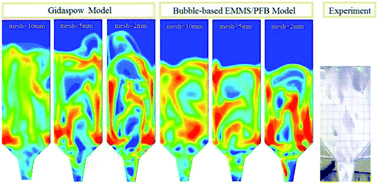
The size of the experimental pressurize jetting fluidized bed is 300 × 800 × 30 (mm) above the distributor, which may therefore be considered as a 2 dimensional geometry. Therefore, 2-D simulation is adopted in order to reduce computation time in this study. Fig. 7 sketches the simulated 2D pressurized fluidized bed. Quadrilateral meshes are generated with the type of pave at the scales of 2 mm, 5 mm, and 10 mm, respectively. Correspondingly, the total mesh set consists of 71
076, 11
314 and 2884 cells. Considering the accuracy of the results and the computation time cost by comparison of the above 3 mesh schemes (seen as Fig. 8), 5 mm mesh size was adopted afterwards if there is no special statement in this study.
The gas flows into the pressurized bed through the bottom inlet and the distributor respectively and leaves from the top outlet, where 0.7 MPa pressure is set by prescribing operating pressure boundary condition. Initially, the solid particles are uniformly distributed in the bed with a fixed voidage which is estimated from experimental data. The no-slip boundary was prescribed for the gas, while the partial–slip boundary developed by Johnson and Jackson38 was adopted for the solids with the specularity coefficient 0.6. Other detailed simulation setting parameters are list in Table 4.
In order to obtain the detailed information of the bubbling bed, two measurement points are also set on the jetting fluidized bed, as shown in Fig. 7, while the lower measurement point's coordinate (code named LBH) is x = 135 mm, y = 90 mm and the upper measuring point's (code named HBH) coordinates is x = 135 mm, y = 150 mm, as shown in Fig. 7.
In the simulations, the velocity both on the points LBH and HBH was monitored and the time–averaged values of velocity can be calculated. Both the drag models seem to reach their converged velocity. As shown in Fig. 9, on the point LBH, the predicted values of velocity are about 0.80 m s−1 from the Gidaspow drag model and 0.61 m s−1 from the new revised bubble-based EMMS/PFB drag model, respectively, while the experiment date is 0.55 m s−1. And on the point HBH, the predicted values of velocity are about 1.38 m s−1 from the Gidaspow drag model and 1.04 m s−1 from the new revised bubble-based EMMS/PFB drag model, respectively, while the experiment date is 0.91 m s−1. Obviously, the EMMS drag predicts the experimental value of velocity well.
![]() | ||
| Fig. 10 Radial time–averaged velocity profiles of particles at the height of 0.09 m (a) and 0.15 m (b). | ||
Though the revised bubble-based EMMS/PFB drag model and Gidaspow model are both with same trend and order for the solid velocity predictions, the former has a higher accuracy. Bubbles, one of the main meso-scale performance, have a great influence on the inter-phase heat and mass transfer. The bubble-based EMMS/PFB drag model can capture more obvious bubbles, even with a relatively courser grid size of 10 mm, as seen in Fig. 8. This is very valuable in engineering scale bed simulation.
| ab | Acceleration of bubble, m s−2 |
| ae | Acceleration of particles in emulsion, m s−2 |
| C1ε | Model constant in standard k–ε model, dimensionless |
| C2ε | Model constant in standard k–ε model, dimensionless |
| Cam | Coefficient of added mass force, dimensionless |
| Cde | Effective drag coefficient for a particle in emulsion phase, dimensionless |
| Cde0 | Standard drag coefficient for a particle in emulsion phase, dimensionless |
| Cdi | Effective drag coefficient for inter-phase, dimensionless |
| Cdi0 | Standard drag coefficient for a bubble, dimensionless |
| Cd0 | Standard drag coefficient for a particle, dimensionless |
| db | Bubble diameter, m |
| dp | Particle diameter, m |
| Fam | Added mass force per unit volume, kg m−2 s−2 |
| fb | Ratio of gas in the bubble phase to that in total, dimensionless |
| Fde | Drag force of emulsion phase in unit volume, (kg m−2 s−2) |
| Fdi | Drag force of bubble in unit volume, (kg m−2 s−2) |
| Fdb | Drag force of bubble phase in unit volume, (kg m−2 s−2) |
| Fe | Drag force on each particle in emulsion phase, (kg m−2 s−2) |
| Fi | Drag force on each bubble in inter-phase, (kg m−2 s−2) |
| G | Gravity acceleration, m s−2 |
| H | Vertical distance from the distributor, m |
| Hd | Heterogeneous index, dimensionless |
| me | Number density of emulsion phase, dimensionless |
| mi | Number density of inter-phase, dimensionless |
| Nst | Energy consumption for suspending and transporting particles, J s−1 kg−1 |
| P | Operating pressure, MPa |
| Ree | Characteristic Reynolds number of emulsion phase, dimensionless |
| Rei | Characteristic Reynolds number of inter-phase, dimensionless |
| Rei | Characteristic Reynolds number, dimensionless |
| Ub | Superficial gas velocity in the bubble phase, m s−1 |
| Ue | Average superficial velocity of the emulsion phase, m s−1 |
| Uf | Distributor gas velocity, m s−1 |
| Ug | Superficial gas velocity, m s−1 |
| Uj | Jetting gas velocity |
| Ugb | Superficial gas velocity in the bubble phase, m s−1 |
| Uge | Superficial gas velocity in the emulsion phase, m s−1 |
| Up | Superficial particle velocity, m s−1 |
| Upe | Superficial particle velocity in the emulsion phase, m s−1 |
| Umf | Superficial gas velocity at minimum fluidization, m s−1 |
| Uslip | Superficial slip velocity, m s−1 |
| Uslip,e | Superficial slip velocity of emulsion phase, m s−1 |
| Uslip,i | Superficial slip velocity of inter-phase, m s−1 |
| UΘt | Terminal velocity of particles under ambient pressure, m s−1 |
| Ut | Terminal velocity of particles under elevated pressure, m s−1 |
| ag | Volume fraction of gas phase in k–ε model, dimensionless |
| βe-bubble | Effective drag coefficient with structure in a control volume, kg m−3 s−1 |
| βw | Effective drag coefficient without structure in a control volume, kg m−3 s−1 |
| δb | Volume fraction of bubble phase |
| εg | Voidage |
| εmf | Incipient voidage |
| σk | Model constant in standard k–ε model, dimensionless |
| σs | Model constant in standard k–ε model, dimensionless |
| This journal is © The Royal Society of Chemistry 2016 |