Weifang Suab,
Tao Lin*a,
Wei Chu
*bc,
Yachao Zhubc,
Jing Lib and
Xiusong Zhaod
aKey Laboratory of Green Chemistry and Technology of Ministry of Education (MOE), College of Chemistry, Sichuan University, Chengdu 610064, PR China. E-mail: lintaochem@scu.edu.cn
bDepartment of Chemical Engineering, Institute of New Energy and Low-Carbon Technology, School of Chemical Engineering, Sichuan University, Chengdu 610065, China. E-mail: chuwei1965@scu.edu.cn
cSichuan Provincial Engineering Technology Center for Environmental Protection Catalytic Materials, Chengdu 610064, China
dDepartment of Chemical Engineering, University of Queensland, Brisbane 4067, Australia. E-mail: george.zhao@uq.edu.au
First published on 25th November 2016
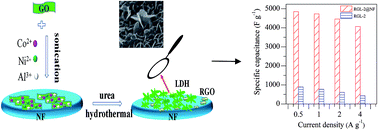
A novel nano-flower RGO/NiCoAl–LDH composite was fabricated through a smart binder-free hydrothermal process, for advanced electrochemical energy storage in supercapacitors. The morphology of the nano-flower structure was self-assembled using several nanosheets vertically interconnected with each flake, and the as-obtained nano-flower structure of the porous nanosheet morphology greatly enhanced the capacitance and the rate capacity of the electrode material for supercapacitors. When the composite was used in an electrode, the sample with 6.36 mg graphene oxide revealed surprising and optimized high performance. There was ultrahigh specific capacitance of 4732 F g−1 at 1 A g−1, and 4068 F g−1 at 4 A g−1, showing a good performance. The results exhibited the synergy and advantages of RGO with NiCoAl–LDH on a nickel foam carrier with nano-flower morphology. The results exhibit the superiority of the modified active metal substrate and elaborate graphene's influence on the material morphology. This will open up broad prospects for the future field of electrode materials for supercapacitors.
Graphene which has very high conductivity (26
000 S cm−1) and high specific surface area (2630 m2 g−1, theoretical value) can provide good electron transfer paths and can facilitate the dispersing of LDHs to avoid agglomerating.14–19 Furthermore, high conductivity with direct and reliable contact enhances the performance of LDH in supercapacitors and further develops its applications.19–21 So far, graphene-based supercapacitors have shown a very good prospect in the application of supercapacitors. Qiu et al. doped different kinds of nano-carbon into NiCoAl–LDH and discussed the role of nanostructured carbon in terms of the pore structure and electrical conductivity. The results show that the existence of CNT and graphene is more beneficial to improve their electrochemical performance. The nanohybrid electrode (LDH-CNT/RGO) displays the highest specific capacitance of 1188 F g−1 at a current density of 1 A g−1 and 850 F g−1 at 10 A g−1 (72% of the initial capacitance).12
Nickel foam, as a commercial material with high electronic conductivity and excellent 3D structure, has become the remarkable substrate material for electrode. It would not only reduce the diffusion resistance of electrolyte but also facilitate ion transportation and maintain electron pathways smoothly during the very rapid charge–discharge reactions. When the nickel foam is used as active substrate material, RGO/NiCoAl–LDH composite film can be in situ formed on the nickel foam surface. Nickel foam pore induce hydrotalcite crystal grown oriently.22,23 We believe that such combination not only simplifies the preparation process which is fussy and time-consuming, but also enhances the contact and adhesion between the LDH and RGO in the composite.24,25 Guo et al. fabricated Ni(OH)2/RGO on nickel foam though hydrothermal process and the hybrid has a super specific capacitance of 3328.7 F g−1 at 2.2 A g−1.25
In recent years, our team members have done a lot of work in the field of supercapacitor, especially on the research of nano-carbon reinforced electrode material. Zhu et al. have prepared a novel Ni/NiO/graphene and it delivered high specific capacitance of 1027.27 F g−1 at a current density of 2 A g−1 and 720 F g−1 at 20 A g−1.3 Zhao et al. prepared the composite material consisting of carbon-coated LiFePO4 and RGO sheets possesses a unique and effective three-dimensional “sheet-web” structure using an ultrasonic-assisted rheological phase method, the sample showed an excellent cycling stability with only about 10% capacity decay at 10C after 1000 cycles.2 Peng et al. were synthesized active carbon with the high BET surface area (2457 m2 g−1) and its specific capacitance can remain 95% after 5000 cycles.26
In this work, nickel foam was employed as an active substrate to prepare RGO/NiCoAl–LDH composite by a facile binder-free hydrothermal process for electrode material of capacitors, and the influence of the content of graphene oxide on the morphology and electrochemical performance were further discussed. As electrode materials for supercapacitors, the hybrids show a high specific capacitance and relatively good cycling stability, which suggest their potential application in supercapacitors.
The nickel foam (NF) (1 cm × 2 cm) was cleaned carefully by using an absolute ethyl alcohol solution with sonication for 2 h, then dried at 60 °C for 12 h in the oven. The synthesis of NiCoAl–LDH/RGO composite was carried out through a one-step hydrothermal process. The typical preparation process is clarified as follows: first, a certain amount of graphene oxide (GO) was uniformly dispersed in 40 mL of deionized water by ultrasonication for 2 h, then Ni(NO3)2·6H2O, Co(NO3)2·6H2O, Al(NO3)3·9H2O (the metal ion molar ratio 2
:
1
:
1) were dissolved in above solution with string 1 h, finally urea was dissolved in the above solution to obtain a mixed solution with the total metal ion and urea concentrations of 12 and 36 mM. The NF substrate was then immersed in this aqueous solution. The mixture was loaded into a 50 mL Teflon-lined stainless steel autoclave for hydrothermal reaction at 100 °C for 24 h. The amount of added GO was 4.26 mg, 6.36 mg, 8.48 mg, 10.6 mg, the corresponding hybrids growing on the nickel foam were remarked as RGL-1@NF, RGL-2@NF, RGL-3@NF, RGL-4@NF respectively. The residual precipitant were also collected, labelled as RGL-2/NF. The final product was washed with water and ethanol several times. The as-prepared product was dried at 60 °C in oven for the whole night.
For comparison, the composite which doped 6.36 mg GO was also synthesized under the identical conditions but without NF and was noted RGL-2.
:
1
:
1 in N-methyl-2-pyrrolidone (NMP), and the suspension was uniformly coated on a NF substrate with an area of 1 × 1 cm2 and then dried at 60 °C in an oven for the whole night. The other composite that with an approximate area of 1 × 2 cm2 were directly used as working electrodes, while a Hg/HgO electrode as the reference electrode and graphite electrode as the counter electrode, respectively. Cyclic voltammograms (CV), galvanostatic charge–discharge, and electrochemical impedance spectroscopy (EIS) measurements were carried out using an electrochemical workstation (CHI660e, Shanghai).
The surface functional groups of the corresponding samples and the effect of urea in the hydrothermal process are further confirmed by the Fourier transform IR (FT-IR) spectra. For GO, the bands at 1056 cm−1 and 1733 cm−1 are belonged to the stretching vibrations of C–O in alkoxy and C
O in carboxylic acid.3,30 The bands at 1216 cm−1 and 1623 cm−1 are the bending vibration from hydroxyl groups and the C
C stretching vibrations.31,32 Compared with the peak intensities of GO, the stretching vibration of C–O, C–O–C and C
O become weaker in RGO/LDH, it demonstrates that the most of GO in the hybrid have been reduced to RGO. At the same time, the peak intensities of –OH (around 3402 cm−1) in the RGO/LDH is stronger than RGO and the shape of peak is consistent with LDH's, indicating urea both has played a vital role in the reduction reaction of GO, and acts as the precipitant in the reaction process. Characteristic bands of the –OH stretching vibrations (the –OH groups are in the water molecules and the hydrogen bonding among the hydroxyl groups in the sample) located at around 3400 cm−1, companied with the bending vibrations at 1633 cm−1.33 The strong and sharp bands (1366 cm−1 and 823 cm−1) in NiCoAl–LDH can be attributed to the bending vibrations of carbonate ions intercalated in the lamellar structure.7 The bands below 1000 cm−1 are assigned to the translational modes of Co–OH, Al–OH and M–O–M bands.34–37 With the addition of RGO, the peak of 1366 cm−1 become weak, implying carbonate ions in the partial interlayer space are replaced by graphene flakes.
![]() | ||
| Fig. 3 CV curves of (a) RGL-2 and RGL-2@NF hybrid at a scan rate of 5 mV s−1. (b) Charge–discharge curves of RGL-2 and RGL-2@NF at 1 A g−1. | ||
The CV curves of the RGL-2@NF at different potential sweep rates are shown in Fig. 4(a). A symmetric shape during the charge–discharge process is observed at a low scan rate. Curves are out of shape as the scan rate increases, which is explained by the mechanism of electrochemical reactions that at low scan rates, the movement of OH− ions is slower than that at high scan rates, and the active materials have a higher utilization ratio. Most of the CV curves are symmetric which suggest the fine reversibility of the oxidation and reduction processes. Co(OH)2 and Ni(OH)2 may happen during the electrochemical reactions according to the following reactions.5,16,30–44
| Co(OH)2 + OH− → CoOOH + H2O + e− |
| CoOOH + OH− → CoO2 + H2O + e− |
| Ni(OH)2 + OH− → NiOOH + H2O + e− |
![]() | ||
| Fig. 4 (a) CV curves of the RGL-2@NF nanosheets at various scan rates; (b) galvanostatic charge–discharge curves of RGL-2@NF electrode measured at various current densities. | ||
Fig. 4(b) shows the galvanostatic charge–discharge property of RGL-2@NF composites. CV and GCD curves of the other hybrids are presented in Fig. S1–S4.† The specific capacitance Cs (F g−1) can be calculated as the following equation.16,44,45
| Cs = C/m = (I × Δt)/(m × ΔV) |
In order to investigate the impact of GO content, we have an electrochemical activity test for RGL-1@NF, RGL-2@NF, RGL-3@NF and RGL-4@NF. Galvanostatic charging–discharging at constant current density of 1 A g−1 is an effective method for exploring the influence of different graphene oxide content on their electrochemical properties. All the curves display a wide discharge plateau corresponding to the Faraday process. Fig. 6(a) shows that RGL-2 has a lower charge plateau, suggesting less electrochemical polarization.46 It can be clearly seen that the charge/discharge time varies with GO content at the same current density, and the RGL-2@NF (the mass of GO is 6.36 mg) display the longest discharge time, implying the highest specific capacitance. This is corresponding to the result of CV curve which has the largest integral area.
![]() | ||
| Fig. 6 (a) Galvanostatic charge–discharge curves of RGL-1@NF, RGL-2@NF, RGL-3@NF and RGL-4@NF. (b) CV curves of RGL-1@NF, RGL-2@NF, RGL-3@NF and RGL-4@NF. | ||
We further compared the difference of the hybrids with different GO content. The typical scanning electron microscopy (SEM) images Fig. 8(a–d) can be clearly seen that well-defined nanosheets perpendicularly grown on the RGO surface. This morphology is in line with the other results reported in the literature. Song et al. prepared NiCoAl–LDH@RGO with a sandwich-like structure,45 but the difference is that we can obtain a flower-like structure by controlling the content of GO. The morphologies of the staggered accumulation of nanosheets vary with the addition of different GO content. When the addition of GO amount is 4.26 mg, big and random sheets intersect in different directions. So it only has the small specific surface area Fig. 8(a). Upon increasing GO amount to 6.36 mg, uniform vertical nanosheets can be fabricated. As increasing the GO content, GO can induce LDH sheets jumping to the same direction and develop flower-like structure by the type of side by side in each area. This result was observed serendipitously and underscored that GO content could profoundly affect the morphology, structure and electrochemical activity of the electrode materials.
![]() | ||
| Fig. 8 SEM images of (a) RGL-1@NF composite, (b) RGL-2@NF composite, (c) RGL-3@NF composite, (d) RGL-4@NF composite. | ||
The morphology and structure of NiCoAl–LDH deposited on 3D graphene are shown in Fig. 9. The TEM images Fig. 9(a) and (b) show interconnected dark lines on graphene, which suggests the formation of vertically aligned interconnected NiCoAl–LDH microflakes on the graphene surface clearly. In TEM image Fig. 9(b), homogeneous and thin nanosheets of NiCoAl–LDH depict the formation of LDH over the graphene sheets. However, RGL-2 of nanosheets which didn't dope nickel foam in the preparation process display disorder and thick. The phenomenon is corresponding to the results of SEM Fig. 7(c) and (d). When there is abundant amount of GO sheets in the solution, LDH nanosheets tend to be vertical to the GO plate to blanket its surfaces, which presents a 3D structure.44 Favourable morphology with evenly distributed and good porosity would lead to a larger specific surface area, which provides the structural foundation for the high specific capacitance Fig. 9(b). The 3D structure of NiCoAl–LDH together with graphene could provide a large accessible surface area, which play a vital role in enhancing the supercapacitor performance. The HR-TEM images of the RGL-2@NF reveal the combing effect between NiCoAl–LDH nanoparticles and graphene. The visible lattice fringes with a spacing of about 0.38 nm, attributing to the (006) planes of the NiCoAl–LDH phase, and 0.23 nm corresponding to the (009) planes. Furthermore, the NiCoAl–LDH nanoparticles targeted grow on the graphene which were observed in Fig. 9(d), indicative of a plate-like structure for small-sized nanoparticles. In addition, the scanning TEM (STEM) image of the RGL-2@NF hybrids and the corresponding elemental mapping from the rectangle region marked in Fig. 9(d) further reveal NiCoAl–LDH vertical loading on graphene surfaces and intimate interaction between them.47,48
In order to describe the fabrication process of the porous nano-sheet RGL@NF, the detailed preparation process of the composite is illustrated in Scheme 1. First, GO was dispersed in water by sonication uniformly, then a reasonable amount of Ni(NO3)2·6H2O, Co(NO3)2·6H2O and Al(NO3)3·9H2O were slowly added into the GO suspension. Due to abundant negatively charged oxygen-containing functional groups attaching on the GO surface, such as –OH, –COOH, which can absorb metal ions depending on the electrostatic force.49,50 When the metal ions were added into the GO suspension, metal ions were adsorbed onto the surface of GO.51 Second, the above solution was heated to 100 °C and kept for 24 h in oven. During this process, the urea was decomposed gradually to provide OH− and alkaline environment for the formation of NiCoAl–LDH crystal on the GO surface. Subsequently, the initial LDH crystal seeds on the GO surface grew gradually to nanosheets and GO was simultaneously reduced to graphene. With reaction time increasing, hundreds of self-assembled micro-petals interconnected with several flakes, resulting in the 3D flower-like nanosheets morphology. Obviously, the reduced graphene oxide plays a vital role in self-assembling the vertically aligned LDH nanoflakes. Meanwhile nickel foam cleverly offered a directional template to make for uniform anchoring of the RGL-2 array onto the surface of the NF, thereby fabricating a three-dimensional (3D) porous diverse structure.
The surprising performance of aligned growth RGO/NiCoAl–LDH nanosheets on nickel foam can be attributed to the following aspects: ahead, the nanosheets with network structures can make the electrode material expose more inner active sites;37 second, compared with the thick petal-like RGO/NiCoAl–LDH, the interconnected network of RGL@NF directly oriented growing among nickel foam framework or bone, exhibits the uniform and unagglomerate nanoparticles and leads to closer electric contact of active material with conductive substrates and high utilization of active sites on the enlarged surface area.36 Third, due to the 3D cross-link-grid structure, the pore fabric of electrode material is more regular and the pore number also can increase largely, the fact can be confirmed from SEM.
More details about the surface electronic states of the compositions are obtained by X-ray photoelectron spectroscopy (XPS) Fig. 10(a)–(d). The survey spectrum was performed at the region of 0–1100 eV Fig. 10(a). It mainly shows carbon (C 1s), oxygen (O 1s), nickel and cobalt species. It can be definitely observed that the sample is composed of Ni, Co, Al, C, O elements. The C 1s spectra can be divided into four peaks which are assigned to four different kinds of oxygen-containing functional groups: the carbon and oxygen single-bond (C–O, 285.5 eV), the carbon and oxygen single-bond (C–C, 284.5 eV), the carbonyl carbon (C
O, 286.6 eV), and the carboxylate carbon (O–C
O, 288.9 eV) derived from carbonate of the interlayer in the NiCoAl–LDH/RGO/NF.38 In the high-resolution C 1s spectra of RGL-2 Fig. 10(b), the absorbance band intensity of C–C is strong with little existence of oxygen-containing functional groups, demonstrating the high quality graphene.9 This phenomenon is mainly attributed to considerable deoxygenation in the hydrothermal process.52,53 The Ni 2p spectra shows two main peaks at 855.6 eV and 873.4 eV which are assigned to Ni 2p3/2 and Ni 2p1/2 respectively. Its spin-energy separation is 17.8 eV and the satellite peaks (Ni 2p3/2, satellite: 861.7 eV, Ni 2p1/2, satellite: 879.8 eV) Fig. 10(c). This is typical of Ni(OH)2 structure, many previously reported data also confirmed this point.19,37 A similar case is shown in Fig. 10(d), the binding energy at 780.5 eV, 796.5 eV are corresponding to the Co 2p3/2, Co 2p1/2, and its spin-energy separation is 16.0 eV. The obvious shake-up satellite peak are observed, thus confirmed the existence of Co(OH)2. We all believe that the coexisting of these elements will improve the electrochemical performance which can be affirmed by the electrochemical test later.
![]() | ||
| Fig. 10 XPS spectra of RGL-2@NF composite: (a) survey spectrum, (b) C 1s spectrum, and (c) Ni 2p spectrum, (d) Co 2p spectrum of the RGL-2@NF composite. | ||
So as to confirm the chemical performance of the hybrids and further explain the role of nickel foam, electrochemical impedance spectroscopy (EIS) was carried out on CHI660e. Fig. 11 shows the impedance spectra of RGL-2 and RGL-2@NF. The Nyquist plots recorded in the frequency range from 105 Hz to 10−2 Hz with an open circuit potential of 0.3 V.16,24 The equivalent circuit for the fitting of the EIS data is obtained by Zsimp Win software. All of the plots have three regions: the x-intercept of the plot at high frequency represents the equivalent resistance (Rs);54,55 the semicircle in high frequency region be perceived as the charge transfer resistance (Rct) at the contact interface of the electrode–electrolyte and the nearly straight line reflect the diffusion of OH− ions on the active materials.14,56–59 As can be seen from the Fig. 11 inset, the hybrid which is aligned attracted on the nickel foam displays a smaller Rs value (0.64 Ω) and Rct value (0.003 Ω) than the hybrid without nickel foam (Rs value: 0.64 Ω, and Rct value: 0.003 Ω). Generally, the low charge transfer resistance of the hybrid electrode will be favourable for providing a convenient or fast pathway for ion and electron transport,60,61 thus exhibiting the excellent electrochemical property. This is attributed to the existence of RGO.61,62 In addition, we also observed obviously the RGL-2@NF hybrid exhibits a line that is similar to vertical in the low frequency region, demonstrated the excellent electro-chemical capacitance of the RGL-2@NF in the 6 M KOH solution. Then it directly shows that the nickel foam plays a key role in the charge–discharge process. In conclude, the nickel foam play a significant role in building a diverse structure and improving the performance in electrochemistry.
![]() | ||
| Fig. 11 EIS spectra of RGL-2 and RGL-2@NF composite electrode. The inset shows the impedance in the high frequency regions of two samples. | ||
Table 1 lists the specific capacitance of the samples prepared at different content of GO. Obviously, its value increased when increased GO amount. However, because of large amount of GO covering its active sites, it shows bad electrochemical performance when the content of GO is excessive.
| Sample | Capacitance (F g−1) | ||||
|---|---|---|---|---|---|
| 0.5 A g−1 | 1 A g−1 | 2 A g−1 | 4 A g−1 | 8 A g−1 | |
| RGL-1@NF | 2013 | 1773 | 1424 | 897 | 300 |
| RGL-2@NF | 4849 | 4732 | 4462 | 4068 | 3262 |
| RGL-3@NF | 4243 | 4050 | 4068 | 3281 | 2583 |
| RGL-4@NF | 3776 | 3107 | 2292 | 1595 | 693 |
Footnote |
| † Electronic supplementary information (ESI) available. See DOI: 10.1039/c6ra23863g |
| This journal is © The Royal Society of Chemistry 2016 |