Silver nanoparticles supported on a nitrogen-doped graphene aerogel composite catalyst for an oxygen reduction reaction in aluminum air batteries

Shihua Liab, He Miao*a, Qing Xub, Yejian Xuea, Shanshan Suna, Qin Wanga and Zhaoping Liu*a
aKey Laboratory of Graphene Technologies and Applications of Zhejiang Province, Ningbo Institute of Materials Technology and Engineering (NIMTE), Chinese Academy of Sciences, Zhejiang 315201, P.R. China. E-mail: liuzp@nimte.ac.cn; miaohe@nimte.ac.cn
bThe School of Material Science and Chemical Engineering, Ningbo University, Zhejiang 315211, P. R. China

Received 15th September 2016 , Accepted 5th October 2016

First published on 5th October 2016


Abstract

Herein, we developed silver nanoparticles supported on a nitrogen doped graphene (Ag/N-RGO) aerogel by a facile one-step hydrothermal method as an efficient ORR electrocatalyst. The Ag/N-RGO showed remarkable catalytic activity and stability in the alkaline electrolyte. The as-proposed facile strategy to synthesize Ag/N-RGO is promising for the development of inexpensive ORR electrocatalysts.

Oxygen reduction reaction catalysts (ORRCs) are crucial components in electrochemical energy storage and conversion technologies, such as metal–air batteries and fuel cells.1–4 It is believed that Pt and its alloys are the most state-of-the-art electrocatalysts for ORR due to their excellent catalytic activity.5,6 However, the scarce resource, high cost and poor stability of Pt based ORRCs limit their wide application.7,8 As a result, the development of inexpensive, cost-effective, and efficient non-Pt based ORRCs is of great importance. As a matter of fact, numerous studies have been performed to design and prepare non-precious metal, metal oxide and metal-free electrocatalysts for ORR.9–12

In the past few years, considerable research and significant progress has been made in graphene based ORRCs, such as the heteroatom-doped graphene13–15 and metal16–18 or metal oxide19–21 loaded on graphene composites, due to the merits of the cost, durability and activity of these materials. In addition, silver, as a cheap precious metal, has been extensively investigated due to its high electrocatalytic activity toward ORR.3,22–24 Because of these advantages, the composites of silver supported on graphene have demonstrated remarkable catalytic activity and stability towards ORR, and have great potential for metal air batteries.25,26

Lim et al.25 prepared a composite catalyst of Ag nanoparticles loaded on reduced graphene oxide (Ag/RGO) and found that compared to Ag/C, Ag/RGO yielded a more positive onset potential and half-wave potential. But the overall catalytic activities of Ag/RGO are still inferior to those of Pt/C. In order to further improve the catalytic activity of the composite catalyst of Ag loaded on the graphene, Qiao et al.26 developed a silver/nitrogen-doped graphene (Ag/N-rGO) composite catalyst. The Ag/N-rGO showed excellent ORR activity, including a very positive onset potential and high current density, which outperforms that of Ag/rGOs. However, the process to prepare the Ag/N-rGO catalyst was complicated and difficult to scale up.

In this study, to the best of our knowledge, we synthetized the first silver nanoparticles (Ag NPs) supported on nitrogen doped graphene (Ag/N-RGO) as highly efficient ORRCs by a facile one step hydrothermal method. From this method, the loading of silver on graphene and doping of nitrogen atoms into the graphene framework were synchronously realized, which simplified the preparation process of Ag/N-RGO compared to the other studies.26,27 The Ag/N-RGO exhibited a remarkable catalytic activity in terms of the positive onset potential and half-wave potential, high limiting current density and electron transfer number, and low H2O2 yield in alkaline media. Moreover, the Ag/N-RGO catalyst showed a much better durability than the commercial Pt/C catalyst.

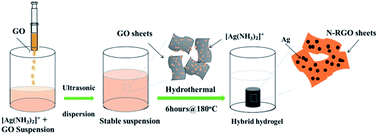
The fabrication process for Ag/N-RGO is demonstrated in Fig. 1a. Initially, graphene oxide (GO) was dispersed in water by sonication, reaching a concentration up to 5 mg mL−1. Next, silver nitrate (100 mg) was dissolved in 10 mL of deionized water, and then the superfluous ammonium hydroxide was added to form a silver–ammonia solution. A 20 mL aliquot of GO dispersion was added into the silver–ammonia solution and stirred thoroughly to form a stable aqueous suspension. Subsequently, the suspension was hydrothermally assembled at 180 °C for 6 h to prepare the N-doped graphene based 3D hydrogel. In this way, Ag NPs could nucleate and grow on the graphene surface with the simultaneous incorporation of nitrogen species into the graphene lattice. The as-prepared hydrogel was directly dehydrated via a freeze-drying process to maintain the 3D architecture. Finally, a black monolithic hybrid aerogel composed of N-doped graphene networks and Ag NPs was collected.


image file: c6ra23049k-f1.tif
Fig. 1 (a) Schematic of the fabrication process for the Ag/N-RGO catalyst. (b) XRD patterns of N-RGO, Ag/RGO and Ag/N-RGO catalysts. (c) Typical SEM image and inset TEM image for Ag/N-RGO catalyst.

Fig. 1b shows the XRD patterns of the as-prepared N-RGO, Ag/RGO and Ag/N-RGO catalysts. According to the powder diffraction file (PDF# 04-0783), the peaks located at about 38.1°, 44.3°, 64.4° and 77.5° are attributed to the Ag (111), Ag (200), Ag (220), and Ag (311), respectively. Remarkably, no apparent diffraction peaks of silver oxides can be identified in the hybrids. The sharp diffraction peaks imply the fine crystallinity of Ag. Moreover, as shown in the Fig. 1b inset, a broader diffraction peak is located at about 25° with relatively weak intensity, which indicates the poor ordering of the RGO and N-RGO sheets. Fig. 1c shows the microstructure of the Ag/N-RGO. The SEM image reveals the decoration of Ag NPs on the intertwined graphene sheets. As the AgNO3 mass during the fabrication process increases, there is an increase in the Ag NPs deposited on the graphene sheets, which causes the graphene sheet structure to be gradually destroyed (Fig. S1, ESI). When the AgNO3 mass is ten times as much as the graphene mass, the lamellar structure of graphene almost disappears (Fig. S1, ESI). The inset TEM image demonstrates that the diameter of Ag NPs with a torispherical shape and fine crystallinity is close to 80–100 nm. Compared to Ag/RGO (Fig. S2, ESI), the Ag/N-RGO obtained by a similar method almost has the same microstructures except for the much larger size of the Ag nanoparticles. This may be attributed to the decrease of the oxygen-containing functional groups in GO caused by nitrogen doping because the oxygen-containing functional groups are usually considered as the nucleation sites of silver species.26

Fig. 2a shows the XPS spectra of RGO, N-RGO, Ag/RGO and Ag/N-RGO catalysts. Evidently, the C, O and N signals appear in all four samples. The N 1s peaks in both Ag/N-RGO and N-RGO reveal that the N atoms are incorporated into the RGO lattice structure. The Ag 3d band with two peaks at 368.2 eV and 374.2 eV (±0.2 eV) in Fig. 2c exist in Ag/N-RGO and Ag/RGO corresponding to Ag 3d5/2 and Ag 3d3/2, respectively.18 This confirms that the Ag NPs are deposited on graphene sheets during the hydrothermal process. In the Ag/N-RGO, the mass percentages of Ag and N are 11 wt% and 6.8 wt%, respectively (Table S1, ESI). High resolution XPS spectra of N 1s band and percentages of N species of Ag/N-RGO and N-RGO are shown in Fig. 2b and Table S2 (ESI), respectively. It can be found that there are three nitrogen species (the pyrrolic N (399.8 ± 0.2 eV), pyridinic N (398.5 ± 0.2 eV) and graphitic N (401.6 ± 0.2 eV)) in the Ag/N-RGO and N-RGO samples. Among the three nitrogen species, the pyridinic N is considered as the main active site for catalyzing ORR.28 Compared to N-RGO, more pyridinic N exists in Ag/N-RGO which is likely due to the fact that the generation of silver promotes the doping of pyridinic N in N-RGO during the hydrothermal reaction, which can effectively improve the catalytic activity of Ag/N-RGO.


image file: c6ra23049k-f2.tif
Fig. 2 (a) XPS spectra of RGO, N-RGO, Ag/RGO and Ag/N-RGO catalysts. (b) High resolution N 1s spectra of N-RGO and Ag/N-RGO. (c) High resolution Ag 3d spectra of Ag/RGO and Ag/N-RGO.

To investigate the ORR catalytic activities of the samples in this study, linear sweep voltammetric (LSV) measurements were carried out on a rotating disk electrode (RDE). Fig. 3a shows the LSV polarization curves of Ag/N-RGO, Ag/RGO, Ag + N-RGO, Ag/C and Pt/C measured at a rotation rate of 1600 rpm in O2-saturated 0.1 mol L−1 KOH. The onset potential and half-wave potential of Ag/N-RGO which are 0.96 V and 0.76 V, respectively, are more positive than those of the other Ag-based catalysts. In addition, the limiting diffusion current density at 0.36 V of Ag/N-RGO is 5.3 mA cm−2, which is the highest among the Ag-based samples and close to that of commercial Pt/C. Considering the noble nature of Ag, we also calculated the ORR activities relative to the weight of Ag in all of the Ag-containing electrocatalysts at 0.9 V vs. RHE. The Ag mass activity (see Table S3, ESI) of the Ag/N-RGO is 5.3 A g−1, which is the highest among the catalysts. For the Ag/N-RGO catalysts with different Ag content, the sample prepared with a mass ratio of 1 for AgNO3/GO has the best ORR catalytic activity (Fig. S3, ESI). The overall catalytic activity of Ag/N-RGO is much higher than that of Ag + N-RGO, which is evidence of the synergetic effect between Ag and N-RGO. It should be mentioned that the ORR catalytic activity of the Ag/N-RGO is somewhat inferior to that of the commercial Pt/C, whereas some electrochemical parameters of this catalyst still surpass those of the Ag supported on N-doped graphene catalysts reported in other studies (see Table S3, ESI). Therefore, the as-proposed facile strategy to synthesize Ag/N-RGO is promising for the development of inexpensive ORR electrocatalysts.


image file: c6ra23049k-f3.tif
Fig. 3 (a) Linear-sweep voltammogram (LSV) curves, (b) Tafel plots, (c) ring current (iring) of catalysts on RRDE, (d) n and (e) χHO2 in the potential range from 0.2 V to 0.8 V vs. RHE calculated from RRDE data of Ag/RGO, Ag/N-RGO, Ag + N-RGO, Ag/C and Pt/C. Electrolyte: O2-saturated 0.1 mol L−1 KOH; rotation rate: 1600 rpm; scan rate: 5 mV s−1.

In order to further investigate the catalytic mechanism of Ag/N-RGO, the electron transfer number (n) per oxygen molecule in the ORR process was calculated by the Koutecky–Levich (K–L) equation (eqn (1)–(3), ESI). Fig. S4 (ESI) shows the LSV curves at the different rotation rates and K–L plots (J−1 vs. ω−1/2) at the different electrode potentials for Ag/N-RGO, Ag/RGO, Ag + N-RGO and Ag/C samples. According to the K–L plots, the average n values for Ag/N-RGO, Ag/RGO, Ag + N-RGO and Ag/C samples are 3.98, 3.90, 3.96, 3.60 and 3.50 at the potential 0.21–0.51 V, respectively. This indicates that a close four-electron reaction pathway occurs on the Ag/N-RGO catalyst. The Tafel plots of the Ag/N-RGO, Ag/RGO, Ag + N-RGO and Ag/C catalysts in the potential region between 0.68 V and 0.88 V are shown in Fig. 3b. The Tafel slopes were calculated from the Tafel equation29 and are listed in Table S3 (ESI). The Tafel slope of the Ag/N-RGO is about 70 mV dec−1, which is the lowest among the four samples. Moreover, a diameter of the semicircle of Ag/N-RGO in the Nyquist plots (Fig. S6, ESI) is smaller than that of Ag/RGO or Ag/C, thus a much smaller charge transfer resistance and better kinetics can be obtained for Ag/N-RGO.

The cyclic voltammetry curves are measured in the O2-saturated 0.1 mol L−1 KOH electrolyte and shown in Fig. S5 (ESI). There are three distinct anodic peaks, designated as A1, A2 and A3, located at about 1.18 V, 1.24 V and 1.33 V, respectively. The peak A1 can be attributed to a surface monolayer of Ag2O film. The other anodic peaks (A2, A3) are associated with the formation of inner hydrous oxide layers of AgOH and more compact outer layers of Ag2O.30,31 The cathodic peak R1 is ascribed to the oxygen reduction. For the Ag/N-RGO, the potential of peak R1 (0.81 V) shifts more positively compared to the other Ag-based samples, and the current of peak R1 is also the highest one among the four samples, which demonstrates that the Ag/N-RGO catalyst has the best ORR catalytic activity.17,32

To further demonstrate the ORR catalytic behaviors of Ag/N-RGO, Ag/RGO, Ag + N-RGO and Ag/C catalysts, we employed a rotating ring-disk electrode (RRDE) technique to accurately evaluate the percentage of the formed peroxides (HO2) with respect to the total oxygen reduction products (χHO2) and the electron transfer number (n) during ORR. Fig. 3c shows the ring (iring) current collected on the catalysts in 0.1 mol L−1 O2-saturated KOH solution at a rotation rate of 1600 rpm. Evidently, the iring of Ag/N-RGO catalyst is the lowest one among the four Ag-based samples during ORR. χHO2 and n can be calculated by the disk current (idisk), the ring current (iring) and the ring collection efficiency (N) with eqn (4) and (5) (ESI), respectively. Fig. 3d and e show the relationship between n and χHO2 in the potential range from 0.2 V to 0.8 V. During the entire potential range, the Ag/N-RGO catalyst demonstrates the highest n and lowest χHO2 among the four Ag-based samples. In particular, the Ag/N-RGO can catalyze ORR by a 3.93 electron transfer reaction and yield about 4% of hydrogen peroxide at 0.36 V. This is almost consistent with the result obtained from the K–L plots.

To evaluate its durability, the stability of the Ag/N-RGO and commercial 20% Pt/C were measured by a chronoamperometric measurement on RRDE in 0.1 mol L−1 O2-saturated KOH at the rotating rate of 1600 rpm for 40[thin space (1/6-em)]000 seconds. As can be seen in Fig. 4a, the Ag/N-RGO shows a slight degradation, and the current retention is as high as 95% after 40[thin space (1/6-em)]000 s, exhibiting a much better stability than that of 20% Pt/C. The χHO2 was derived from the RRDE measurement shown in Fig. 4a during the degradation test. The χHO2 values of both Pt/C and Ag/N-RGO catalysts show the gradually increasing trend, whereas the χHO2 increment of Ag/N-RGO is just about 8%, which is much lower than that of Pt/C (12%). Furthermore, the LSV curves of Pt/C and Ag/N-RGO catalysts in an O2-saturated 0.1 mol L−1 KOH electrolyte before and after long-term durability test were measured (Fig. 4b). For the Ag/N-RGO catalyst, almost no negative shift of the half-wave potential can be found after the long time aging test. Whereas, the half-wave potential of 20% Pt/C shifts about 20 mV toward the negative potential after the durability test.


image file: c6ra23049k-f4.tif
Fig. 4 (a) Long-term durability and percentage of χHO2 peroxide in the aging test of Ag/N-RGO and Pt/C in O2-saturated 0.1 mol L−1 KOH electrolyte at 1600 rpm, respectively. (b) LSV curves of Ag/N-RGO and Pt/C in the O2-saturated 0.1 mol L−1 KOH electrolyte at 1600 rpm with a scan rate of 5 mV s−1 before and after long-term durability tests, respectively.

For further evaluating the catalytic activities of the Ag/N-RGO composite catalysts, the aluminum air batteries using Ag/N-RGO and Ag/RGO as the ORRCs were measured, and their IV/IP curves are shown in Fig. 5. The aluminum air battery with a Ag/N-RGO electrocatalyst has an open circuit voltage of 1.96 V and it also shows a much higher maximum power density of 268 mW cm−2 than that of Ag/RGO (242 mW cm−2). This demonstrates that the Ag/N-RGO catalyst can be used as an ORRC with high catalytic activity in the aluminum air batteries.


image file: c6ra23049k-f5.tif
Fig. 5 Polarization curves (IV) and corresponding power density plots of the Al–air battery.

In summary, we developed silver nanoparticles supported on nitrogen doped graphene (Ag/N-RGO) as a highly efficient ORR electrocatalyst with superior performance by a facile one-step hydrothermal method for the first time. Notably, the Ag/N-RGO catalyst shows the remarkable ORR electrocatalytic activities with the onset potential, half wave potential and limiting diffusion current density being 0.96 V, 0.76 V and 5.3 mA cm−2, respectively. Compared to the commercial 20% Pt/C, the Ag/N-RGO shows a much better long-term stability. In addition, the aluminum air battery with the Ag/N-RGO electrocatalyst shows a very high maximum power density of 268 mW cm−2. The simple synthesis method, low cost, and high activity of the present Ag/N-RGO catalyst highlights its great potential as an efficient catalyst for metal air batteries.

Acknowledgements

This work was supported by the Key Research Program of the Chinese Academy of Sciences (Grant No. KGZD-EW-T08) and the Natural Science Foundation of Ningbo (2015A610245 2015A610251).

Notes and references

  1. H. Meng and P. K. Shen, Electrochem. Commun., 2006, 8, 588–594 CrossRef CAS.
  2. B. F. Vojislav, R. Stamenkovic, B. Simon Mun, G. Wang, C. A. L. Philip, N. Ross and N. M. Markovic, Science, 2007, 315, 493–497 CrossRef PubMed.
  3. C. L. Lee, H. P. Chiou, C. M. Syu and C. C. Wu, Electrochem. Commun., 2010, 12, 1609–1613 CrossRef CAS.
  4. F. Cheng and J. Chen, Chem. Soc. Rev., 2012, 41, 2172–2192 RSC.
  5. J. Chen, K. Takanabe, R. Ohnishi, D. Lu, S. Okada, H. Hatasawa, H. Morioka, M. Antonietti, J. Kubota and K. Domen, Chem. Commun., 2010, 46, 7492–7494 RSC.
  6. K. H. Choi, Y. Jang, D. Y. Chung, P. Seo, S. W. Jun, J. E. Lee, M. H. Oh, M. Shokouhimehr, N. Jung, S. J. Yoo, Y. E. Sung and T. Hyeon, Chem. Commun., 2016, 52, 597–600 RSC.
  7. J. B. Henry, A. Maljusch, M. Huang, W. Schuhmann and A. S. Bondarenko, ACS Catal., 2012, 2, 1457–1460 CrossRef CAS.
  8. G. Wu and Z. Piotr, Acc. Chem. Res., 2013, 46, 1878–1889 CrossRef CAS PubMed.
  9. J. Z. F. Cheng, W. Song, C. Li, H. Ma, J. Chen and P. Shen, Inorg. Chem., 2005, 2038–2044 Search PubMed.
  10. F. Cheng, Y. Su, J. Liang, Z. Tao and J. Chen, Chem. Mater., 2010, 22, 898–905 CrossRef CAS.
  11. X. S. Nick Daems, I. F. J. Vankelecom and P. P. Pescarmona, J. Mater. Chem. A, 2014, 2, 4085–4110 Search PubMed.
  12. Y. Jin and F. Chen, Electrochim. Acta, 2015, 158, 437–445 CrossRef CAS.
  13. J. M. You, M. S. Ahmed, H. S. Han, J. E. Choe, Z. Üstündağ and S. Jeon, J. Power Sources, 2015, 275, 73–79 CrossRef CAS.
  14. Y. L. L. Qu, J.-B. Baek and L. Dai, ACS Nano, 2010, 4, 1321–1326 CrossRef PubMed.
  15. Y. Zhang, M. Chu, L. Yang, W. Deng, Y. Tan, M. Ma and Q. Xie, Chem. Commun., 2014, 50, 6382–6385 RSC.
  16. D. He, Y. Jiang, H. Lv, M. Pan and S. Mu, Appl. Catal., B, 2013, 132–133, 379–388 CrossRef CAS.
  17. R. Liu, X. Yu, G. Zhang, S. Zhang, H. Cao, A. Dolbecq, P. Mialane, B. Keita and L. Zhi, J. Mater. Chem. A, 2013, 1, 11961 CAS.
  18. L. Yuan, L. Jiang, J. Liu, Z. Xia, S. Wang and G. Sun, Electrochim. Acta, 2014, 135, 168–174 CrossRef CAS.
  19. Z. S. Wu, S. Yang, Y. Sun, K. Parvez, X. Feng and K. Mullen, J. Am. Chem. Soc., 2012, 134, 9082–9085 CrossRef CAS PubMed.
  20. M. Wang, J. Huang, M. Wang, D. Zhang, W. Zhang, W. Li and J. Chen, Electrochem. Commun., 2013, 34, 299–303 CrossRef.
  21. Y. F. Zhao, S. Q. Chen, B. Sun, D. W. Su, X. D. Huang, H. Liu, Y. M. Yan, K. N. Sun and G. X. Wang, Sci. Rep., 2015, 5, 7629 CrossRef CAS PubMed.
  22. F. H. B. Lima, J. F. R. de Castro and E. A. Ticianelli, J. Power Sources, 2006, 161, 806–812 CrossRef CAS.
  23. J. J. Han, N. Li and T. Y. Zhang, J. Power Sources, 2009, 193, 885–889 CrossRef CAS.
  24. Y. Lu, Y. Wang and W. Chen, J. Power Sources, 2011, 196, 3033–3038 CrossRef CAS.
  25. E. J. Lim, S. M. Choi, M. H. Seo, Y. Kim, S. Lee and W. B. Kim, Electrochem. Commun., 2013, 28, 100–103 CrossRef CAS.
  26. R. Zhou and S. Z. Qiao, Chem. Mater., 2014, 26, 5868–5873 CrossRef CAS.
  27. S. Jin, M. Chen, H. Dong, B. He, H. Lu, L. Su, W. Dai, Q. Zhang and X. Zhang, J. Power Sources, 2015, 274, 1173 CrossRef CAS.
  28. R. S. D. Guo, C. Akiba, S. Saji and J. N. Takahiro Kondo, Science, 2016, 351, 361–365 CrossRef PubMed.
  29. X. Xu, C. Tan, H. Liu, F. Wang, Z. Li, J. Liu and J. Ji, J. Electroanal. Chem., 2013, 696, 9–14 CrossRef CAS.
  30. A. H. J. Guo, D. Chu and R. Chen, J. Phys. Chem. C, 2010, 114, 4324–4330 Search PubMed.
  31. Y. Wang, X. Lu, Y. Liu and Y. Deng, Electrochem. Commun., 2013, 31, 108–111 CrossRef CAS.
  32. J. Liu, J. Liu, W. Song, F. Wang and Y. Song, J. Mater. Chem. A, 2014, 2, 17477–17488 CAS.

Footnote

Electronic supplementary information (ESI) available. See DOI: 10.1039/c6ra23049k

This journal is © The Royal Society of Chemistry 2016
Click here to see how this site uses Cookies. View our privacy policy here.