Ya Wang,
Sheng-Li Chen*,
Yong-Jie Jiang,
Ying-Qian Cao,
Fen Chen,
Wei-Ke Chang and
Yu-Li Gao
State Key Laboratory of Heavy Oil Processing, China University of Petroleum (Beijjing), Beijing 102249, PR China. E-mail: slchen@cup.edu.cn
First published on 28th October 2016
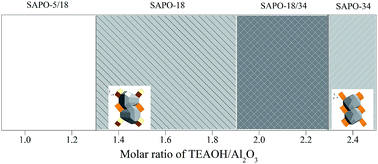
SAPO-18, SAPO-18/34 intergrowth and SAPO-34 molecular sieves have been selective synthesized using different amount of template (tetraethyl ammonium hydroxide, TEAOH). The samples were characterized by XRD, XRF, TG-DSC, 13C (29Si) CP/MAS NMR and NH3-TPD. The synthesized products switched from SAPO-5/18, to SAPO-18, SAPO-18/34, and finally to SAPO-34 with the increasing of TEAOH amount. The TEAOH in SAPO-18 cages mainly acted the role of space filling. While in SAPO-34, the TEAOH was mainly used to compensate the negative charge of the framework. SAPO-34 possessed much more Si(4Al) structure compared to SAPO-18 and SAPO-18/34. For methanol to olefins reaction, SAPO-18 yielded the highest propene and C4 than that over SAPO-18/34 and SAPO-34, SAPO-34 had the highest ethene yield among the three catalysts. The working lifetimes of SAPO-18/34 and SAPO-34 were significantly longer than that of SAPO-18.
The framework topology of SAPO-34 (IZA code is CHA), is comprised of cylinder-like cages (6.7 × 6.7 × 10.0 Å) with 8-ring openings (3.8 × 3.8 Å), and the small pore opening only allows linear olefins and small molecules to diffuse through.13,20 The microporous framework structure of SAPO-18 (IZA code is AEI) is similar to that of SAPO-34 (see Fig. 1). Both SAPO-34 and SAPO-18 include sheets of connected double six-membered rings (D6R). The sheets are connected along the z-axis (via O-bridges) to form a stacked structure. The lateral shift between the sheets is a rotation of 180° around the z-axis of AEI structure, while it is 0° rotation for the CHA structure. The connection creates a three-dimensional channel system for SAPO-18, and its eight-membered pore openings is the same as SAPO-34.8,15,17 SAPO-18/34 is a type of composite molecular sieve with an intergrowth structure of CHA and AEI.12–14 The stacking faults of SAPO-18/34 intergrowth crystal structures were described by Sławiński et al.21,22 and were displayed in Fig. 2. The stacking layers of SAPO-34 can be described as sequences of AAAA… or BBBB…, and the stacking layers sequence of SAPO-18 is ABAB…, while SAPO-18/34 intergrowth is between SAPO-34 and SAPO-18, due to the stacking faults. The SAPO-18, SAPO-18/34 and SAPO-34 molecular sieves are usually synthesized by hydrothermal method. The accurate control of conditions for selective synthesis of these samples is very important, because of similarity in the structures of SAPO-18, SAPO-18/34 intergrowth and SAPO-34 molecular sieves.
Chen et al.15,17 reported the synthesis of SAPO-18 and SAPO-34 with C8H19N as a template. The relative amount of template was crucial to form the pure SAPO-18. For the ratio of C8H19N/(Si + Al + P) smaller than 0.4, SAPO-5 was very likely to appear, and when the ratio is larger than 0.6, the product includes none or very low crystalline-form content. Unlike the high Si/(Si + Al + P) ratio (typically higher than 0.10) for SAPO-34, the SAPO-18 can be prepared with very low amounts amount of silicon. Liu and co-workers5 reported that pure SAPO-34 could be synthesized if n(DEA)/n(Al2O3) ≥ 1.5 and n(SiO2)/n(Al2O3) > 0.1. When n(DEA)/n(Al2O3) was between 0.4 and 0.8, pure SAPO-11 can be obtained. Smith et al.13 prepared a series of SAPO-18/34 intergrowth molecular sieves with a range of SiO2/Al2O3 ratio from 0 to 0.3 in the presence of TEAOH as template. It was found that low levels of silicon content resulted in the AEI structure and high levels of silicon content resulted in an AEI/CHA intergrowth structure. Wendelbo et al.18 found that less water and less Mg and Zn were used for preparing MgAPO-18 and ZnAPO-18 relative to MgAPO-34 and ZnAPO-34. Fan et al.23 reported that SAPO-18 can be synthesized at higher crystallization temperatures (200 °C) than SAPO-34.
It is clear that synthetic conditions are crucial for selective synthesis of SAPO-18, SAPO-18/34 and SAPO-34. For the synthesis of these molecular sieves, there are many different chemicals can be used as template.5,15,24–31 The templates play an important role in the synthesis process. For example, templates are required for space filling, structure directing and charge compensated compensation.5,32,33 It is worth mentioning that one template can be used to direct the syntheses of different type of molecular sieves under the different synthetic conditions, and synthesis using different templates may also yield the same molecular sieve. In this work, preferential formation of SAPO-34, SAPO-18, and SAPO-18/34 intergrowth molecular sieves was studied by adjusting the amount of template (TEAOH). Samples obtained were characterized and their catalytic performances in the MTO process were investigated.
| Sample | x (TEAOH) | pH of gel | Yield (%) | D50 (μm) | Product phase |
|---|---|---|---|---|---|
a Gel molar composition is xTEAOH : 1.0Al2O3 : 1.0P2O5 : 0.1SiO2 : 40H2O.b Crystallization condition is 100 °C – 24 h, then 180 °C – 48 h. |
|||||
| 1.0T | 1.0 | 2.98 | 65 | 2.962 | SAPO-5/18 |
| 1.2T | 1.2 | 3.42 | 59 | 0.500 | SAPO-5/18 |
| 1.4T | 1.4 | 3.60 | 69 | 0.366 | SAPO-18 |
| 1.6T | 1.6 | 4.30 | 60 | 0.215 | SAPO-18 |
| 1.8T | 1.8 | 5.11 | 47 | 0.243 | SAPO-18 |
| 2.0T | 2.0 | 6.77 | 41 | 0.515 | SAPO-18/34 |
| 2.2T | 2.2 | 7.06 | 39 | 1.931 | SAPO-18/34 |
| 2.4T | 2.4 | 7.54 | 33 | 2.941 | SAPO-34 |
The sources of the framework elements were pseudoboehmite (76.4 wt% Al2O3, XinNian Petrochemical Additives Company), orthophosphoric acid (85 wt%, Tianjin Guangfu Fine Chemical Research Institute) and silica sol (30 wt% SiO2, Yinfeng Silicon Products Co., Ltd). The structure directing agent was TEAOH (35 wt%, Shanghai Cainorise Chemicals Co., Ltd). The preparation procedures are as follows. First, the silica sol and pseudoboehmite were added to TEAOH solution under continuous stirring at room temperature. Then dilute phosphoric acid solution was added to the SiO2–Al2O3–TEAOH mixture, and a resultant homogeneous synthesis gel (SiO2–Al2O3–TEAOH–H3PO4–H2O mixture) was prepared through intensive stirring. After that, the synthesized gel was sealed in a Telfon-lined stainless-steel autoclave. The autoclave temperature was kept at 100 °C for 24 h and then at 180 °C for 48 h under rotation. During the hydrothermal treating process, the gel crystallized to SAPO series molecular sieves. The molecular sieves obtained were treated with centrifuging, rinsing and drying. Then calcined at 600 °C for 6 h to remove the organic template inside the molecular sieves. The yield of molecular sieves was the weight ratio of the recovered solid to the Al2O3, P2O5 and SiO2 in the synthesis gel.
:
1.0P2O5
:
0.1SiO2
:
40H2O
:
xTEAOH. The peaks in the X-ray diffraction patterns of as-synthesised samples were compared with standard CHA36 (SAPO-34), AEI15 (SAPO-18) and AFI37 (SAPO-5) structures (Fig. 3). When the TEAOH/Al2O3 molar ratio was lower than 1.4, the peaks indicated the existence of AEI and AFI structure in sample 1.0T and 1.2T. Moreover, the absence of the peaks at 10.4° implied that sample 1.0T and 1.2T were not just the mixture of AFI and AEI, they were AFI/AEI (SAPO-5/18) intergrowth molecular sieves. Futhermore, the change of intensity of peaks at 7.4, 19.7, 22.4° indicated that there were more AEI structure in sample 1.2T than in sample 1.0T.
![]() | ||
Fig. 3 X-ray diffraction patterns of as-synthesised samples (gel composition is xTEAOH : 1.0Al2O3 : 1.0P2O5 : 0.1SiO2 : 40H2O). | ||
When the TEAOH/Al2O3 molar ratio was 1.4, 1.6 and 1.8 (4 < pH < 6), the diffraction peaks of sample 1.4T, 1.6T and 1.8T matched well with the standard AEI structure, this demonstrated these samples were SAPO-18 molecular sieves. In addition, sizes of SAPO-18 are smallest among synthesized samples (see Table 1). Increasing the TEAOH/Al2O3 molar ratio of the gel to 2.0 and 2.2, the peaks indicated that there were both AEI and CHA structure in sample 2.0T and 2.2T, however, the absence of the peaks at 10.4° implied that, they were not physical mixture of AEI and CHA, and instead it was the SAPO-18/34 (AEI/CHA) intergrowth molecular sieves. The peak intensity at 16.9, 20.2 and 21.0° revealed that, the relative content of SAPO-34 structure was higher in sample 2.2 than in sample 2.0. The SAPO-34 s (sample 2.4T) were obtained from the gel with the TEAOH/Al2O3 molar ratio was 2.4 (pH = 7.54).
Combined with the results of pH value of gel and XRD of as-synthesized samples, it can be concluded that, when TEAOH/Al2O3 molar ratio x of the gel was 1.0 < x < 1.4, the pH value was 3–3.5, and the synthesized samples were SAPO-5/18. When 1.4 < x < 1.8, the pH value was 3.5–5.5, the obtained samples were SAPO-18. SAPO-18/34 intergrowth molecular sieves can be synthesized when 2.0 < x < 2.2, 5.5 < pH < 7. When x = 2.4, pH was 7.54, SAPO-34 sieves were obtained. With the increase of template amount x from 1.0 to 2.4, the pH value of gel changed notably, this affect the combination structure of Si, Al and P ions, resulting in different crystallization products. The yield of the molecular sieves decreased with increasing template amount. The size of samples increased with the amount of TEAOH when n(TEAOH/Al2O3) > 1.6.
The SEM images of calcined samples were shown in Fig. 4. From the SEM images, it can be seen that SAPO-5/18 (sample 1.0T, 1.2T) formed in the plate-like crystals. SAPO-18 s (sample 1.4T, 1.6T and 1.8T) formed in the disc-like or strip-like crystals. The particle size of SAPO-18s obtained from SEM images was obviously smallest among these samples, agreeing with the laser particle size analysis results (Table 1). SAPO-18/34 intergrowth phase formed in the cubic crystals (sample 2.0T and 2.2T). SAPO-34 formed in the cubic crystals too (sample 2.4T).
The surface area and pore volume of some synthesized SAPO samples were measured by the nitrogen adsorption–desorption method and the results are shown in Table 2. As shown in Table 2, the micropore volume and micropore surface area of these samples were very similar to each other, indicating the crystal-lattice volume and structure of SAPO-34 and SAPO-18, which is the source of the micropore volume and micro-pore surface area, is almost identical. Of all the three samples measured, 1.6T sample had the largest mesopore volume (0.19 cm3 g−1) and external surface area (40 m2 g−1), resulting from the fact that the 1.6T sample had the smallest crystal size. The smaller the molecular crystals, the larger their external specific surface area. The SAPO-34 (sample 2.4T), which had the largest crystal size, had the smallest mesopore volume and external specific surface area.
| Sample | Surface area (m2 g−1) | Pore volume (cm3 g−1) | ||||
|---|---|---|---|---|---|---|
| Smicroa | Sextb | Stotalc | Vmicrod | Vmeso | Vtotal | |
| a t-Plot micropore surface area.b t-Plot external surface area.c BET surface area.d t-Plot micropore volume. | ||||||
| 1.6T (SAPO-18) | 402 | 40 | 442 | 0.19 | 0.19 | 0.38 |
| 2.0T (SAPO-18/34) | 412 | 12 | 424 | 0.20 | 0.08 | 0.28 |
| 2.4T (SAPO-34) | 421 | 4 | 425 | 0.21 | 0.04 | 0.25 |
| Sample | n (TEAOH/Al2O3) | Product composition | (Si/Al2)gel | (Si/Al2)solid | Si incorporationa |
|---|---|---|---|---|---|
| a Defined as the molar ratio of [Si/(Si + Al + P)solid]/[Si/(Si + Al + P)gel]. | |||||
| 1.6T (SAPO-18) | 1.6 | Al0.521P0.453Si0.044O2 | 0.10 | 0.17 | 1.76 |
| 2.0T (SAPO-18/34) | 2.0 | Al0.513P0.449Si0.054O2 | 0.10 | 0.21 | 2.18 |
| 2.4T (SAPO-34) | 2.4 | Al0.505P0.439Si0.059O2 | 0.10 | 0.23 | 2.40 |
![]() | ||
| Fig. 5 The calculated (dotted lines) and measured (solid lines) 29Si CP/MAS NMR spectra of calcined samples. 1 Si(4Al), 2 Si(3Al), 3 Si(2Al), 4 Si(1Al), 5 Si(0Al). | ||
It can be seen from Fig. 5 that SAPO-18, SAPO-18/34 and SAPO-34 all exhibited broad band centred at −87 ppm and −110 ppm, attributed to Si(4Al) and Si(0Al) environments respectively. The band had a certain asymmetry suggesting the presence of Si(3Al), Si(2Al), Si(1Al) structures. Therefore, the silicon substitution of SM2 and SM3 occurred simultaneously for all the three samples. The proportional distributions of Si(nAl) (n = 0–4) of the SAPO molecular sieves are displayed in Table 4. It is evident from Fig. 5 and Table 4 that higher intensity of Si(4Al) existed in SAPO-34 than in SAPO-18 and SAPO-18/34. This indicates a more pronounced effect of substitution mechanism SM2 in SAPO-34, and this mechanism creates a negative charge per Si atom in the framework. This is usually balanced by the positive charge of the organic molecules occluded within the microporous structure. However, SM3 leads to the formation of neutral silicon islands.40 According to the results of elemental composition and Si coordination structure analysis, the increasing of TEAOH amounts results in more silicon incorporated into framework in SAPO-34 than in SAPO-18/34 and SAPO-18 molecular sieves. Furthermore, SAPO-34 possesses more Si(4Al) structure. Therefore, SAPO-34 requires more template molecules to balance the negative charges of its framework.
| Sample | Si(4Al) | Si(3Al) | Si(2Al) | Si(1Al) | Si(0Al) |
|---|---|---|---|---|---|
| 1.6T (SAPO-18) | 0.43 | 0.15 | 0.02 | 0.19 | 0.23 |
| 2.0T (SAPO-18/34) | 0.50 | 0.08 | 0.03 | 0.10 | 0.29 |
| 2.4T (SAPO-34) | 0.56 | 0.02 | 0.11 | 0.10 | 0.20 |
TG and DSC profiles are plotted in Fig. 6. Generally, there are three weight loss steps. The first step of weight loss (I) is the removal of adsorbed water at temperatures below 100 °C with an endothermic process. The second step (II) is the decomposition of the template with a strongly exothermic process between 100 °C and 430 °C. The third final step (III), at temperatures higher than 430 °C with an exothermic process too, is combustion of organic residues occluded in the channels and cages of the SAPO molecular sieves.10,42 The weight losses at different steps are presented in Table 5. At step I, SAPO-34 and SAPO-18/34 lose ∼0.7 wt%, while SAPO-18 lose 1.2 wt% of physically absorbed water. When the temperature was higher than 100 °C, the weight loss II and III of SAPO-18 was much larger than that of SAPO-34 and SAPO-18/34. This indicates more template molecules were incorporated in the cage of SAPO-18 than in the SAPO-34 and SAPO-18/34 samples. The template content for three samples was determined by carbon analyzer, and the results were shown in Table S1.† The template content measured by carbon analyzer for sample 1.6T, 2.0T and 2.4T agreed well with that measured by TG. According to the reports,5,43 the value of moles of template per cage in SAPO-34 with TEAOH is 1.0, and it was well matched by the calculated result of SAPO-34 (sample 2.4T, Table 5). Due to the large cage size of AEI structure, SAPO-18 and SAPO-18/34 should possess more template in the cage, and the results in Table 5 confirmed that. However, as previously discussed, in compared to SAPO-18/34 and SAPO-18, the SAPO-34 (sample 2.4T) needed much more template to balance the negative charges of the framework. Consequently, the role of the template must be in a different way in selectively directing the formation of SAPO-18, SAPO-18/34 intergrowth and SAPO-34 molecular sieves.
![]() | ||
| Fig. 6 TG (solid lines) and DSC analysis (dotted lines) of samples (blue lines, sample 1.6T, SAPO-18; red lines, sample 2.0T, SAPO-18/34; black lines, sample 2.4T, SAPO-34). | ||
| Sample | Weight loss (wt%) | Moles of template per cage | |||
|---|---|---|---|---|---|
| I < 100 °C | II 100–430 °C | III > 430 °C | II + III | ||
| 1.6T (SAPO-18) | 1.15 | 14.17 | 7.97 | 22.14 | 1.42–1.60 |
| 2.0T (SAPO-18/34) | 0.71 | 7.47 | 9.81 | 17.28 | 1.03–1.17 |
| 2.4T (SAPO-34) | 0.68 | 4.95 | 11.00 | 15.95 | 0.95–1.07 |
The 13C CP/MAS NMR characterization of as-synthesized samples 1.6T, 2.0T and 2.4T was performed, and the spectra were shown in Fig. 7. From Fig. 7 it can be seen that template TEAOH give two types of peaks, at 6–9 and 52–55 ppm respectively. The peak at 6–9 ppm was ascribed to –CH3 group of template, and –CH2 group gave signals at 52–55 ppm. We believe resonances in 7.2 and 53.0 ppm are due to the interaction of (CH3CH2)4N+ with framework of SAPO molecular sieve, and resonances in 7.7 and 53.7 ppm are due to that of (CH3CH2)4N–OH. In SAPO-34 (sample 2.4T), the template mainly existed as (CH3CH2)4N+ cations, they were used to balance the negative charge of the framework. However, for SAPO-18 (sample 1.6T), the peak areas in 7.2 and 53.0 ppm were larger than that in 7.7 and 53.7 ppm. It means that the template was not mainly presented as (CH3CH2)4N+ cations, but as (CH3CH2)4N–OH, and the template was mainly for space filling. For SAPO-18/34 intergrowth (sample 2.0T), because of the relatively large proportion of Si content and Si(4Al) structure (see Tables 3 and 4), plus the existence of AEI cage, the template in SAPO-18/34 presented both as (CH3CH2)4N+ cations and (CH3CH2)4N–OH, and the content of the two forms showed no obvious difference.
| Sample | Acidity (mmol NH3 g−1) | ||
|---|---|---|---|
| Weak | Strong | Total | |
| 1.6T (SAPO-18) | 0.62 | 0.57 | 1.20 |
| 2.0T (SAPO-18/34) | 0.66 | 0.67 | 1.33 |
| 2.4T (SAPO-34) | 0.53 | 0.77 | 1.30 |
The MTO catalytic performances of samples were tested in a fixed bed reactor and experiment results are summarized in Table 7 and Fig. 9. From Table 7, it can be concluded that, among these sample, sample 1.2T, which contained SAPO-5, has the lowest light olefins yield in MTO reaction. SAPO-5 consists of an one-dimensional 12 membered-ring channel system with a pore diameter of 0.73 nm, which falls into the large pore category.40 So C4 and C5+ product yields were obviously higher for sample 1.2T (SAPO-5/18) than for the others (SAPO-18, SAPO-18/34 and SAPO-34). The yields for propene and C4 over SAPO-18 (sample 1.4T, 1.6T and 1.8T) are higher than that over SAPO-34 (2.4T) and SAPO-18/34 (2.0T and 2.2T), which might be attributed to the slightly larger size of AEI cage of SAPO-18 than the CHA cages of SAPO-34. According to the hydrocarbon pool mechanism and previous research work on spatial confinement effects imposed by the cage structure of SAPO molecular sieves,13,45,46 the AEI cage has more space for higher-substituted methylbenzenes to reside, and favors the production of propene and C4 hydrocarbon. SAPO-18/34 intergrowth molecular sieve possesses the longest catalytic lifetime and comparatively higher yield of ethene and propene, due to its relatively moderate acidity and AEI/CHA intergrowth cages. SAPO-34 has the highest ethene yield because of its smaller CHA cage.
| Sample | Hydrocarbon product yields (wt%) | Lifetime (min) | ||||
|---|---|---|---|---|---|---|
| C2H4 | C3H6 | C4 | C5+ | C1–C3 alkanes | ||
| a Catalysts lifetime was defined as the time when 98% of methanol conversion can be achieved.b Hydrocarbon product yields were considered on a carbon basis, and the value displayed correspond to the data that the highest yield of ethene plus propene achieved when methanol conversion = 100%.c Reaction conditions: 470 °C, WHSV for methanol is 2.5 h−1, 95 wt% methanol solutions. | ||||||
| 1.2T (SAPO-5/18) | 37.88 | 24.85 | 21.06 | 9.61 | 6.60 | 200 |
| 1.4T (SAPO-18) | 38.52 | 41.32 | 12.04 | 4.05 | 4.07 | 95 |
| 1.6T (SAPO-18) | 39.43 | 40.58 | 12.52 | 3.83 | 3.64 | 95 |
| 1.8T (SAPO-18) | 40.01 | 40.14 | 11.39 | 3.54 | 4.92 | 95 |
| 2.0T (SAPO-18/34) | 50.65 | 34.37 | 7.53 | 1.55 | 5.90 | 185 |
| 2.2T (SAPO-18/34) | 53.86 | 33.28 | 5.54 | 1.44 | 5.88 | 185 |
| 2.4T (SAPO-34) | 55.36 | 32.34 | 5.20 | 1.37 | 5.73 | 170 |
Fig. 9 shows the methanol conversion and yields of hydrocarbons with time on stream at sample 1.6T (SAPO-18), 2.0T (SAPO-18/34) and 2.4T (SAPO-34). The initial methanol conversion of SAPO-18, SAPO-18/34 and SAPO-34 reached 100%. Furthermore, the yield of ethene plus propene was significantly higher in SAPO-18 and SAPO-18/34 than in SAPO-34 in the initial stage (time on stream < 80 min), and the yield of propane was higher in SAPO-34 than the others. Combined with the results of NH3-TPD (Table 6), this phenomenon can be explained by that the strong acid site favors the hydrogen transfer reaction, then the yield of propane will be increased over catalysts which contained more strong acid sites.9,47 With time on stream increasing, the methanol conversion and the yields of light olefins (C2
and C3
) of all the three samples decreased. The working lifetimes of 2.0T and 2.4T were significantly longer than that of 1.6T, and the working lifetime of 2.0T was slightly longer than that of 2.4T.
Rapid deactivation due to coke formation during MTO reaction over these small pore-size molecular sieves, the coke can reduce the mass transport of reactants and products.48,49 The coke content on deactivated SAPO catalysts was analyzed by carbon analyzer, and the results were shown in Table 8. It can be seen that coke content increased with the sample changed from 1.6T (SAPO-18) to 2.0T (SAPO-18/34) then to 2.4T (SAPO-34). The coke content on SAPO-18 was obviously less than SAPO-18/34 and SAPO-34. This might be due to that the total acidity amount for SAPO-18 were the least among the three samples (see Table 6). However, SAPO-34 contained less acid amount but more coke content than SAPO-18/34. This might be due to the obvious difference of crystal size between sample 2.4T (SAPO-34) and 2.0T (SAPO-18/34). The larger crystal size, the more diffusion limitation for reactants and products. So, the coke content on 2.4T was larger than 2.0T.
| Sample | Coke content on SAPO-34a (wt%) |
|---|---|
| a Coke content (wt%) = the mass of carbon of SAPO-34 with coke deposited/the mass of SAPO-34 with coke deposited × 100%, and SAPO-34 with coke deposited was collected when methanol conversion < 50%. | |
| 1.6T (SAPO-18) | 8.14 |
| 2.0T (SAPO-18/34) | 13.29 |
| 2.4T (SAPO-34) | 16.37 |
:
1.0P2O5
:
0.1SiO2
:
40H2O
:
xTEAOH), the products synthesized switched from SAPO-5/18, to SAPO-18, then to SAPO-18/34, and finally to SAPO-34. Meanwhile, the yield of the molecular sieves decreased, and the silicon content in SAPO samples increased. 29Si CP/MAS NMR revealed SAPO-34 possessed more Si(4Al) coordination environment than in SAPO-18 and SAPO-18/34 intergrowth. According to results of TG and 13C CP/MAS NMR spectra, SAPO-18 possessed more template in the cage than SAPO-18/34 and SAPO-34, the TEAOH of SAPO-18 mainly acted as the role of space filling. While in SAPO-34, the TEAOH were mainly used to compensate the negative charge of the framework. NH3-TPD results indicated that the amount of strong acid sites increased with increase of template amount used, while the strength of weak acid sites changed little. The amount of weak acid sites decreased in the order of SAPO-18/34 > SAPO-18 > SAPO-34. Among the three catalysts for methanol to olefins reaction, SAPO-18/34 intergrowth molecular sieve possessed the longest catalytic lifetime and higher yield of ethene and propene, due to its relatively moderate acidity and AEI/CHA intergrowth cages; SAPO-18 had higher propene and C4 yield, SAPO-34 had the highest ethene yield.
Footnote |
| † Electronic supplementary information (ESI) available: The carbon content and calculated template weight content of as-synthesized samples. See DOI: 10.1039/c6ra23048b |
| This journal is © The Royal Society of Chemistry 2016 |