
Ying Chea,
Xiaoyi Zhu*ab,
Jianjiang Liac,
Jin Suna,
Yanyan Liua,
Chunde Jind and
Chaohong Dong*a
aCollege of Textile & Clothing, Laboratory of Fiber Materials and Modern Textile, The Growing Base for State Key Laboratory, School of Environmental Science and Engineering, Qingdao University, Qingdao 266071, P. R. China. E-mail: xyzhu@qdu.edu.cn; dongzhh11@163.com
bCollege of Automation and Electrical Engineering, Qingdao University, Qingdao 266071, P. R. China
cCollaborative Innovation Centre for Marine Biomass Fibres, Materials and Textiles of Shandong Province, Qingdao University, Qingdao 266071, P. R. China
dSchool of Engineering, Zhejiang A & F University, Lin'an 311300, P. R. China
First published on 3rd November 2016
The sluggish kinetics and large volume expansion occurring during cycle process are critical disadvantages for molybdenum dioxide (MoO2) based anode materials for lithium-ion batteries (LIBs). The design and controllable synthesis of MoO2 based materials with unique hierarchical structure are desired. In this work, we present a one step in situ method to synthesize MoO2/carbon aerogel composites with MoO2 nanoparticles embedded in the carbon aerogel matrix using an environmentally friendly alginate as the carbon precursor. The key feature of our strategy involves the use of a carbon aerogel matrix which facilitates the Li ion transport and offers the space for MoO2 volume expansion during the discharge and charge processes. The composite prepared under optimum conditions, namely a stabilization temperature at 375 °C, exhibited a brilliant performance with a specific capacity of 574 mA h g−1 at a current density of 100 mA g−1, good cycle stability (i.e., a reversible capacity of 490 mA h g−1 at a current density of 200 mA g−1 for 120 cycles), excellent rate capability (remains at 331 mA h g−1 even at a current density of 1000 mA g−1). This finding presents an easy, eco-friendly and efficient strategy for the fabrication of potential high-performance LIBs anodes.
Alginate, as a common seaweed biomass, has been applied to the synthesis of LIBs anode materials as a carbon matrix because it can chelate with various metal cations such as Ca2+, Fe2+, Co2+, Ni2+, Mn2+, Sn2+ to form the so-called “egg-box model”.14–19 Our research team has made several inspiring discoveries in this field.20–23 Lv et al. fabricated high performance fibrous transition metal oxides anodes such as elemental Ni doped NiO, yolk–shell structured carbon@Fe2O3 and hollow CuO fibers with controllable nanostructures for LIBs by using 1 dimensional seaweed fibers as templates.22 Li et al. prepared carbonaceous microfibers embedded with Co3O4 nanoparticles by direct pyrolysis of wetspun cobalt alginate fibers. The synthesized Co3O4-carbonaceous microfibers affords a high reversible capacity (780 mA h g−1) for long cycling when used as the anode material for LIBs.23
In this work, we described a one step in situ method to synthesize a MoO2/carbon aerogels (MoO2@SAC) with MoO2 nanoparticles embedded in carbon aerogels matrix using an environmental friendly sodium alginate (SA) as the carbon precursor. A hydrogel networks prepared via an ion-exchange process by replacing Na+ in SA with H+ is used to wrap the ammonium molybdate tetrahydrate ((NH4)6Mo7O24·4H2O (AMM)). Meanwhile, the hydrogel also provide an appropriate pH environment for AMM to transform into MoO3.24 Alginate acid support as the carbon precursor to provide conductive aerogels matrix. Furthermore, we believed that different Mo-contained bimetallic oxides such as Fe2Mo3O8, CaMoO4 can be obtained by this method using different metal cation solution substituting for hydrochloric acid.25,26
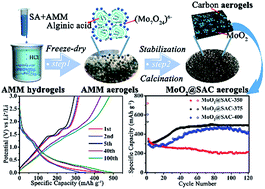
The synthesis of the MoO2@SAC involved a three-step process, which was illustrated in Fig. 1. Firstly, SA aqueous solution mixed with AMM was dropped into HCl solution under stirring to fulfil a complete exchange between H+ and Na+ to get the AMM hydrogels (Fig. 1a). Subsequently, the obtained hydrogels were dehydrated via a freeze-drying process to generate the AMM aerogels (Fig. 1b). Finally, the AMM aerogels were stabilized in air, and subsequently carbonized under nitrogen atmosphere. During the air stabilization process, AMM was split into an intermediate product MoO3 (eqn (1)) (Fig. S1†), while in the carbonization process MoO3 would be reduced to MoO2 (eqn (2)) and the product MoO2@SAC-X (X = 350, 375, 400, denotes as the different stabilization temperature) aerogels were achieved (Fig. 1c).
| (NH4)6Mo7O24·4H2O → 6NH3 + 7MoO3 + 7H2O | (1) |
| MoO3 + C → MoO2 + CO2 | (2) |
![]() | ||
| Fig. 2 (a) XRD patterns of MoO2@SAC-X and AMM aerogels, (b) TGA curves of MoO2@SAC-X aerogels, (c) Raman spectrum of MoO2@SAC-375. | ||
Thermogravimetric analysis (TGA) was carried out under air to evaluate the amount of carbon in MoO2@SAC aerogels. As shown in Fig. 2b, the mass loss occurred before 200 °C is mainly due to the volatilization of absorbed H2O or other volatile impurities on the sample surface. Fig. S3† shows that the weight loss for SAC aerogels (synthesized by pyrolysis of alginic acid aerogels) started at around 350 °C and ended at about 500 °C without any residue. For the MoO2@SAC-X aerogels, it can be seen that the weight loss started at 350 °C and ended at 530 °C. The residual loss after 530 °C was about 45%, 63% and 81%, respectively, corresponding to the oxidation product MoO3. The theoretical value of the weight increase from MoO2 to MoO3 is 12.5 wt%, thus, the contents of carbon in MoO2@SAC-X aerogels can be roughly calculated to be around 66.7%, 43.7% and 36.0%. The result demonstrates that more carbon is consumed as the temperature increased in the stabilization process.
Fig. 2c shows Raman spectrum of MoO2@SAC-375 aerogels. The peaks at 816, 735 and 567 cm−1 can be attributed to ν(O–Mo–O), ν(O2–Mo) and ν(O1–Mo), respectively, confirming the bond vibration modes of MoO2. The finger bands at 355 and 197 cm−1 can be assigned to the phonon vibration modes of MoO2.27,28 The D band (1350 cm−1) and the G band (1592 cm−1) corresponding to disordered carbon and graphite bands were both observed.29 Besides, the ratio of ID/IG is about 7/11, indicating a high degree of graphitization in MoO2@SAC-375.
The morphology of MoO2@SAC-X aerogels are investigated by the field emission scanning electron microscopy (FE-SEM). Fig. 3a and b show the SEM images of MoO2@SAC-375 aerogels. Obviously, the aerogels are composed of MoO2 nanoparticles which are embedded in carbon aerogels matrix. The nanosized MoO2 is beneficial to the transition of Li ions and provides more active sites. What is more, the carbon layer outside can enhance the conductivity and accommodate the volume change of MoO2 nanoparticles during charge and discharge process. The morphology of MoO2@SAC-350 and MoO2@SAC-400 are also displayed in Fig. S4.† It shows that no MoO2 nanoparticle is visible when the stabilization temperature is 350 °C. When the temperature rose to 400 °C, aggregation phenomenon occurred and the carbon layer outside MoO2 nanoparticles disappeared at the same time. These morphology change of various stabilization temperature may lead to a decrease of Brunauer–Emmett–Teller (BET) surface and further influence the electrochemical performance.
The BET surface areas, pore volume and average pore size of SAC and MoO2@SAC-X aerogels are shown in Table S1 and Fig. S7.† SAC aerogels show a high BET surface area of 360 m2 g−1, owing to its porous network structure. For MoO2@SAC-X aerogels, the BET surface area is 210.1, 196.7 and 25.22 m2 g−1, respectively. The BET surface areas decreased because more carbon participated in the redox reaction and the carbon network partly destroyed with stabilization temperature increased. The high surface area and porosity are attributed to reaction between MoO3 and carbon, and the thermal decomposition of alginic acid, where the oxygen-containing groups (–OH and –COOH) convert to H2O and CO2.23 The N2 adsorption–desorption isotherm and Barret–Joyner–Halenda (BJH) pore size distribution analysis of MoO2@SAC-375 are displayed in Fig. 3c and d. It displays a typical type I adsorption isotherm and the average BJH pore diameter calculated from the adsorption branch of the isotherm is mainly centred at 5 nm, indicating the mesoporous structure. The large specific surface area provides more active sites for Li ions storage. In addition, the porous structure is not only conductive to the transition of Li ions through the active material, but also beneficial to the accommodation of volume expansion during discharge/charge process.
To further examine the architecture, the MoO2@SAC-375 aerogels was investigated by TEM and HRTEM. Fig. 4a shows MoO2 nanoparticles with size of 50–200 nm are embedded in carbon aerogels matrix. Fig. 4b shows the magnified TEM image of the red rectangle in Fig. 4a. Amorphous carbon derived from carbon aerogels can be obviously observed outside. Fig. 4c displays the HRTEM image of red rectangle in the Fig. 4b. The Fast Fourier Transform (FFT) and the inverse FFT (IFFT) images of the region identified in Fig. 4c are shown in the inset. The d-spacing value of 0.34 and 0.24 nm are attributed to (110) and (−212) plane of MoO2. The FFT image can be visualized along the (110) and (−212) planes of the monoclinic MoO2. The selected area IFFT image show clear lattice fringes of the (110) and (−212) planes with a spacing of 0.34 and 0.24 nm, respectively. Furthermore, the high-angle annular dark-field scanning transmission electron microscopy (HAADF-STEM) and energy-dispersive X-ray spectroscopy (EDS) mapping analysis indicate the homogeneous presence of Mo, O and C elements. In particular, the abundant C further illustrated that the carbon matrix well coated MoO2 nanoparticles.
The cyclic voltammetry (CV) curves of the MoO2@SAC-375 electrode at 0.1 mV s−1 over a voltage range of 0.01 and 3.0 V is shown in Fig. 5a. During the first discharge cycle, two distinct reduction peaks at 0.52 and 0.72 V are attributed to the irreversible reduction of the electrolyte and the formation of solid electrolyte interphase (SEI) films.30 These two peaks disappear in the subsequent cycles. The reversible reduction peaks located at 1.26, 1.28 and 1.57 V corresponding to phase transitions of the partially lithiated LixMoO2 are observed.31 In the subsequent cycles, these peaks shift slightly to 1.24, 1.25 and 1.52 V, which is attributed to the phase transformations between the monoclinic and orthorhombic phases in the partially lithiated LixMoO2.31 The additional peaks below 0.25 V are associated with a three-electron reduction conversion reaction, where LixMoO2 was further reduced to metallic Mo.9 The charge and discharge processes of MoO2@SAC electrode can be divided into two parts over a voltage range of 0.01–3.0 V. Over 1.0 V, Li ions inserted into the structure of MoO2, resulting in the formation of LixMoO2. When discharged potential is lower than 1.0 V, LixMoO2 would gradually convert to Mo metal and Li2O, leading to the decrease in intensity of the intercalation and deintercalation peaks with cycles. The Li ions insertion/extraction into/out of MoO2 can be described as the following eqn (3) and (4).32
| xLi+ + xe− + MoO2 ↔ LixMoO2 (0 ≤ x ≤ 0.98) | (3) |
| Li0.98MoO2 + 3.02Li ↔ 2Li2O + Mo | (4) |
The charge/discharge curves of the MoO2@SAC-375 electrode at a current density of 200 mA g−1 over a voltage range of 0.01–3.0 V are shown in Fig. 5b. The MoO2@SAC-375 electrode displays a discharge capacity of 438 mA h g−1 and charge capacity of 318 mA h g−1 with an initial coulombic efficiency (CE) of 72%. The potential plateaus in discharge progress at 1.24 and 1.52 V are consistent with the CV results. More importantly, these plateaus are still visible after the 100th cycle, indicating a good cycle stability. The increase of reversible capacity in initial 40 cycles is typical for MoO2 materials.13,33–36 It might be indicated that an activation process related to the partial crystallinity degradation to disorder of the electrodes exists, which is known as electrode activation/formation effect.8,35
Cycling performance at a current density of 200 mA g−1 for MoO2@SAC-X electrodes is displayed in Fig. 5c. Obviously, the MoO2@SAC-375 electrode exhibits the best cycle performance with a reversible capacity of 490 mA h g−1 after 120 deep discharge/charge cycles, much better than those of MoO2@SAC-350 and MoO2@SAC-400. It can be seen that MoO2@SAC (Fig. S5†) and MoO2@SAC-350 shows the similar electrochemical performance with low capacity and poor cycling stability. This might be related to the lower crystallinity of MoO2 in the two samples. Compared with MoO2@SAC-375, MoO2@SAC-400 exhibits a comparative specific capacity and worse stability. This is because Li ions in MoO2@SAC-400 are liable to insert MoO2 structure due to the relative lower carbon content. Therefore, metallic Mo derived from LixMoO2 during the charge process may aggregate to form metal clusters which no longer participate in the conversion reactions, thus leading to the final decay after 100 cycles.8 What's more, the cycle performance of the MoO2@SAC-375 was compared with commercial MoO2 and pure SAC aerogels. The commercial MoO2 exhibits much faster capacity fading with a discharge capacity of only 197 mA h g−1 left after 50 cycles at 200 mA g−1 (Fig. S6b†). Under the identical test conditions, the SAC aerogels show a stable but much lower discharge capacity of 187.9 mA h g−1 after 100 cycles (Fig. S6a†). Therefore, the cycle performance results indicate carbon aerogels matrix is beneficial to buffer volume expansion during cycling, while MoO2 can offer high specific capacity. MoO2@SAC-375 exhibit the best performance indicate there would be an optimal carbon content in the composite.
Fig. 5d shows the rate capabilities of the MoO2@SAC-X electrodes. The MoO2@SAC-375 electrode delivers stable capacity of 574, 483, 425 and 331 mA h g−1 with the current densities increase stepwise from 100 to 200, 500 and 1000 mA g−1, respectively. When the current density finally returns to 100 mA g−1, a reversible capacity of 565 mA h g−1 can be recovered, which is significantly better than the other samples. The excellent rate performance is attributed to the carbon aerogels matrix which enhance the conductivity of the composite.
XRD patterns of the MoO2@SAC-375 aerogels after 1st and 120th cycles at a current of 200 mA g−1 are shown in Fig. 6. It can be seen that total amorphization of MoO2 presented after 120 cycles indicating the conversion reactions between MoO2 and Li. In the cycling process, the MoO2@SAC-375 aerogels gradually lost their crystallinity and transformed to an amorphous structure, which is beneficial to the improving of the Li ions diffusion kinetics; also, more Li ions could inserted into or be extracted from the anode.
Fig. 7 shows the Nyquist profiles Electrochemical Impedance Spectroscopy (EIS) for MoO2@SAC-350, MoO2@SAC-375 and MoO2@SAC-400 electrodes before discharge–charge cycle. In the inset of Fig. 7, the simplified equivalent circuit was used to interpret the measured results.31 It can be seen that these plots all consist two parts: a semicircle due to the ohmic resistance and charge transfer resistance at high frequencies, and a short inclined line relating to the ion diffusion in low frequency regions within the anode.32 The semicircle for MoO2@SAC-350 electrode was much smaller than that of MoO2@SAC-375 and MoO2@SAC-400, indicating that the carbon aerogels can facilitate electron transfer from embedded MoO2 nanoparticles within the whole electrode and thus decrease resistance. Table 1 lists the parameters of the equivalent circuit for MoO2@SAC-350, MoO2@SAC-375 and MoO2@SAC-400 after fitting the diameter of the semi-circular curve. Obviously, Rct of MoO2@SAC-375 electrode was much smaller than that of MoO2@SAC-350 and MoO2@SAC-400, suggesting that the electron transference of the former is prior to that of the latter.
![]() | ||
| Fig. 7 Electrochemical impedance spectroscopy (EIS) for MoO2@SAC-X electrodes. Inset: the equivalent circuit used to fit the experimental data and the plot enlarged over the high frequency range. | ||
| Samples | Rs | Rct |
|---|---|---|
| MoO2@SAC-350 | 2.591 | 236.5 |
| MoO2@SAC-375 | 1.721 | 112.6 |
| MoO2@SAC-400 | 1.534 | 357.3 |
Table S2† shows the comparison between the MoO2/carbon anodes prepared by other typical methods and the present method. It can be seen that although the capacity is not superior than previous materials, the MoO2/carbon anode prepared by our present method shows a relatively longer cycle number of 120 cycles. We believed that cycle stability of Li-ion anodes is as important as the capacity. In addition, as a most important innovation, we proposed a new method to chelate alginate with anionic group and the content of chelator is controllable during the synthesis procedure.
On the whole, the excellent electrochemical performance of MoO2@SAC aerogels can be attributed to the high specific capacity of MoO2 and the unique network carbon matrix feature. The size of MoO2 nanoparticles in the composite is 50–200 nm, which is beneficial to increase the contact area of active materials with electrolyte and shorten the Li ions diffusion length significantly. The porous structure of carbon aerogels matrix can decrease the electrochemical impedance of the electrode and enable fast charge flow, and can be able to accommodate the volume expansion of MoO2 nanoparticles during charge/discharge cycles, which ensuring the high cycling stability. It is indicated that the synergistic effect between MoO2 and carbon aerogels matrix lead to the brilliant Li-storage property.
:
1
:
1 in N-methyl-2-pyrrolidone (NMP) solvent to form a slurry. Then, the resultant slurry was uniformly pasted on a Cu foil substrate. The prepared electrode sheet was dried in a vacuum oven at 120 °C for 10 h and then pressed. The active material loading density of the electrode is 1.9 mg cm−2. The electrolyte consisted of a solution of 1 M LiPF6 in ethylene carbonate (EC)–dimethyl carbonate (DMC)–diethyl carbonate (DEC) (1
:
1
:
1, in wt%). CR2016-type coin cells were assembled in a glove box for electrochemical characterization. Lithium metal foil was used as the counter and reference electrode. The discharge and charge measurements were conducted using a cell testing instrument (LAND CT2001A) over the potential range of 0.01 to 3.0 V. Cyclic voltammetry (CV) (0.01 to 3.0 V, 0.1 mV s−1) was performed using a CHI 760E electrochemical workstation. Electrochemical impedance spectroscopy (EIS) spectra were measured over a frequency range of 0.01 Hz to 100 kHz.
Footnote |
| † Electronic supplementary information (ESI) available: XRD patterns, N2 sorption data, electrochemical performance and SEM images of the controlled experiments. See DOI: 10.1039/c6ra22642f |
| This journal is © The Royal Society of Chemistry 2016 |