
Construction of highly functionalized naphthalenes using an in situ ene–allene strategy

Dianpeng Chenab, Gangdong Xingb, Jinzhong Yao*a and Hongwei Zhou*ab
aCollege of Biological, Chemical Sciences and Engineering, Jiaxing University, Jiaxing 314001, People's Republic of China. E-mail: jzyao2002@163.com
bDepartment of Chemistry, Zhejiang University (Campus Xixi), Hangzhou 310028, People's Republic of China

Received 1st September 2016 , Accepted 25th October 2016

First published on 25th October 2016


Abstract

Construction of highly functionalized naphthalene derivatives remains a challenging task for organic chemists because of the effect of the substituent. In this paper, we have developed a sequence of propargyl-allenyl isomerization and electrocyclization for the synthesis of polyfunctionalized naphthalenes.
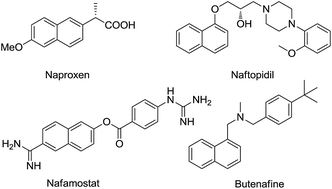

The benzenoid aromatic compounds are arguably the most common structures in nature and the laboratory and polysubstituted naphthalenes, as an important class of benzenoid aromatic compounds, have attracted considerable interest because of their unique physiological activities and functions.1–5 Numerous famous molecules in the naphthalene family, for example, naproxen,2 naftopidi,3 nafamostat,4 and butenafine5 (Fig. 1), occupy a prominent place in medicinal chemistry.
image file: c6ra21889j-f1.tif
Fig. 1 Drugs containing naphthalene.

Allene-mediated cyclization reactions have attracted much attention by the organic community,6 and the electrocyclization of ene–allenes represents one of efficient tools for constructing a new benzene ring, in which the allene moiety could be thought as an “activated olefin”, generally enhancing the possibility of reaction compared with a normal olefin.7 In the last decade, sequential reactions about the in situ generated allenes have been increasingly explored,8 getting benefit from convenient construction of starting materials instead of unstable or reactive polyfunctionalized allene substrates. Our group also established a series of sequential reactions for the efficient synthesis of fused polycyclic skeletons, including benzothiepine sulfones, 2,3-dihydropyrroles and furans, polyfunctionalized quinolines and benzenoid aromatic compounds.9

Generally, performing a 6π-electrocyclic reaction requires a triene moiety (or analogue) involving a middle cis-double bond, which might be not easy to achieve for the acyclic substrates because of the steric hindrance (Scheme 1a).10 During our research on organosulfur chemistry, we found that the treatment of 3-substituted propargyl aldehydes with aqueous MeSNa stereoselectively offers thermodynamically unfavored (E)-3-(methylthio)-3-substituted acrylaldehydes (Scheme 1b), which might provide an efficient way to construct a highly substituted benzene ring, using in situ ene–allene electrocyclization strategy. Herein we wish to report a sequence of propargyl-allenyl isomerization, electrocyclization and aromatization, yielding highly functionalized naphthalene derivatives, which are difficult to obtain via direct functionalization to naphthalene because of the effect of the substituent (Scheme 1c).


image file: c6ra21889j-s1.tif
Scheme 1 Proposal for the construction of naphthalenes.

As a first attempt, we chose (E)-1-phenyl-1-methylthio-3-methoxypent-1-en-4-yne (1a) as the starting material, which could be readily prepared via the treatment of (E)-(E)-3-(methylthio)-3-phenylacrylaldehyde with ethynyl magnesium bromide and iodomethane. We anticipated that the treatment of 1a by acyl chloride under Sonogashira conditions could offer ene–allene intermediate via a sequence of Sonogashira coupling and propargyl-allenyl isomerization. We initiated our study by testing the reaction of 1a with benzoyl chloride (2a) in THF at room temperature, with the assistance of Pd(PPh3)2Cl2, CuI and triethylamine (TEA). To our delight, this set of conditions afforded the expected product naphthalenyl phenylethanone (3a) in 55% yield (Table 1, entry 1) and the structure of 3d was revealed by X-ray diffraction analysis of the (2,4-dinitrophenyl)hydrazone of 3d (see ESI).11 Replacing triethylamine by DIPEA (N,N-diisopropylethylamine) gave similar yields and the stronger organic bases such as DBU (1,8-diazabicyclo[5.4.0]undec-7-ene) and DBN (1,5-diazabicyclo[4.3.0]non-5-ene) afforded sluggish results (Table 1, entries 2–4). Subsequent screening of other common solvents, such as toluene, xylene, chlorobenzene, 1,4-dioxane, acetonitrile and DMF did not improve the yield (Table 1, entries 5–10). Raising the reaction temperature to 60 °C offered a satisfactory yield of 85% (Table 1, entry 13). Thus, the optimized reaction conditions were chosen as follows: 0.5 mmol of 1a, 0.6 mmol of 2a, 0.025 mmol of Pd(PPh3)2Cl2, 0.025 mmol of CuI and 1.5 mmol of triethylamine in 5 mL THF were stirred at 60 °C under nitrogen.

Table 1 Optimization of the reaction conditionsa

image file: c6ra21889j-u1.tif

Entry Base Solvent T (°C) Yield of 3a (%)
a Conditions: 1a (0.5 mmol), 2a (0.6 mmol), Pd(PPh3)2Cl2 (0.025 mmol), CuI (0.025 mmol) and TEA (1.5 mmol) in 5 mL THF were stirred at 60 °C under nitrogen.
1 TEA THF r.t. 55
2 DIPEA THF r.t. 54
3 DBU THF r.t. 0
4 DBN THF r.t. 0
5 TEA Toluene r.t. 12
6 TEA Xylene r.t. 15
7 TEA Chlorobenzene r.t. 21
8 TEA 1,4-Dioxane r.t. 44
9 TEA MeCN r.t. 37
10 TEA DMF r.t. 49
11 TEA THF 40 64
12 TEA THF 50 75
13 TEA THF 60 85


With this result in hand, we examined the scope of the reaction and obtained polysubstituted naphthalenes in moderate to good yields under mild conditions (Table 2). The R2 and R3 can be phenyl groups optionally substituted with an electron-withdrawing or an electron donating group (3b–3f). The R1 can be alkyl, benzyl (3g–3h) and 2-methylenefuran (3i–3j), and the yields are satisfactory.

Table 2 Synthesis of naphthalene derivativesa
a Conditions: 1 (0.5 mmol), 2 (0.6 mmol), Pd(PPh3)2Cl2 (0.025 mmol), CuI (0.025 mmol) and TEA (1.5 mmol) in 5 mL THF were stirred at 60 °C under nitrogen.
image file: c6ra21889j-u2.tif


Then our attention was diverted to the rearrangement of propargyl phosphite to allenyl phosphonate, one of most facile methods generating allenes, which requires just propargyl alcohols as the substrates.12 We prepared propargyl alcohol (4) as the substrates and treated it with chlorodiphenylphosphine with the assistance of Ga(OTf)3 (ref. 9c) and triethylamine. The expected (naphthalen-1-yl(phenyl)methyl)diphenylphosphine oxides (5) were obtained in good yields (Table 3).

Table 3 Synthesis of naphthalene-1-yl-methyl diphenylphosphine oxide compoundsa
a Conditions: 4 (0.5 mmol), Ph2PCl (0.6 mmol), Ga(OTf)3 (0.025 mmol) and TEA (1.5 mmol) in 5 mL THF were stirred at 0–60 °C under nitrogen.
image file: c6ra21889j-u3.tif


The alkylthio groups, helping construct the cis middle double bond of the substrates, are useful for numerous transformations in organic chemistry, which could be used as a convenient chemical handle for preparing other compounds.13 We treated 3a with NaIO4 in aqueous methanol and 2-(2-methoxy-4-(methylsulfinyl)naphthalen-1-yl)-1-phenylethanone 6 was isolated in 90% yield (Scheme 2).


image file: c6ra21889j-s2.tif
Scheme 2 The oxidation of 3a.

Through our previous studies, phosphine oxides are serviceable building blocks and applied widely in Wittig-type olefination.14 Herein we treated 5a with NaH in the presence of dry THF under oxygen atmosphere and obtained (4-(methylthio)naphthalen-1-yl)(phenyl)methanone, which contains a synthetically “omnipotent” carbonyl group, in 65% yield (Scheme 3).


image file: c6ra21889j-s3.tif
Scheme 3 The transformation of 5a.

We proposed a plausible pathway as shown in Scheme 4. The substrate 1, via a Sonogashira coupling/propargyl-allenyl isomerization in the presence of triethylamine through propargyl intermediate A, gives allene intermediate B, which undergoes electrocyclization reaction to give product 3 (Scheme 4).


image file: c6ra21889j-s4.tif
Scheme 4 Plausible mechanism.

In summary, we have developed a protocol for the synthesis of polyfunctionalized naphthalenes via propargyl-allenyl isomerization and electrocyclization. As a result of the readily accessible starting materials and simple operation, this reaction should be an appealing strategy in organic synthesis. Further studies on the synthetic application are currently ongoing.

Acknowledgements

This work was supported by Zhejiang Provincial Natural Science Foundation of China (No. LY14B020008).

Notes and references

  1. (a) T. Katoh, G. Imamura, S. Obata and K. Saiki, RSC. Adv., 2016, 6, 13392 RSC; (b) M. Arai and K. Ito, Chem. Lett., 2015, 44, 1416 CrossRef CAS.
  2. (a) W. L. Noorduin, B. Kaptein, H. Meekes, R. M. Kellogg and E. Vlieg, Angew. Chem., Int. Ed., 2009, 48, 4581 CrossRef CAS PubMed; (b) K. Arai, Y. Ohara, T. Iizumi and Y. Takakuwa, Tetrahedron Lett., 1983, 24, 1531 CrossRef CAS; (c) A. G. El-Sehemi, S. Bondock and Y. A. Ammar, Med. Chem. Res., 2014, 23, 827 CrossRef CAS; (d) E. Vedejs and N. Lee, J. Am. Chem. Soc., 1995, 117, 891 CrossRef CAS.
  3. (a) Shivani, B. Pujala and A. K. Chakraborti, J. Org. Chem., 2007, 72, 3713 CrossRef CAS PubMed; (b) M. Kumar, R. I. Kureshy and H. C. Bajaj, J. Org. Chem., 2013, 78, 9076 CrossRef CAS PubMed; (c) D. S. Bose, A. V. N. Reddy and S. W. Chavhan, Synthesis, 2005, 14, 2345 CrossRef.
  4. (a) F. M. Franco, D. E. Jones, P. K. W. Harris, C. M. Jarvis and J. W. Janetka, Bioorg. Med. Chem., 2015, 23, 2328 CrossRef CAS PubMed; (b) D. Wiemuth and S. Gruender, Mol. Pharmacol., 2011, 80, 911 CrossRef CAS PubMed; (c) T. Sato, Y. Matsuo, T. Honma and S. Yokoyama, J. Med. Chem., 2008, 51, 7705 CrossRef CAS PubMed.
  5. (a) M. Fu, R. Shang, W. Cheng and Y. Fu, Angew. Chem., Int. Ed., 2015, 54, 9042 CrossRef CAS PubMed; (b) K. Beydoun, G. Ghattas, K. Thenert and W. Leitner, Angew. Chem., Int. Ed., 2014, 53, 11010 CrossRef CAS PubMed; (c) E. Fuglseth, E. Otterholt, H. Hoegmoen, E. Sundby, C. Charnock and B. H. Hoff, Tetrahedron, 2009, 65, 9807 CrossRef CAS; (d) T. H. K. Thvedt, K. Kaasa, E. Sundby, C. Charnock and B. H. Hoff, Eur. J. Med. Chem., 2013, 68, 482 CrossRef PubMed.
  6. (a) M. A. Tius, Chem. Soc. Rev., 2014, 43, 2979 RSC; (b) H. Yamamoto, M. Ueda, N. Yamasaki, A. Fujii, I. Sasaki, K. Igawa, Y. Kasai, H. Imagawa and M. Nishizawa, Org. Lett., 2016, 18, 2864 CrossRef CAS PubMed; (c) Y. Zhao, X. Tang, J. Tao, P. Tian and G. Lin, Org. Biomol. Chem., 2016, 14, 4400 RSC; (d) S. Nakano, N. Inoue, Y. Hamada and T. Nemoto, Org. Lett., 2015, 17, 2622 CrossRef CAS PubMed; (e) R. Zeng, C. Fu and S. Ma, Angew. Chem., Int. Ed., 2012, 51, 3888 CrossRef CAS PubMed; (f) B. Alcaide, P. Almendros, T. M. Campoa and I. Fernándezc, Chem. Commun., 2011, 47, 9054 RSC; (g) W. B. Roderick and Y. Lu, Org. Lett., 2010, 12, 3938 CrossRef PubMed; (h) W. Chen, J. Cui, Y. Zhu, X. Hu and W. Mo, J. Org. Chem., 2012, 77, 1585 CrossRef CAS PubMed; (i) O. M. Kostiantyn, Q. Huang, C. O. Austin, A. Hadi and P. D. Michael, J. Org. Chem., 2016, 81, 9235 CrossRef PubMed; (j) E. M. Cabaleiro-Lago, J. Rodriguez-Otero, R. M. Garcia-Lopez, A. Pena-allego and J. M. Hermida-Ramon, Chem.–Eur. J., 2005, 11, 5966 CrossRef CAS PubMed; (k) F. Wang, X. Tong, J. Cheng and Z. Zhang, Chem.–Eur. J., 2004, 10, 5338 CrossRef CAS PubMed; (l) J. Rodriguez-Otero and E. M. Cabaleiro-Lago, Angew. Chem., Int. Ed., 2002, 41, 1147 CrossRef CAS.
  7. For a review for the synthetic application of propargyl-allenyl isomerization, see: (a) Y. Xing, Y. Wei and H. Zhou, Curr. Org. Chem., 2012, 16, 1594 CrossRef CAS; (b) Y. Wang and J. B. Donald, Org. Lett., 2006, 8, 5295 CrossRef CAS PubMed; (c) S. Mohammad, K. A. Piyush and K. Bijoy, J. Org. Chem., 2011, 76, 10122 CrossRef PubMed; (d) T. S. William and J. F. Alison, J. Org. Chem., 2012, 77, 7730 CrossRef PubMed; (e) T. Philip and W. M. Harold, J. Org. Chem., 1995, 60, 3274 CrossRef.
  8. (a) R. U. Braun, M. Ansorge and T. J. J. Müller, Chem.–Eur. J., 2006, 12, 9081 CrossRef CAS PubMed; (b) J. E. Sears, T. J. Barker and D. L. Boger, Org. Lett., 2015, 17, 5460 CrossRef CAS PubMed; (c) D. M. D'Souza, A. Kiel, D. P. Herten and T. J. J. Müller, Chem.–Eur. J., 2008, 14, 529 CrossRef PubMed; (d) R. Gidlof, M. Johansson and O. Sterner, Org. Lett., 2010, 12, 5100 CrossRef PubMed; (e) D. M. D'Souza, F. Rominger and T. J. J. Müller, Angew. Chem., Int. Ed., 2005, 44, 153 CrossRef PubMed; (f) G. Kumaraswamy, N. Jayaprakash and G. Balakishan, Org. Biomol. Chem., 2011, 9, 7913 RSC.
  9. (a) H. Zhou, Y. Xing, J. Yao and Y. Lu, J. Org. Chem., 2011, 76, 4582 CrossRef CAS PubMed; (b) H. Zhou, L. Liu and S. Xu, J. Org. Chem., 2012, 77, 9418 CrossRef CAS PubMed; (c) G. Zhao, Q. Zhang and H. Zhou, Adv. Synth. Catal., 2013, 355, 3492 CrossRef CAS; (d) G. Zhao, Q. Zhang and H. Zhou, J. Org. Chem., 2014, 79, 10867 CrossRef CAS PubMed; (e) D. Chen, G. Xing and H. Zhou, Org. Chem. Front., 2015, 2, 947 RSC; (f) L. Liu, D. Chen and H. Zhou, Adv. Synth. Catal., 2015, 357, 389 CrossRef CAS.
  10. (a) G. Gao, Y. Niu, Z. Yan, H. Wang, G. Wang, A. Shaukat and Y. J. Liang, Org. Chem., 2010, 75, 1305 CrossRef CAS PubMed; (b) C. S. López, O. N. Faza, F. P. Cossío, D. M. York and A. R. Lera, Chem.–Eur. J., 2005, 11, 1734 CrossRef PubMed; (c) N. A. Porter, D. J. Hogenkamp and F. F. Khouri, J. Am. Chem. Soc., 1990, 112, 2402 CrossRef CAS.
  11. CCDC 1491859.
  12. (a) G. Gangadhararao, R. N. P. Tulichala and K. C. K. Swamy, Chem. Commun., 2015, 51, 7168 RSC; (b) T. Song, L. Zheng, F. Ye, W. Deng, Y. Wei, K. Jiang and L. Xu, Adv. Synth. Catal., 2014, 356, 1708 CrossRef CAS; (c) K. V. Sajna and K. C. K. Swamy, J. Org. Chem., 2012, 77, 5345 CrossRef CAS PubMed; (d) M. Alajarin, B. Bonillo, M. Marin-Luna, P. Sanchez-Andrada and A. Vidal, Chem.–Eur. J., 2013, 19, 16093 CrossRef CAS PubMed.
  13. (a) J. Šturala, S. Boháčová, J. Chudoba, R. Metelková and R. Cibulka, J. Org. Chem., 2015, 80, 2676 CrossRef PubMed; (b) Z. Yu and J. G. Verkade, Tetrahedron Lett., 1998, 39, 2671 CrossRef CAS; (c) S. Nakamura, R. Nakagawa, Y. Watanabe and T. Toru, J. Am. Chem. Soc., 2000, 122, 11340 CrossRef CAS.
  14. (a) Y. Gu and S. Tian, Top. Curr. Chem., 2012, 327, 197 CrossRef CAS PubMed; (b) T. Takeda, Modern Carbonyl Olefination, Wiley-VCH, Weinheim, 2004 Search PubMed.

Footnote

Electronic supplementary information (ESI) available: Experimental procedures, characterization data, crystallographic data in CIF and NMR spectra. CCDC 1491859. For ESI and crystallographic data in CIF or other electronic format see DOI: 10.1039/c6ra21889j

This journal is © The Royal Society of Chemistry 2016
Click here to see how this site uses Cookies. View our privacy policy here.