Seyed Saeid Rahdara,
Mahdi Abdollahi
*b,
Ebrahim Ahmadia and
Abbas Biglaric
aPolymer Reaction Engineering Department, Faculty of Chemical Engineering, Tarbiat Modares University, P. O. Box: 14115-114, Tehran, Iran. E-mail: abdollahim@modares.ac.ir; Tel: +98 21 82884959
bChemistry Department, Faculty of Science, Zanjan University, P. O. Box 45195-313, Zanjan, Iran
cDepartment of Chemistry, Institute for Advanced Studies in Basic Sciences (IASBS), P. O. Box: 45195-1159, Zanjan, Iran
First published on 4th November 2016
Free-radical copolymerization of vinyl acetate (VAc) and dibutyl maleate (DBM) in deuterated chloroform (CDCl3) initiated with 2,2′-azobis(isobutyronitrile) at 60 °C was monitored via online 1H-NMR kinetic experiment. The reactivity ratios of the VAc (rVAc) and DBM (rDBM) were calculated using data obtained from two online experiments. Two, i.e. classic and new, approaches were used to collect conversion and copolymer composition data. Results showed that for a copolymerization with a relatively large difference between the reactivity ratios (rVAc to rDBM ratio of about 5) the reactivity ratios can be calculated by data collected only from one online 1H-NMR experiment. In the case of copolymerization with the chloroform where copolymers with a number-average molecular weight (Mn) equal to or below 104 g mol−1 were synthesized, rVAc and rDBM were found to be 0.1135 and 0.0562 (r1r2 = 0.0064), respectively, [J. Polym. Res., 2014, 21, 582]. In the present work where copolymers with an Mn value of about 2 × 10⁴ g mol−1 were synthesized, rVAc and rDBM were found to be 0.1911 and 0.0381 (r1r2 = 0.0073), respectively. The chemospecificity of the chloroform and corresponding trichloromethyl (CCl3) radical in the reaction with the propagating radical and comonomers, respectively, was deduced from instantaneous copolymer composition curves. The results revealed that DBM adds preferentially onto the CCl3 radicals derived from AIBN/CHCl3 or AIBN/CDCl3, indicating that copolymer composition and hence apparent reactivity ratios can be affected by the copolymer's molecular weight. Results may also be attributed to the preferential addition of the propagating radicals with a terminal DBM unit to CHCl3 or CDCl3.
Copolymer composition is an important factor in the evaluation of copolymer characteristics.8 Controlling the polymer property parameters, such as copolymer composition, comonomer sequence distribution, molecular weight and distribution, as well as the kinetics of the copolymerization play the most important roles in copolymerization reactions. In order to calculate the polymer productivity and copolymer composition, comonomer reactivity ratios must be known. The method that is used most often nowadays for estimating monomer reactivity ratios is to perform copolymerization at low conversion with various initial feed compositions.9 Among the techniques available to determine monomer reactivity ratio at low conversions, Mayo–Lewis,10 Finemann–Ross,11 inverted Finemann–Ross,12 Kelen–Tudos,13 extended Kelen–Tudos,14–16 Tidwell–Mortimer,17 and Mao–Huglin18 methods can be mentioned. Mayo–Lewis (ML), extended Kelen–Tudos (eKT) and Mao–Huglin (MH) methods can also be used for manipulation of the high conversion results.
Average copolymer composition can be affected by various factors, such as comonomer reactivity ratios19 and chemo- and regio-specificity in the initiation, transfer and termination steps.19–22 It has been reported for the regio-selectivity of the radicals that they react with most monomers exclusively by tail β-addition, while radicals generally show a high degree of chemo-selectivity in reactions with vinyl monomers.20,23
The effect of molecular weight (or equivalently chain length) on the instantaneous copolymer composition has been examined and proven.24–27 When the copolymerization is performed in the presence of CTA, propagating chains are terminated by CTA and chains are initiated by CTA-derived radicals. For example, thiyl radicals generated from thiol CTA react with styrene (St) faster than acrylates.19,27 On the other hand, the thiol reacts preferentially with propagating radicals with styryl ends owing to the chemospecificity of propagating radicals in the reaction with thiol. In such a copolymerization, therefore, the ω- and α-ends of the copolymer chains are mostly not representative of the overall copolymer composition. In other words, chains are both initiated and terminated by St, meaning that short chains are much richer in St than in the acrylates.19,27
In conventional free-radical copolymerization, the comonomer reactivity ratios are generally determined at low conversion, where composition drift in the comonomer mixture can be considered to be negligible. The average chemical composition of the resulting copolymer is analyzed by various methods, such as 1H-NMR. However, in controlled/living radical polymerization, the copolymer chain forms slowly throughout the reaction time and hence measurement of the copolymer composition at low conversion can be affected by the structure of the initiator, which may preferentially react only with one of the comonomers,28,29 resulting in inaccurate comonomer reactivity ratio estimation by a classic approach. Therefore, to obtain reliable results, it is necessary to measure the cumulative copolymer composition at a conversion higher than about 10–15%. As a result, ML, eKT and MH methods are appropriate to calculate comonomer reactivity ratios in such situations where the effect of conversion should also be considered in the calculation of comonomer reactivity ratios.
Recently, a new approach based on the modified cumulative average copolymer composition at either low or high conversion has been introduced for the calculation of the accurate comonomer reactivity ratios in controlled/living radical copolymerization, as well as in any other living chain-growth copolymerization system.30 In such conditions, the influence of possible preferential addition of one of the comonomers onto the (macro)initiator-derived (macro)radical on the copolymer composition is actually excluded (for more details, see section of “Determination of the reactivity ratios by two different approaches”).
Free-radical telomerization, i.e. free radical polymerization in the presence of a CTA, so-called telogen, is a technique to produce low to medium molecular weight functional polymers, so called telomers.31 Similar to controlled/living radical polymerization, the molecular weight of the telomer produced is not high enough; therefore, the influence of the preferential addition of the comonomers onto the CTA-derived radical as well as of the preferential addition of the CTA with propagating radicals on the copolymer composition cannot be ignored. In such conditions, different values for apparent reactivity ratios of the comonomers are obtained depending on the molecular weight of the synthesized copolymers. Then, the chemo-selectivity of the CTAs and corresponding radicals towards propagating radicals and comonomers, respectively, can be evaluated.
The reactivity ratios of vinyl acetate (VAc) (rVAc) and dibutyl maleate (DBM) (rDBM) in the free-radical copolymerization initiated by 2,2′-azobis(isobutyronitrile) (AIBN) in the presence of chloroform as a telogen were calculated from medium/high conversion data by the classic approach to be 0.1102 and 0.0421, respectively, by eKT method and 0.1135 and 0.0562, respectively, by MH method.32 Although both reactivity ratios of VAc and DBM are much less than 1, there is a relatively significant difference between the reactivity ratios of VAc and DBM. In general, for copolymerization systems with significant differences between the comonomer reactivity ratios, such as VAc/methyl acrylate,7 VAc/ethyl acrylate,33 VAc/butyl acrylate33 and VAc/butyl methacrylate,34 considerable composition drifts in the comonomer mixture and copolymer are expected. Hence, for the above-mentioned systems, comonomer mixture and instantaneous copolymer compositions change considerably with the progress of the reaction and thus it is possible to calculate the monomer reactivity ratios online following these changes (for example by online 1H-NMR kinetic experiment) during the copolymerization reaction only for one initial comonomer mixture composition.7
To further evaluate the accuracy of the estimated reactivity ratios in telomerization reactions, such as those reported in previous work,32 as well as to investigate the molecular weight dependency of the copolymer composition used in the estimation of apparent comonomer reactivity ratios, free-radical copolymerization of VAc and DBM initiated by AIBN in the presence of chloroform-d (CDCl3) as a CTA is followed in the present work only for two initial comonomer mixture compositions by online 1H-NMR kinetic experiment. Then, reactivity ratios of VAc and DBM are calculated using the classic and above-mentioned new approaches. The effect of copolymer molecular weight on the apparent comonomer reactivity ratios is then discussed. The accuracy of the estimated reactivity ratios is finally evaluated by considering the 95% joint confidence limits.
:
50 vol/vol. Two samples VD1 and VD2 were prepared with mole fractions of VAc equal to 0.7143 and 0.8333, respectively, in the initial comonomer mixture. The final reaction mixture prepared was then added to the NMR tube (5 mm in diameter). The solutions in the NMR tubes were then degassed with nitrogen gas (99.9% purity) to exclude oxygen from the reaction mixtures, which acts as a retardant in the free radical polymerization reactions.
The sample containing the reaction mixture was allowed to equilibrate for about 5 min. The first recorded spectrum (after the sample tube containing the reaction mixture was inserted into the cavity) was regarded as the spectrum representing zero overall monomer conversion. Although approximately 5 min had passed from insertion of the sample into the cavity to the first scan, negligible conversion had occurred because of the low overall rate of the reaction in the primary moments. To decrease the concentration of the comonomers and hence decrease the polymerization rate, and to avoid an excessive viscosity increase at higher conversions, a high amount of the chloroform-d was used.
A typical 1H-NMR spectrum of an initial reaction mixture containing 0.7143 mole fraction of VAc at the overall monomer conversion of 45.79 mol% with the signal assignments is shown in Fig. 1.
Signal assignments for copolymerization systems were carried out with regard to the spectra recorded for homopolymerization of both VAc and DBM and comparing them with those recorded for the copolymerization systems.32 Fig. 1 indicates clearly that the peaks in the chemical shift range of 4.4–4.65 and 4.65–5.3 ppm for VAc monomer are related to the (–CHVAca) monomer and the [(–CHVAcb) + (–CHVAck)] monomer/polymer, respectively. Additionally, the peaks of monomeric (–CHDBMe) and monomer/polymer [(–CHDBMf) + (–CHDBMn)] protons appear in the chemical shift ranges of 6–6.3 and 3.7–4.3, respectively. In all of the spectra for each sample, the overall integrals of peaks for protons “f” and “n” in the unreacted and reacted, respectively, DBM (Fig. 1) were adjusted to an arbitrary value of 4. The integral for the signals of other protons in the same spectrum was automatically scaled according to this value. Then all other spectra recorded at various time intervals were scaled similar to the first spectrum, so that the overall integrals of all proton signals in all the other spectra for each sample were equal to the first spectrum of each sample. Thus, the individual conversions of both VAc and DBM can be monitored as a function of reaction time.
Individual comonomer conversions of VAc and DBM as well as the overall copolymer conversion and copolymer composition were determined versus time, and corresponding curves were plotted. Individual conversions of VAc and DBM at any time were calculated via eqn (1) and (2):32
![]() | (1) |
![]() | (2) |
i(t)) at any time are related to the individual comonomer conversions by the following equations:30,32
![]() | (3) |
![]() | (4) |
![]() | (5) |
is the mole fraction of comonomer i in the initial reaction mixture.
i(t) is indeed the cumulative mole fraction of comonomer i incorporated into the produced copolymer chains during the reaction time t. Subscripts i and j indicate comonomers VAc and DBM, respectively.
From the xVAc(t) and xDBM(t) values obtained by online 1H-NMR kinetic experiments, it is possible to calculate x(t), fi(t) and
i(t) as a function of time via eqn (3)–(5). The results of the calculation are given in Table S1 of the ESI.† The corresponding curves for individual and overall conversion of the copolymerization system of VAc and DBM are shown in Fig. 2 and 3. The reaction temperature in the experiments was set at 60 °C. Fig. 2 and 3 reveal that both comonomers copolymerize and DBM incorporates into the copolymer at a higher rate than VAc. This event occurs only when the mole fraction of VAc in the initial feed is higher than that of DBM.32 It was deduced that in the earlier stages of copolymerization, due to the almost alternating structure of the produced chains, a lower amount of DBM in the initial feed leads to faster incorporation of DBM into the copolymer chains. Therefore, significant drift in the comonomer mixture composition with the reaction progress is expected. After that, the ability and tendency of the VAc comonomer for homopolymerization in the absence of DBM comonomer results in the formation of VAc homopolymer chains with a higher rate constant (kp,VAc > kp,copolymer > kp,DBM where kp indicate propagation rate coefficient), from which the overall rate of polymerization and
VAc increase.32 In approval of the aforementioned statement, the overall conversion of comonomers versus time in two different mole fractions of VAc in the initial feed (both higher that 0.5) (Fig. 3) clearly show that the higher the amount of VAc content in the initial feed, the higher the conversion rate will be. In these experiments, DBM always preferentially incorporates into the copolymer chain at a higher rate. The final molar conversion of DBM monomer was recorded to be about 67 and 89% for 0.714 and 0.833, respectively, mole fractions of VAc in the initial reactions mixture, while that of VAc monomer doesn't exceed the 50% at the same time for both experiments.
![]() | ||
Fig. 3 Overall comonomer conversion as a function of reaction time in experiments VD1 ([VAc]0 : [DBM]0 = 2.5 : 1) and VD2 ([VAc]0 : [DBM]0 = 5 : 1) at 60 °C. | ||
Online 1H-NMR spectra recorded for sample VD2 versus the reaction time are shown in Fig. 4. It is clear from this figure that with the progress of the polymerization reaction, the intensities of the peaks related to the protons of comonomers incorporated into the copolymer chains are increasing. So, the progress of the reaction can be followed with time by following the decreasing intensities of the comonomeric areas and the increase in regions related to copolymer protons. As a consequence, it is possible to investigate the kinetics of the VAc/DBM copolymerization reaction. It should be noted that isothermal conditions were established during the course of the reaction due to low rate of the copolymerization reaction and the high amount of solvent used.
![]() | ||
| Fig. 4 Progress of the free-radical solution copolymerization reaction of VAc and DBM as a function of time for experiment VD2 containing 0.8333 mole fraction of VAc in the initial feed. | ||
(Δt′) as well as the individual (xVAc(Δt′) and xDBM(Δt′)) and overall (x(Δt′)) comonomer conversions for a copolymer produced during Δt′ can be calculated at either low or high conversion. Initial comonomer mixture composition for the copolymer formed during this time interval (Δt′) is considered in fact to be the composition of the comonomer mixture at time t (i.e. f(t), which is defined as the molar ratio of comonomer i to comonomer j in the comonomer mixture). Therefore, the new approach uses data obtained from online 1H-NMR spectra during any time intervals to calculate the reactivity ratios of the comonomers.7 These data can be obtained via the following equations:28,30
![]() | (6) |
![]() | (7) |
![]() | (8) |
![]() | (9) |
| x(Δt′) = fVAc(t)xVAc(Δt′) + fDBM(t)xDBM(Δt′) | (10) |
| Δt′ = t′ − t and t′ > t | (11) |
(Δt′) indicate the molar ratio of VAc to DBM in the reaction mixture at time t and that in the copolymer produced during the time interval Δt′. xVAc(Δt′), xDBM(Δt′) and x(Δt′) indicate individual conversions of VAc and DBM and corresponding overall conversion, respectively, during the same time interval Δt′. Data obtained by eqn (6)–(10) are given in Table S2 of the ESI† for both experiments VD1 and VD2.
It should be noted that data obtained for each sample are sufficient to calculate the monomer reactivity ratios. However, it is preferable to combine the data for two samples and then calculate the more reliable reactivity ratios of VAc and DBM. The results of the calculation of the comonomer reactivity ratios by different methods including extended Kelen–Tudos (eKT) and Mao–Huglin (MH) methods are given in Table 1. In this table, the term “classic approach 1” refers to the conventional approach reported in the previous work23 that can be used to calculate reactivity ratios by the different methods, such as eKT and MH methods, while the term “classic approach 2” refers to an approach similar to “classic approach 1” except that data collected from only two online 1H-NMR kinetic experiments are used in the calculations. In addition, the term “new approach” refers to the recently introduced procedure in the calculation of reactivity ratios by using only one online 1H-NMR kinetic experiment.7 This procedure is based on following the comonomer mixture and copolymer compositions at different reaction time intervals (see eqn (6)–(11)), from which enough data for calculation of reactivity ratios can be obtained for a copolymerization system with a large difference between the comonomer reactivity ratios.7
| Terminal unit model (TUM) | |||
|---|---|---|---|
| rVAc | rDBM | Approach/method used | Reference |
| 0.1102 | 0.0421 | Classic approach 1/eKT | 32 |
| 0.1135 | 0.0562 | Classic approach 1/MH | 32 |
| 0.1787 ± 0.0089 | 0.0062 ± 0.1185 | Classic approach 2/eKT | This work |
| 0.1792 ± 0.0090 | −0.0081 ± 0.1165 | Classic approach 2/MH | This work |
| 0.1911 ± 0.0045 | 0.0381 ± 0.0788 | New approach/MH | This work |
| 0.1901 ± 0.0045 | 0.0151 ± 0.0755 | New approach/eKT | This work |
| Simplified penultimate unit model (PUM) | |||
|---|---|---|---|
| rVAc/r′VAc | rDBM/r′DBM | Approach/method used | Reference |
| 0.1612 ± 0.0450/0.1954 ± 0.0486 | 0/0 | Classic approach 2/MH | This work |
| 0.1812 ± 0.0205/0.1890 ± 0.0247 | 0/0 | New approach/MH | This work |
A simplified penultimate unit model (PUM) was also used to calculate the ultimate (rVAc) and penultimate (r′VAc) reactivity ratios of VAc by assuming rDBM = r′DBM = 0 (Table 1). There is no significant difference between the ultimate and penultimate reactivity ratios of VAc, suggesting that copolymer composition, microstructure and drifts in the comonomer mixture and copolymer compositions of the VAc/DBM copolymerization system can be described well by the terminal unit model (TUM).
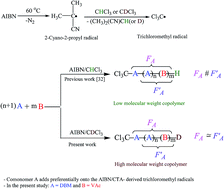
In the previous work,23 free-radical copolymerization of VAc and DBM was performed with a procedure the same as that in the present work; however, chloroform was used instead of deuterated chloroform. GPC results showed that number-average molecular weight of the copolymers formed in the free-radical copolymerization of VAc and DBM with CHCl3 as a CTA (Mn = 10
350 g mol−1 with PDI = 2.36 for foVAc = 0.5)32 is much lower than that with CDCl3 as a CTA in the present work (Mn = 20
595 and 19
856 g mol−1 with PDI = 1.95 and 2.06 for foVAc values of 0.714 and 0.833, respectively). It can be attributed to the different transfer constants to the solvent where the chain transfer ability of deuterated chloroform has been reported to be lower than that of chloroform.31 The higher the molecular weight is, the lower the influence of the chemospecificity in reactions with CTA and/or corresponding radical on the copolymer composition will be (Scheme 1). Hence, different reactivity ratios are expected, as can be seen in Table 1. One can expect that the copolymer compositions obtained in the present work are more accurate than those obtained in the previous work,32 which will be discussed in the next section based on the 95% joint confidence limits.
As mentioned before, individual monomer conversions versus time data may be used to determine changes in the comonomer mixture composition as a function of the overall monomer conversion. Using the Meyer–Lowry equation35 and reactivity ratios of the MH method in the new approach, theoretical mole fraction of DBM in the comonomer mixture (fDBM(t)) as a function of the overall monomer conversion were calculated and compared with the corresponding experimental data (Fig. 5). It is clear from this figure that for DBM mole fractions in the initial feed under study, incorporation of DBM into the copolymer chains is more favored than that of VAc. Drift in the comonomer mixture composition with conversion is significant, indicating that following two reactions under study allows us to collect enough data for estimation of the reactivity ratios.32
Fig. 6 indicates the theoretical (calculated by using the Meyer–Lowry equation along with the material balance equation introduced in the literature,35 where reactivity ratios of the MH method in the new approach were used) and experimental values obtained for cumulative copolymer composition versus overall conversion.
The basic equation for instantaneous copolymer composition is defined as follows:
![]() | (12) |
The theoretical instantaneous copolymer composition curve obtained from the differential copolymer composition equation of Mayo–Lewis (eqn (12)) by using monomer reactivity ratios obtained in the previous32 and present works are shown in Fig. 7. For reactivity ratios obtained by the new approach via the MH method, copolymerization of the VAc/DBM system shows an unstable azeotropic point equals to foVAc = 0.5432. This means that the copolymer composition will drift away from the azeotropic composition with conversion. Furthermore, small monomer concentration fluctuations will cause the operating point to move away from the azeotrope point.
![]() | ||
| Fig. 7 Theoretical variation of the instantaneous copolymer composition (FVAc) as a function of the mole fraction of VAc in the initial feed (foVAc) for VAc/DBM copolymerization (theoretical values were calculated from the copolymer composition equation (eqn (12)) by using the reactivity ratios of various approaches). | ||
The results observed in Fig. 7 can be attributed to the preferential addition of DBM onto the trichloromethyl (CCl3) radicals derived from a reaction between the AIBN-derived 2-cyano-2-propyl radicals and CTA (CHCl3 or CDCl3) (Scheme 1) and/or to the preferential addition of the propagating radicals with terminal DBM unit to the CTA. In other words, there is no higher tendency for VAc monomer and corresponding radical to react with CCl3 radicals and CTA. Therefore, results observed in Fig. 7 may be attributed to this fact that radicals generated from DBM comonomer are more stable than those from VAc comonomer.36,37 It can be attributed to the resonance of the carbon-centered radical with the carbonyl group in the DBM. DBM monomer has been reported to be unable to homopolymerize while it can copolymerize easily with comonomers such as VAc and styrene.32,36 Once the DBM adds to the primary CCl3 radicals, electron-rich VAc then adds preferentially to the DBM-derived stable radicals followed by addition of electron-deficient DBM to the VAc-derived unstable radicals. In other words, the VAc/DBM system has a tendency towards alternating copolymerization with a rVAcrDBM value close to zero (Table 1). Consequently, performing copolymerization reactions with at least two different conditions leading to the low/medium and high molecular weight copolymers is introduced in the present work as a strategy to exactly determine a comonomer that adds preferentially to the initiator/CTA-derived radicals and/or a propagating radical that adds preferentially to the CTA.
In the previous32 and present works where CHCl3 and CDCl3, respectively, were used as CTAs, 2-cyano-2-propyl radicals are generated from AIBN and then react with above-mentioned CTAs, producing CCl3 radicals31,38 (Scheme 1) with a possible different reactivity towards comonomers (VAc and DBM in the present study) in the free-radical copolymerization. To our knowledge, there are no reports on the absolute rate constant (k1) for the addition of carbon-centered radicals to DBM; however, owing to its structure, the k1 value of the DBM is expected to be almost similar to that of the methyl acrylate (MA). A similar trend for carbon-centered radicals with a halo- (chloro- in the present case) or cyano-heteroatom substituent is expected.23 For example, k1 values for the addition of 2-cyano-2-propyl radicals to VAc and MA at 315 K have been reported to be 41 and 370 L mol−1 s−1, respectively,39 indicating that the MA (and hence DBM) is more reactive than the VAc.23,39
Addition of the CCl3 radicals to various vinyl C
C bonds of the CH2
CHX (X indicates substituent) monomers has been investigated in the literature.20,23,40–44 k1 values for the addition of the CCl3 radicals to VAc and MA at 30 and 22 °C, respectively, have been reported to be 1120 (ref. 40) and 29
000 (ref. 44) L mol−1 s−1, respectively, indicating again that the MA (and hence DBM) is more reactive than the VAc. Based on the results in Fig. 7, a similar trend was observed in the present work where electron-deficient DBM adds onto the CCl3 radicals faster than electron-rich VAc, meaning that CCl3 radicals possess some electrophilic character.
There are no reports on the addition of the VAc- and DBM (or MA)-radicals to CHCl3 or CDCl3; however, the absolute rate constant for addition of the VAc radical to bromotrichloromethane (CBrCl3), leading to dead VAc–Br and a CCl3 radical, has been reported to be 2740 L mol−1 s−1.40 More experimental data is needed to exactly evaluate the possible preferential reaction of CTA (CHCl3 or CDCl3 in the present study) with one of the propagating radicals with terminal VAc and DBM units. Although the chemospecificity of CTA with propagating radicals has not been considered in Scheme 1, based on the results given in Fig. 7 and those observed for the preferential reaction of the thiol (RSH) with the propagating radicals with the St unit in comparison with those with the acrylate unit,19,27 one may expect that CHCl3 or CDCl3 may react preferentially with propagating radicals with a terminal DBM unit.
Comonomer reactivity ratios obtained by all methods were used in the Meyer–Lowry equation to plot the theoretical estimation of comonomer mixture and copolymer composition. The best fitting between the theoretical and experimental values was obtained for reactivity ratio values of the MH method calculated by the new approach in the present work (Fig. 6 and 7), indicating the accuracy of the reactivity ratios obtained by the new approach with corresponding copolymer composition data obtained from high molecular weight copolymers produced during two online 1H-NMR kinetic experiments.
![]() | ||
| Fig. 8 95% joint confidence limits for the reactivity ratio data determined by the eKT and MH methods via classic approach 2 and the new approach in the copolymerization of VAc and DBM. | ||
Footnote |
| † Electronic supplementary information (ESI) available: The experimental data obtained from 1H-NMR spectra can be seen as a separate DOC file. See DOI: 10.1039/c6ra21888a |
| This journal is © The Royal Society of Chemistry 2016 |