
Facile formation of silver nanoparticles as plasmonic photocatalysts for hydrogen production

Jianli Jiaoa, Jinquan Wan*abc, Yongwen Maabc and Yan Wangab
aSchool of Environment and Energy, South China University of Technology, Guangzhou 510006, China. E-mail: ppjqwan@scut.edu.cn
bThe Key Lab of Pollution Control and Ecosystem Restoration in Industry Clusters, Ministry of Education, South China University of Technology, Guangzhou 510006, China
cState Key Laboratory of Pulp and Paper Engineering, South China University of Technology, Guangzhou 510640, China

Received 24th August 2016 , Accepted 31st October 2016

First published on 31st October 2016


Abstract

We show an efficient way to produce H2 using silver nanoparticles (AgNPs) as the plasmonic photocatalyst. AgNPs were successfully synthesized by a facile method (in situ photo-reduction). Then, an effective photocatalytic system was presented, which generated H2 from water under irradiation. The AgNPs exhibited an admirable photocatalytic activity with an average rate of hydrogen evolution of 20 mmol g−1 h−1, using triethanolamine as a sacrificial electron donor and without the use of semiconductors. The photocatalytic activity of the AgNPs can be attributed to the LSPR effect.

Hydrogen energy, a new-type of clean energy carrier,1 has attracted much attention to solve the increasingly urgent energy and environment problems. Therefore, much research has been carried out on hydrogen production techniques.2 Among the different hydrogen production routes, photocatalytic water-splitting is a promising technology for hydrogen generation by utilizing abundant solar light. It has been extensively studied by many research groups in recent years.3 The key to improving photocatalytic hydrogen production techniques is the preparation of highly efficient and stable photocatalysts. Conventional photocatalysts are almost exclusively focused on the study of semiconductor materials since the TiO2 electrode was found to be able to achieve water-splitting as a photocatalyst in 1972.4 However, in order to enhance the photocatalytic activity, noble metal nanoparticles incorporated in semiconductors, namely plasmonic photocatalysts, have been successfully applied.5 Besides, the mechanism of plasmonic photocatalysis was firstly proposed by Koichi Awazu in 2008.6 The metallic plasmonic nanoparticles have an excellent mobility of charge carriers and high absorption, and they also have the ability to tune the resonance wavelength by changing their size or shape, so it is promising that the entire solar spectrum can be exploited.7

Recently, some isolated plasmonic photocatalysts without a semiconductor-based material were reported to utilize surface plasmon resonance. For instance, Liu et al. successfully applied isolated copper nanoparticles for hydrogen evolution, which showed that metal nanoparticles can act as a light absorber and a catalytically active site simultaneously.8 Dong et al. studied the mechanism and application of Bi nanostructures using direct plasmonic photocatalysis.9

Silver, one of the most abundantly used noble metals, has high conductivity and promising photocatalytic activity. AgNPs are generally supported on semiconductor substrates to be used as a plasmonic photocatalyst due to the existence of the localized surface plasmon resonance (LSPR) effect.10 When the metal nanoparticles absorb incident light, the energy of photogenerated electrons is transferred from the metal nanoparticles to the semiconductor with the assistance of LSPR. A question that arises is, taking water-splitting for example, why not transfer the plasmonic energy directly from the metal to the water molecules nearby? Herein, isolated AgNPs were obtained via a facile method. Without the combination of substrates, its photocatalytic activities for hydrogen evolution have been discussed.

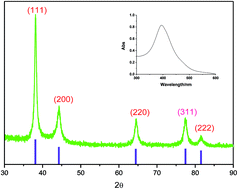
In this study, AgNPs were prepared in situ. Each peak in the powder X-ray diffraction (XRD) pattern of Fig. 1 can be indexed to face-centered Ag [JCPDS number 04-0783], as 2θ = 38.11°, 44.27°, 64.42°, 77.47° and 81.53° corresponding to the (111), (200), (220), (311) and (222) planes of Ag crystal.11 No peaks of impurity crystalline phases are detected. The crystallite size (L) of the material has been evaluated by Scherrer’s formula (L = /β[thin space (1/6-em)]cos[thin space (1/6-em)]θ).12 The crystallite size of the AgNPs was found to be about 25 nm. The inset shows the UV-vis absorption spectrum of the aqueous-dispersed AgNPs, displaying a broad absorption band centered at 395 nm which was attributed to the LSPR effect of the AgNPs.13


image file: c6ra21269g-f1.tif
Fig. 1 XRD pattern of silver nanoparticles in situ synthesized and the JCPDS card of Ag; inset shows the UV-vis spectrum of the sample.

The morphology and microstructure of the prepared samples were investigated by scanning electron microscopy (SEM), transmission electron microscopy (TEM) and high resolution transmission electron microscopy (HRTEM). As shown in Fig. 2a and d, samples consist of spherical particles with an average diameter ranging from 20 to 50 nm. The corresponding high-resolution transmission electron microscopy (HRTEM) (Fig. 2b) image confirms that the nanoparticles are AgNPs, where the clear lattice spacing of ≈0.235 nm corresponds well to the lattice spacing of the (111) plane for the cubic Ag phase [JCPDS number 04-0783].


image file: c6ra21269g-f2.tif
Fig. 2 SEM, HRTEM and TEM images of the AgNPs (a, b, d); XPS survey spectra of the AgNPs (c).

In order to further determine the chemical state of the element present in the sample synthesized in situ, XPS analysis has been performed (Fig. 2c), the peaks at 368.3 and 374.3 eV are assigned to metallic Agd5/2 and Agd3/2 (ref. 14) respectively, which further confirms the presence of Ag0.

Without the combination of substrates, the AgNPs exhibit a high photocatalytic performance for the hydrogen evolution reaction (HER). Fig. 3a shows the time courses of photocatalytic hydrogen evolution over the AgNPs in the HER system. In the photocatalytic reaction, when 1 mL of silver ammonia solution (2 mmol L−1) was added to aqueous solution (70 mL) containing triethanolamine (10 mL) as an electron sacrificial agent, the H2 evolution average rate is 20 mmol g−1 h−1 under illumination. When the irradiation was stopped, H2 evolution was halted. This indicates that the reaction is driven by the photocatalyst. Although the rate of hydrogen production shows a slight decay during the irradiation time (20 h) intermittently, it suggests that the photocatalyst (AgNPs) performance is stable on the whole.


image file: c6ra21269g-f3.tif
Fig. 3 (a) Time courses of H2 evolution in the HER system; (b) the transient photocurrent density response of the AgNPs under irradiation, repeated every 10 s over five on/off irradiation cycles; (c) wavelength-dependent H2 evolution from water by AgNPs.

Photocurrent is a common measure to test photogenerated electrons in the photocatalytic material under illumination. Fig. 3b shows the transient photocurrent density response of the AgNPs under UV-vis irradiation, repeated every 10 s over five on/off irradiation cycles. It is fast, steady, and there is no photogenerated electrons appearing under dark conditions, which proves the photogenerated electrons and holes can be excited in the AgNPs under irradiation. Also, the result further indicates the AgNP photocatalyst is pretty stable and reproducible.

To confirm that the reaction proceeds through light absorption with AgNPs, we estimated the dependence of the rate of H2 evolution on the wavelength of incident light. As shown in Fig. 3c, the trend of the H2 evolution rates is in consonance with the absorption spectrum.

The QY (Quantum Yield) of the AgNPs was measured using monochromatic lights with a band-pass filter (λ = 400) and an irradiatometer (0.4 W). The QY (4.3%) was calculated by the following formula.15

image file: c6ra21269g-t1.tif

It is very interesting that metal AgNPs act as an efficient photocatalyst for hydrogen evolution. As is well known, silver is not semiconductor and has no band gap. Therefore, the mechanism of the photocatalytic reaction in this work can be different from semiconductor theory. In fact, the surface plasmon resonance effect of AgNPs has been proved by enhancing the efficiencies of surface-enhanced Raman scattering.16 The photocatalytic properties of AgNPs under irradiation may be ascribed to the excitation of LSPR. Phillip Christopher pointed out that the AgNPs absorb photons which cause LSPR, and the absorption of photon energy changes into electrons and holes by Landau damping.17 Electrons (SP state) excited by LSPR18 are directly injected from plasmonic-metal nanostructures to initiate chemical reactions. In our experiment, the water molecules are reduced to hydrogen by isolated AgNPs without a semiconductor, which indicates that the high energy of photogenerated electrons from AgNPs by LSPR can be directly injected into the water molecules nearby (Fig. 4).


image file: c6ra21269g-f4.tif
Fig. 4 Schematic diagram of the mechanism of the photocatalysis of the AgNPs.

In conclusion, AgNPs were prepared by an in situ photo-reduction method, and it has been proved to be a new plasmonic photocatalyst for hydrogen evolution. The results demonstrate that AgNPs can produce hydrogen from water as a plasmonic photocatalyst. The effective photocatalytic activity was due to the LSPR effect of AgNPs.

Acknowledgements

This study was funded by the National Natural Science Foundation of China (No. 31570568), State key laboratory of Pulp and Paper Engineering in China (201535) and Guangdong High level talent project (201339).

Notes and references

  1. A. Midilli, M. Ay, I. Dincer and M. A. Rosen, Renewable Sustainable Energy Rev., 2005, 9, 255 CrossRef CAS.
  2. (a) K. J. Wu and J. S. Chang, Process Biochem., 2007, 42, 279 CrossRef CAS; (b) M. M. Najafpour, G. Renger, M. Hołyńska, A. N. Moghaddam, E.-M. Aro, R. Carpentier, H. Nishihara, J. J. Eaton-Rye, J.-R. Shen and S. I. Allakhverdiev, Chem. Rev., 2016, 116, 2886 CrossRef CAS PubMed; (c) J. Liu, Y. Liu, N. Y. Liu, Y. Z. Han, X. Zhang, H. Huang, Y. Lifshitz, S.-T. Lee, J. Zhong and Z. K. Kang, Science, 2015, 347, 970 CrossRef CAS PubMed.
  3. (a) A. Kudo and Y. Miseki, Chem. Soc. Rev., 2009, 38, 253 RSC; (b) K. Sivula, F. L. Formal and M. Gratzel, ChemSusChem, 2011, 4, 432 CrossRef CAS PubMed; (c) T. Hisatomi, J. Kubota and K. Domen, Chem. Soc. Rev., 2014, 43, 7520 RSC; (d) S. Martha, P. C. Sahooa and K. M. Parida, RSC Adv., 2015, 5, 61535 RSC; (e) Y. K. Wei, J. Z. Su, X. K. Wan, L. J. Guo and L. Vayssieres, Nano Res., 2016, 9, 1561 CrossRef CAS.
  4. A. Fujishima and K. Honda, Nature, 1972, 238, 37 CrossRef CAS PubMed.
  5. (a) S. F. Kou, W. Ye, X. Guo, X. F. Xu, H. Y. Sun and J. Yang, RSC Adv., 2016, 6, 39144 RSC; (b) X. M. Hou, Mater. Lett., 2015, 139, 201 CrossRef CAS; (c) Y. K. Li, H. M. Yu, C. K. Zhang, L. Fu, G. F. Li, Z. G. Shao and B. L. Yi, Int. J. Hydrogen Energy, 2013, 38, 13023 CrossRef CAS; (d) J. J. Wu, S. L. Lu, D. H. Ge, L. Z. Zhang, W. Chen and H. W. Gu, RSC Adv., 2016, 6, 67502 RSC.
  6. K. Awazu, M. Fujimaki, C. Rockstuhl, J. Tominaga, H. Murakami, Y. Ohki, N. Yoshida and T. Watanabe, J. Am. Chem. Soc., 2008, 130, 1676 CrossRef CAS PubMed.
  7. (a) P. K. Jain, K. S. Lee, I. H. El-Sayed and M. A. El-Sayed, J. Phys. Chem. B, 2006, 110, 7238 CrossRef CAS PubMed; (b) S. Linic, P. Christopher and D. B. Ingram, Nat. Mater., 2011, 10, 911 CrossRef CAS PubMed.
  8. H. Y. Liu, T. T. Wang and H. P. Zeng, Part. Part. Syst. Charact., 2015, 32, 869 CrossRef CAS.
  9. F. Dong, T. Xiong, Y. J. Sun, Z. W. Zhao, Y. Zhou, X. Feng and Z. B. Wu, Chem. Commun., 2014, 50, 10386 RSC.
  10. H. Zoubos, L. E. Koutsokeras, D. F. Anagnostopoulos, E. Lidorikis, S. A. Kalogirou, A. R. Wildes, P. C. Kelires and P. Patsalas, Sol. Energy Mater. Sol. Cells, 2013, 117, 350 CrossRef CAS.
  11. M. Zheng, Z. S. Wang and Y. W. Zhu, Trans. Nonferrous Met. Soc. China, 2006, 16, 1348 CrossRef CAS.
  12. A. A. Belhekar, S. V. Awate and R. Anand, Catal. Commun., 2002, 3, 453 CrossRef CAS.
  13. H. Y. Wang, D. L. Chen, Y. J. Wei, L. Q. Yu, P. Zhang and J. L. Zhao, Spectrochim. Acta, Part A, 2011, 79, 2012 CrossRef CAS PubMed.
  14. M. S. Zhu, P. L. Chen, W. H. Ma, B. Lei and M. H. Liu, ACS Appl. Mater. Interfaces, 2012, 4, 6386 CAS.
  15. (a) J. Willkomm, K. L. Orchard, A. Reynal, E. Pastor, J. R. Durrant and E. Reisner, Chem. Soc. Rev., 2016, 45, 9 RSC; (b) J. He, L. Chen, F. Wang, Y. Liu, P. Chen, C.-T. Au and S.-F. Yin, ChemSusChem, 2016, 9, 624 CrossRef CAS PubMed.
  16. (a) S. J. Lee, A. R. Morrill and M. Moskovits, J. Am. Chem. Soc., 2006, 128, 2200 CrossRef CAS PubMed; (b) X. M. Qian and S. M. Nie, Chem. Soc. Rev., 2008, 37, 912 RSC.
  17. M. J. Kale, T. Avanesian and P. Christopher, ACS Catal., 2014, 4, 116 CrossRef CAS.
  18. S. Link, C. Burda, Z. L. Wang and M. A. El-Sayed, J. Chem. Phys., 1999, 111, 1255 CrossRef CAS.

Footnote

Electronic supplementary information (ESI) available: Experimental procedures. See DOI: 10.1039/c6ra21269g

This journal is © The Royal Society of Chemistry 2016
Click here to see how this site uses Cookies. View our privacy policy here.