Shi-Yu Lua,
Sheng-Hui Liaoa,
Shu-Juan Bao*a,
Meng Jinb,
Bo Wenga and
Chang-Ming Lia
aInstitute for Clean Energy & Advanced Materials, Faculty of Materials and Energy, Southwest University, Chongqing, 400715, P. R. China. E-mail: baoshj@swu.edu.cn
bCollege of Chemistry & Chemical Engineering, Chongqing University, Chongqing 400044, P. R. China
First published on 22nd September 2016
The excellent selectivity and anti-interference ability of enzyme-based biosensors have attracted considerable attention by researchers. However, the short lifetime, difficult electron transfer, and easily leak from the supporting materials restrict the practical applications of enzyme. In this study, an enzyme–inorganic hybrid biosensor constructed from slack Hb–Mn3(PO4)2·3H2O nanosheets was prepared by a simple and effective in situ immobilization method. Designed as an H2O2 sensor, it exhibits a fast electron transfer rate constant (ks = 4.16 s−1), an ultra-wide linear range for H2O2 detection (20 to 56
100 μM), and long life-time (85% of initial response after 29 days), which may be attributed to the effective immobilization of the enzyme and the good biocompatibility of Mn3(PO4)2·3H2O. For the detection of a real sample, the range of recovery of our designed biosensor was around 98.2–102.6%, confirming that our proposed method presents a promising immobilization enzyme-based biosensor for use in practical applications.
The development of nanomaterials and nanotechnology has increased in the area of bioelectroanalysis.10–15 Nanomaterials have enormous surface to volume ratios, tuneable surface properties and controllable chemical compositions and structures, which may bring out multiple functionalities for regulating the biological function of incorporated proteins.16–18 Currently, physical adsorption, conjugation, crosslinking, and self-assembly methods have been developed to immobilize proteins on various nanomaterials to retain the high activity of biomolecules.19–23 Among these methods, self-assembly presents an effective way to construct protein–nanomaterial conjugates that do not involve chemical modifications or protein reactions.
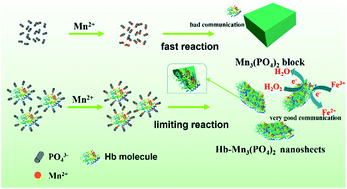
Hemoglobin (Hb), due to its moderate cost, commercial availability and intrinsic catalytic activity towards H2O2, has been widely used as an ideal model to study the direct electron transfer between the heme group and the electrode. In this study, a simple and effective in situ immobilization method was used to fabricate an enzyme–inorganic conjugate, Hb–Mn3(PO4)2·3H2O. In our synthetic process, the phosphate anion was first adsorbed onto the surface of the hemoglobin and then self-assembled with manganese ions to form a slack and porous nanosheet conjugate. The experimental results indicated that in the in situ immobilization process, Hb was effectively immobilized on the Hb–Mn3(PO4)2·3H2O hybrids and could also tailor the nanostructure of Mn3(PO4)2·3H2O for superior physical and chemical properties. By designing an H2O2 sensor, it was observed that the enzyme–inorganic conjugate exhibited an enhanced enzymatic activity and a wide sensing range and stability, which may be attributed to the high surface area and excellent confinement of the enzymes in the nanosheets.
:
1) and deionized water and then dried at room temperature. A 5 μL aliquot of a 5 mg mL−1 of a Hb–Mn3(PO4)2·3H2O hybrid nanosheet suspension (PBS pH = 7.2) was dropped onto the center of the GCEs and dried at room temperature, after which 5 μL of 0.5% Nafion was subsequently placed on the GCEs surface. For comparison, block Mn3(PO4)2·3H2O was first mixed with Hb and stored in a refrigerator at 4 °C for 24 h. Then, it was used for the fabrication of Nafion/Hb/Mn3(PO4)2 and Nafion/Mn3(PO4)2 with similar procedures as described above.
The surface morphology and microstructure of the as-prepared samples were observed using FESEM and TEM, respectively. As shown in Fig. 2(A), pure Mn3(PO4)2·3H2O is a bulky structure. Hb–Mn3(PO4)2·3H2O presents a well-defined, thin-layer with an average thickness less than 20 nm (Fig. 2(B) and (C)). A mesoporous and macroporous structure is observed for the thin layer of Hb–Mn3(PO4)2·3H2O nanosheets (Fig. 2(D)). In order to further examine the distribution of Hb in the Hb–Mn3(PO4)2·3H2O hybrid nanosheets, energy dispersive spectrometry (EDS) mapping of the products was performed. As shown in Fig. 3, elemental Mn, P, and N of the Hb–Mn3(PO4)2·3H2O hybrid have a similar graphic pattern like the electronic image, indicating that Hb is uniformly immobilized in the Hb–Mn3(PO4)2·3H2O hybrid nanosheets.
![]() | ||
| Fig. 2 (A) FE-SEM of pure Mn3(PO4)2·3H2O, (B and C) Hb–Mn3(PO4)2·3H2O, (D and E) TEM images of Hb–Mn3(PO4)2·3H2O and (F) EDS mapping of a selected area in the Hb–Mn3(PO4)2·3H2O nanosheets. | ||
![]() | ||
| Fig. 3 (A) XPS core-level spectra, (B) Mn 2p, (C) P 2p, (D) N 1s of Mn3(PO4)2·3H2O (black) blocks and Hb–Mn3(PO4)2·3H2O (red) conjugate nanosheets. | ||
As shown in Scheme 1, when the MnSO4 solution was added to the PBS solution, a fast co-precipitation and homogeneous nucleation initially occurred. As the particles uncontrollably grew, they also agglomerated into huge blocks.24,25 The main driving force for precipitation was rapid and high supersaturation, which determined the final particle size of the precipitates. When positively charged Hb, consisting of globin and heme,26 was added to the PBS solution, PO43−, HPO42−, and H2PO4− was absorbed on the surface of the Hb by electrostatic attraction.27 As a result, the polyanion concentration was much less than it was in the original solution. Following the addition of the MnSO4 solution, homogeneous nucleation was difficult due to the relatively low degree of supersaturation. Hb restrained the oriented growth of Mn3(PO4)2·3H2O, which was confirmed by the XRD, SEM, and TEM results.
The XPS was analysed to characterize the chemical state and composition of all the as-prepared samples. Fig. 3(A) shows the XPS survey spectra of Mn3(PO4)2·3H2O blocks and Hb–Mn3(PO4)2·3H2O hybrid nanosheets. In addition to the observation of Mn 2p, C 1s, and P 2p signals in two samples, a clear N 1s signal was also seen in the Hb–Mn3(PO4)2·3H2O hybrid nanosheets. Typical XPS spectra of Mn 2p of the as-prepared samples are presented in Fig. 3(B) wherein both the Mn 2p peaks consist of two peaks, which can be ascribed to Mn 2p1/2 (653.1 eV) and Mn 2p3/2 (641.2 eV) of Mn2+.28 In the P 2p region (Fig. 3(C)), two samples exhibited the same doublet at about 132.9 eV, which matched well with the other phosphorous typical of a phosphate group (PO43−). It should be noted that as shown in Fig. 3(D), the N 1s core level XPS spectra of Hb–Mn3(PO4)2 hybrid nanosheets has an intense peak at about 399.65 eV, which can be deconvoluted into C–N/N–H (399.7 eV) and N–C
O (400.9 eV), corresponding to the structure of Hb.29,30 However, this was not observed in the sample of bare Mn3(PO4)2·3H2O. In addition, the atomic percentage of the main elements of different samples is summarized in Table 1. The O, P, and Mn atomic ratios of Hb–Mn3(PO4)2·3H2O were lower than those of the block Mn3(PO4)2, whereas the C and N atomic ratios of Hb–Mn3(PO4)2·3H2O were greater than block Mn3(PO4)2·3H2O, respectively. This analysis revealed that Hb had successfully been immobilized on the Mn3(PO4)2·3H2O nanosheets.
| Mn3(PO4)2 | Hb–Mn3(PO4)2 | |
|---|---|---|
| O | 48.90% | 31.28% |
| P | 9.56% | 4.43% |
| N | 0.00% | 11.17% |
| Mn | 10.39% | 3.54% |
| C | 14.77% | 47.36% |
Fig. 4 shows the FTIR spectra of Hb, Hb–Mn3(PO4)2·3H2O, and pure Mn3(PO4)2·3H2O. The infrared absorption bands at 1536 and 1663 cm−1 are the characteristic absorption peaks of native Hb, which are attributed to the amide I and amide II of Hb and give detailed information on the secondary structure of the polypeptide chain.31 Compared to native Hb, the Hb–Mn3(PO4)2·3H2O nanocomposites present absorption bands at 1536 and 1663 cm−1 without any obvious shift. It also has absorption bands at 948, 1003, and 1069 cm−1, which match well with the absorption of bare Mn3(PO4)2·3H2O. It should be noted that the reduced intensity of the FTIR absorption at 3305 cm−1 may occur due to the interaction between Hb and Mn3(PO4)2·3H2O. These results support that Hb essentially retains its natural structure in the hybrid and has an interaction with the Mn3(PO4)2·3H2O.
Fig. 5(A) depicts the typical cyclic voltammograms of various modified GCEs in a 0.01 M PBS solution (pH 7.0) at a scan rate of 100 mV s−1. No obvious peaks were detected for bare GCE, Nafion/Mn3(PO4)2/GCE, or Nafion/Hb/Mn3(PO4)2/GCE, which shows that the bare GCE and Nafion/Mn3(PO4)2/GCE are electrochemically silent in the potential window. This also indicates that block Mn3(PO4)2·3H2O cannot immobilize Hb effectively and establish communication between Hb and the block Mn3(PO4)2·3H2O. The Nafion/Hb–Mn3(PO4)2/GCE exhibits a couple of stable and well-defined redox peaks at −0.403 and −0.367 V, which demonstrate that Hb–Mn3(PO4)2·3H2O can effectively immobilize Hb, providing it with excellent direct electron transfer capability due to its unique superstructure and biocompatible microenvironment. The redox peak separation potential is 36 mV, which is slightly higher than the theoretical value of a reversible surface reaction process of electrocatalytic Hb.32,33 This small peak-to-peak separation indicates a fast electron transfer rate. As shown in Fig. 5(B), with an increasing scan rate, the cathodic and anodic peak currents gradually and linearly increase in the range of 100–500 mV s−1, indicating a surface-controlled quasi-reversible process occurring on the surface of the Hb–Mn3(PO4)2·3H2O modified electrode. Calculated using the Laviron method, the average electron transfer rate constant (ks) of Hb–Mn3(PO4)2 nanosheets is 4.16 s−1, which is greater than the value reported for Hb immobilized calcium phosphate nanoparticles (0.71 s−1),31 mesoporous silica (0.92 ± 0.18 s−1),34 AuNP/ZnO/Gr nanocomposite (1.30 s−1),35 and MXene-Ti3C2 (2.68 s−1).32 This means that Hb entrapped in the Mn3(PO4)2·3H2O nanosheets could maintain a high activity, and the Mn3(PO4)2·3H2O nanosheets exhibited a very thin layer structure and good biocompatibility, which could improve the electron transfer between Hb and the Mn3(PO4)2·3H2O nanosheets.
In order to investigate the bioactivity of the entrapped Hb, the fabricated electrode was employed to detect H2O2. Fig. 5(C) gives the current–time plot for the Hb–Mn3(PO4)2 modified GCE on successive injections of certain H2O2 solution into PBS solutions at −0.35 V. A well-defined linear relation between the response current and the H2O2 concentration was observed. The calibration plot shows a linear range from 20 to 56
100 μM with a correlation coefficient of 0.996. The detection limit was estimated to be 2.4 μM (a signal-to-noise ratio of 3). It is clear that the Hb–Mn3(PO4)2·3H2O based sensor has a relatively wide dynamic range for a hemoglobin-based H2O2 biosensor.36–39 The long-term stability of the as-fabricated Hb–Mn3(PO4)2·3H2O nanosheets based biosensors were also estimated in our study. The electrode was studied by examining its current response every 2 days, and it was discovered that the biosensor retains 85% of its initial response to H2O2 after 29 days (Fig. 5(D)). These results may be due to the very mild synthetic conditions that help maintain the high activity of the enzymes and Mn3(PO4)2·3H2O nanosheets with good biocompatibility, which provides a microenvironment for the Hb molecules.
Hydrogen peroxide is often used as an efficient oxidizer in the food industry and wastewater treatment. However, it must be below a certain weight in the final products. In order to estimate its potential application in practical samples, the Hb–Mn3(PO4)2·3H2O nanosheet electrode was evaluated for the detection of H2O2 in water and milk. The amount of added standard was between 250 and 3000 μM for examining the dependability of the ultra-wide dynamic range. Recovery tests were used to evaluate the reliability and accuracy of this analytical method. The recovery ranged from 98.2% to 102.6%, confirming that it is possible to determine H2O2 in practical samples using this proposed method (Table 2).
| Sample | Added (μM) | Found (μM) | Recovery (%) |
|---|---|---|---|
| Water | 250.0 | 255.3 | 102.1 |
| 375.0 | 380.2 | 101.3 | |
| 400.0 | 410.5 | 102.6 | |
| Milk | 1000.0 | 991.2 | 99.1 |
| 2500.0 | 2475.3 | 99.0 | |
| 3000.0 | 2948.2 | 98.2 |
| This journal is © The Royal Society of Chemistry 2016 |